
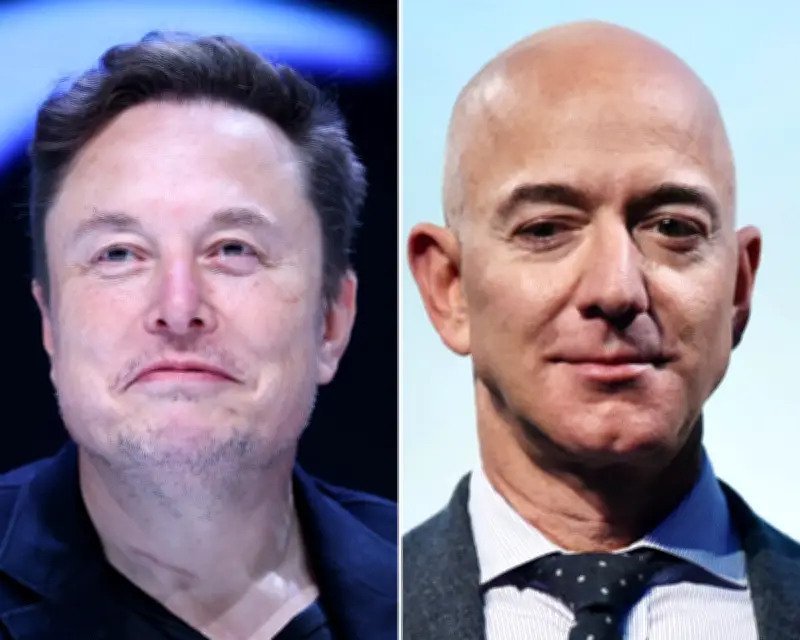
A new petition submitted to the U.S. Federal Communications Commission (FCC) warns that proposed orbital datacenters from SpaceX, Blue Origin, and other tech companies would release staggering levels of pollution, likely altering Earth's atmosphere and causing catastrophic environmental harm. The petition, filed by Public Employees for Environmental Responsibility (PEER), Earthjustice, and DarkSky International, calls for a pause on new licenses for space data center projects, arguing they violate federal law.
Pollution from satellites and rockets accumulating in stratosphere
Tech companies have collectively proposed millions of orbital datacenters, which require FCC approval. Pollution from satellites and rockets burning up upon re-entry appears to be accumulating in the stratosphere at alarming levels, releasing black soot, rare metals, aluminum oxides, and other pollutants with unknown effects. Some scientists fear this pollution could destroy the ozone layer, increase ultraviolet radiation exposure, or destabilize the climate. The pollution may also return to Earth, and millions of satellites would create major light pollution.
Petition argues plans violate federal law
The petition states that datacenter companies describe their plans in "grandiose, civilization-changing terms" but refuse to embrace inquiry into environmental, scientific, economic, or other impacts. It claims Congress requires the FCC to determine whether granting satellite operation applications serves the public interest, and that the National Environmental Policy Act (NEPA) mandates environmental assessments. The groups say NEPA would provide mechanisms to assess impacts, propose alternatives, examine mitigation, and disclose risks.
Steve Volz, former head of the National Oceanic and Atmospheric Administration (NOAA) satellite office, told the Guardian that putting millions of additional satellites into orbit creates significant environmental risk. "There is a lot of complex material in these things, and even if they do burn up, you do not want to be filling up the atmosphere with refuse from these any more than you would want it coming from a smoke stack," Volz said.
Exponential growth in satellites
The number of active satellites has grown from about 1,400 in 2015 to roughly 15,000 currently, with up to 100,000 expected within a decade, not including datacenter networks. Currently, most satellite pollution comes from Starlink and Amazon's mega-constellations for broadband internet, comprising about 10,000 satellites. Launches emit black carbon, nitrogen oxides, carbon monoxide, aluminum oxide, chlorine gases, and mercury. When decommissioned after 5–15 years, satellites vaporize and release metals into the pristine stratosphere.
Unknown interactions in stratosphere
In late 2023, a NOAA-sponsored stratospheric measurement flight found metals in sulfuric acid aerosols that regulate Earth's temperature and act as a planetary "sunscreen." How spacecraft metals interact with natural metals and aerosols is "largely unknown," scientists said. Further research has not been conducted under the Trump administration.
Ruskin Hartley, executive director of DarkSky International, said, "These projects could permanently alter the night sky as we know it. The FCC needs to take seriously its obligation to ensure these projects do not cause unnecessary harm to naturally dark skies."
Resource demands and legal questions
Cole Donovan, a former NOAA space policy expert with Stand Up for Science, noted that space datacenters would demand huge amounts of rare metals already in short supply, creating environmental challenges on the ground. Among those requesting permits is Cowboy Space Corporation, founded by the billionaire co-CEO of Robinhood, which aspires to build an American power grid in space. It wants a 20,000-satellite system with its first launch in 2028. The petition states that Cowboy Space's only environmental mitigation reference in its FCC application is a promise to minimize impact on the astronomy community.
SpaceX claims in its FCC application that its orbital datacenters will "ensure humanity's multi-planetary future amongst the stars," but its only environmental risk reference is a claim to develop "industry-leading brightness mitigations" with no other detail. The petition concludes: "No proponent has provided satisfactory detail to explain how it will mitigate the cumulative environmental harms flowing from the foreseeable operation of more than a million satellites, orbiting our planet, colliding and disintegrating and plummeting back to Earth."



