
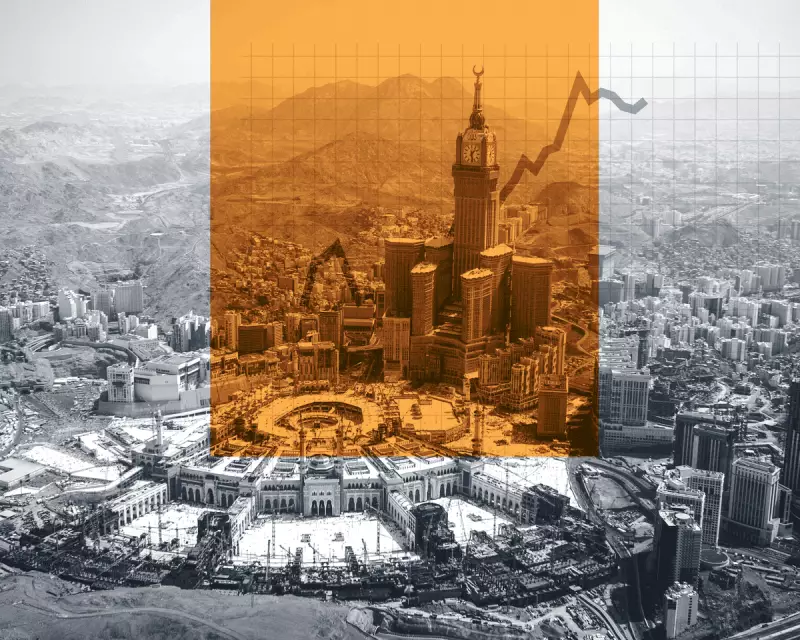
Imagine receiving £129,000 right now. Then another identical sum just one minute later. This staggering cash flow continues relentlessly, minute after minute, year after year. This isn't fantasy - it's the financial reality of Saudi Arabia's state oil giant Aramco, the world's largest oil and gas producer that generates these extraordinary revenues.
The Oil Cash Lifeline and Climate Resistance
This torrent of petroleum wealth sustains Saudi Arabia's authoritarian regime, funding everything from generous fossil fuel subsidies for citizens to ambitious soft power initiatives like football World Cup investments and mind-boggling construction megaprojects. However, this very dependence explains why accelerating global climate action - particularly transitioning away from fossil fuels - represents an existential threat to both Saudi Arabia's economy and its ruling royal family.
For over three decades, Saudi Arabia has fought more determinedly than any other nation to obstruct and delay international climate agreements. Veteran climate negotiator Alden Meyer describes their approach as a diplomatic "wrecking ball" that consistently dismisses abandoning fossil fuels as unrealistic fantasy. Their opposition continues unabated ahead of the upcoming UN Cop30 climate summit in Brazil.
Saudi Arabia's climate contradiction appears stark: the kingdom simultaneously resists global climate action while rapidly adopting renewable energy domestically. Meanwhile, delayed climate measures worsen impacts in a desert nation already experiencing conditions that scientists describe as "at the verge of livability."
Mastering the Art of Climate Delay
Saudi Arabia nearly derailed the global UN climate treaty at its inception thirty years ago. Meyer recalls the dramatic moment when French diplomat Jean Ripert had to ignore vigorously waving Saudi and Kuwaiti delegates to bring down the gavel adopting the treaty. "That's something you can only do if it's a handful of countries," Meyer notes.
Since that early confrontation, Saudi Arabia has strategically mobilized broader coalitions, particularly the Arab group and other major players, achieving significant influence. "They've been the point of the spear in terms of organising the resistance," says Meyer from climate thinktank E3G.
An crucial early victory for Saudi Arabia and its Opec allies involved blocking voting procedures in UN climate negotiations, unlike other UN bodies. Instead, decisions require consensus, giving "outsized influence to laggards, which suits Saudi Arabia very well," according to a Climate Social Science Network report that describes this impasse as "crippling" climate talks.
Armed with this effective veto power, Saudi Arabia has perfected using complex procedural rules to minimize climate progress. The kingdom employs more than a dozen obstruction tactics, from disputing agendas to challenging discussion mandates on sensitive topics like fossil fuel phaseouts. Delay remains a primary objective - Saudi Arabia strongly opposed virtual negotiations during COVID-19 lockdowns, for instance.
Dr Joanna Depledge from Cambridge University acknowledges their expertise: "They are really good at it, absolutely masterful."
The Stakes: Protecting an Oil Empire
The scale of what Saudi Arabia protects through its climate obstructionism challenges comprehension. Aramco dominated as the world's largest oil and gas producer in 2024, while the kingdom possesses the planet's second-largest proven oil reserves after Venezuela.
Saudi oil extraction costs barely $2 per barrel, according to Aramco CEO Amin Nasser, while barrels sold for $60-80 throughout the past year. These extraordinary profit margins generated $250 million daily profits from 2016 to 2023, establishing Aramco as the world's most profitable company during that period.
Historian Nils Gilman explains in Foreign Policy that "Saudi Arabia depends on fossil exports for national survival [and] the regime regards the prospect of a green energy transition as an existential threat." The ruling House of Saud uses oil revenues to finance both domestic social stability and international influence, spending more on fossil fuel subsidies than national healthcare in 2023.
Gilman suggests Saudi ambition focuses not on phasing out fossil fuels but "to monopolise them as global supply tightens," positioning Aramco as the last producer standing. In 2024, Aramco pursued the largest near-term oil and gas expansion plans globally, with 60% incompatible with limiting warming to 1.5°C.
Simultaneously, Saudi Arabia works to maintain customer bases as wealthy nations decarbonize. The Guardian revealed an "oil demand sustainability programme" involving massive global investments to stimulate oil and gas demand in Africa and elsewhere. Critics describe this as intentionally getting nations "hooked on its harmful products."
Climate Impacts: An Existential Domestic Threat
While Saudi Arabia obstructs global climate action, its population already confronts severe climate consequences. Analysis of numerous scientific studies reveals the climate crisis has firmly arrived in the desert kingdom with daunting future implications.
A 2023 report from King Abdullah University of Science and Technology and Kapsarc stated bluntly that "Saudi Arabia's environmental parameters are already at the verge of livability." The nation ranks among Earth's hottest and most water-stressed countries.
The report examined consequences of a 3°C warmer world - current global trajectory suggests reaching this by approximately 2100 - finding it would have "profound implications on the future viability of a sustainable and healthy society, and will likely manifest an existential crisis to Saudi Arabia."
Current warming trends show Saudi Arabia heating nearly three times faster than global averages, with temperatures rising 2.2°C between 1979-2019. Summers warmed even faster at 2.6°C over four decades. Extreme heat already affects Saudi Arabia's most significant event - the hajj pilgrimage - where over 1,300 pilgrims died during 2024's heatwave.
Future scenarios appear apocalyptic: "ultra-extreme heatwaves" reaching 56°C or higher, lasting weeks, with summers averaging 9°C hotter. Even with emissions cuts limiting warming to 2°C, Saudi Arabia could experience 13-fold increases in heat-related mortality, rising to 63-fold increases under worst-case scenarios.
Coastal cities like Jeddah and Dammam face additional deadly humid heat risks, while flash floods increasingly threaten urban areas where over 80% of Saudis reside. The Kaust-Kapsarc report notes Riyadh experienced more than ten flood events over thirty years, claiming over 160 lives and causing substantial socioeconomic damage.
UN Secretary-General António Guterres highlighted the "grim irony" of rising seas threatening coastal oil terminals like Ras Tanura and Yanbu, which handle 98% of Saudi oil exports worth $214 billion in 2023.
The Three-Pronged Saudi Strategy
p>Karim Elgendy, head of the Middle East's first independent climate thinktank Carboun Institute, explains Saudi Arabia's apparent contradictions through a three-element strategy recognizing that "the momentum behind the green energy transition is now unstoppable.""The first element involves slowing the global transition," Elgendy says. "The second focuses on internal decarbonisation," driven by discovering that new electricity capacity costs much less from solar and wind. The Saudi Green Initiative aims for half of electricity capacity from renewables by 2030 while developing a "flourishing" electric vehicle industry.
This conveniently reduces Saudi Arabia's enormous domestic oil consumption - fourth highest globally - freeing billions of dollars worth of oil for export. As transport expert Anvita Arora at Kapsarc noted in 2022: "If we keep consuming our own oil, we won't have any oil left to sell."
"The third element," Elgendy explains, "exports every barrel and molecule as rapidly as possible to finance Saudi Arabia's future transition toward a diversified, decarbonised economy." Essentially, Saudi Arabia races to sell sufficient oil to fund its petrostate transition before global markets stop buying.
"Saudi Arabia wants to become a green nation and participate in the emerging climate economy," Elgendy states, "but currently requires fossil fuel revenues to achieve this transformation." He describes the transition period as Saudi Arabia's greatest vulnerability: "The goal involves shortening that period as much as possible, shortening the darkness."
The kingdom also promotes "carbon circular economy" concepts, emphasizing that emissions rather than oil itself cause climate damage. "They've been trying to play up carbon capture and storage, which could allow continuing their product use," says Meyer. "But CCS remains nowhere ready at scale for substantial emissions reduction."
Despite these initiatives, Climate Action Tracker judges Saudi Arabia's national climate efforts "critically insufficient."
Global Consequences and Potential Solutions
Saudi delaying tactics create global collateral damage. Nikki Reisch from the Center for International Environmental Law warns that "delaying a fossil fuel phaseout only spells more death and destruction across the planet." While Gulf states pursue plans to reduce their own fossil fuel dependence, "nobody can escape the climate impacts that their products unleash - including their own populations."
UN Environment Programme head Inger Andersen emphasizes that "every fraction of a degree avoided is crucial to reduce an escalation of the climate impacts that are harming all nations."
Approaching Cop30, Saudi diplomats continue resisting "transition away from fossil fuels" language agreed by all nations at Cop28 in 2023. However, determined country groups increasingly pursue progress outside UN processes through "coalitions of the willing" that bypass consensus requirements, making obstruction more difficult for Saudi Arabia.
Experts led by Dr Depledge propose reforming UN climate summits through supermajority voting requiring seven-eighths agreement, capturing overwhelming global support while sidelining small obstructive minorities. They suggest sanctioning repeat procedural blockers "just as delaying tactics in football can see offenders receive a yellow card."
They further argue that obstructionism should influence decisions about climate catastrophe compensation for vulnerable nations: "Deliberate delay inside UN climate talks proves as damaging as continuing emissions. Doing both - as Saudi Arabia does - becomes even worse."
As the climate crisis intensifies globally, the international community faces critical challenges overcoming determined resistance from nations whose economic survival depends on maintaining fossil fuel dominance, even as their own populations face increasingly unlivable conditions.



