
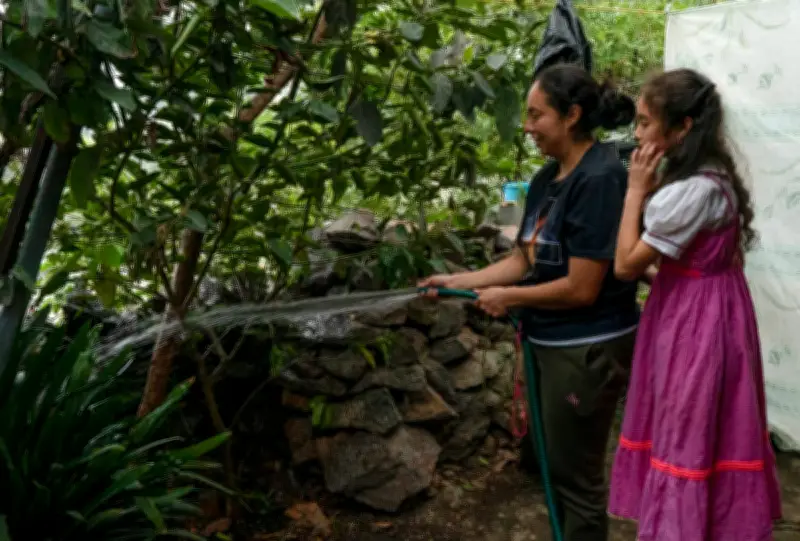
In the informal settlement of Cristo Rey, above San Gregorio Atlapulco in Mexico City, Ana Aparicio Bahena tends her lush garden, picking prickly pears, avocados, and blackberries. Her home, like many in the area, is not connected to the water network. For years, she collected water from a well 30 minutes away, making gardening impossible.
Simple System, Big Impact
Four years ago, a rainwater harvesting system was installed in her garden by Isla Urbana, an organization fighting water scarcity. The system captures rainwater from the roof and filters it, storing 2,500 liters in a main tank and 1,100 liters for plant watering. Now, Aparicio Bahena grows onions, avocados, lemons, and potatoes. “I never used to be able to grow my own food. It’s wonderful,” she says.
Isla Urbana, founded in 2009, installs systems mainly for low-income households, aiming to reach 1 million people by next year. Co-founder Enrique Lomnitz explains, “Much of our work involves delivering water to areas that are hard to reach with conventional systems.” The organization operates as a non-profit for low-income families, funded by private sales, grants, and government contracts.
Widespread Water Scarcity
According to the National Health and Nutrition Survey, almost 17% of Mexican households struggle to meet basic water needs, and 74 million people (57% of the population) lack access to safe water. Droughts, intensified by climate change, are frequent and severe. In response, Isla Urbana has also installed systems at 2,000 public schools, educating children on water sustainability.
In Benito Juárez, Dora Napolitano, a textile artist, bought a 5,000-liter system in 2018 for environmental reasons. “It has been a lifesaver during intense droughts,” she says, noting that the system cost about 40,000 Mexican pesos (£1,700). She adds, “I wanted to show that it was viable.”
Expert Insights
Judith Domínguez, a research professor at El Colegio de México, says rainwater harvesting is a good alternative in areas lacking formal services. “These systems can mitigate water scarcity, especially during rainy seasons, and address social and water vulnerability,” she notes. However, she warns that households must monitor water quality and maintain filters, which can be costly.
For Aparicio Bahena, the system has transformed her life. Harvested water is used for washing, flushing toilets, and cleaning, allowing her family of six to bathe regularly. A small plastic filter makes the water safe to drink. “The water harvesting system really changed our lives. Now we are able to dream and have more time,” she says. “It changed everything.”



