
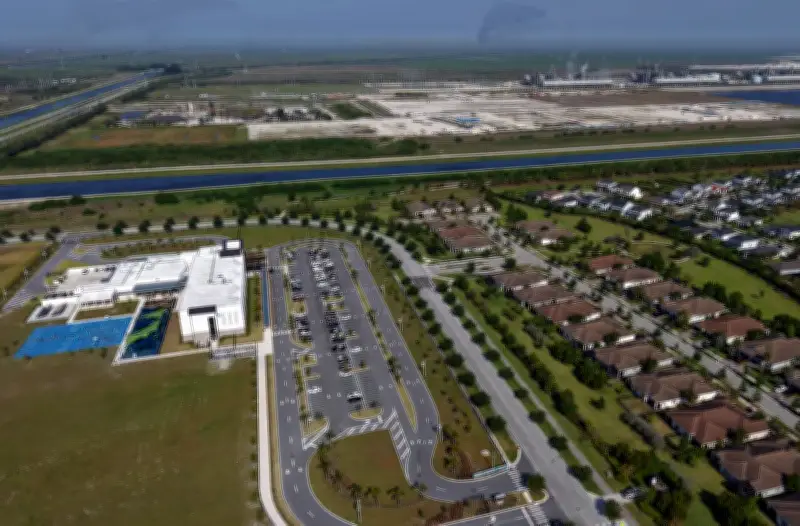
Local environmentalists and residents are raising alarms over a proposed hyperscale datacenter in western Palm Beach County, Florida, warning that its immense energy and heat output could damage the nearby Everglades and exacerbate toxic algal blooms. The 202-acre (82-hectare) site, known as Project Tango, is located about 16 miles (26km) west of Mar-a-Lago on President Donald J Trump Highway, near the northern edge of the Florida Everglades.
Concerns Over Heat and Water Impacts
The datacenter, which would consume up to 600 megawatts (MW) of electricity, could generate significant waste heat. Reinaldo Diaz, founder of Lake Worth Waterkeeper, a nonprofit protecting the watershed, said this heat could increase water temperatures in the surrounding watershed, putting the Everglades at further risk of toxic bacterial blooms. "Our watershed is really complex," Diaz said. "Ours is more like a spiderweb that's why the impacts would be far reaching."
The Everglades have already been stressed by drought, fertilizer runoff, and warm water temperatures. In recent summers, blue-green algae blooms have covered nearly half of Lake Okeechobee, which feeds into the Everglades. These cyanobacteria blooms produce microcystin, a toxin that can sicken people and animals and contaminate drinking water. On July 30, the Florida Department of Health in Palm Beach County issued a health alert about cyanobacteria presence in the lake.
Energy Use and Grid Concerns
At peak capacity, a 600 MW datacenter could use as much power as half a million US homes, based on US Energy Information estimates. This high energy demand could necessitate costly upgrades to the power grid, potentially driving up electricity costs for households. Christina Reichert, an Earthjustice attorney representing neighbors with the Western Palm Beach Community Alliance, said the datacenter could have offsite water, air, and sound impacts not covered by light industrial use zoning. "One of the concerns we had about this location is the risk of increasing the heat in this area because it could lead to algal blooms in that canal that could compromise drinking water and Everglades restoration," Reichert said.
Last month, President Trump downplayed such concerns at a press conference, reiterating his non-binding pledge for datacenter developers to bear their own electricity costs. "You have to convince your community how great these things [are]. You can't fight it. You have to go with it," he said. But Sue Ellen Loyzelle, a founding member of the Western Palm Beach Community Alliance and resident of the neighboring planned community of Arden, stressed the need for regulations. "We don't want our bills to go up, but it's more than that," she said. "What is all of this going to do?" Loyzelle acknowledged the Ratepayer Protection Pledge as a start, adding, "Yeah, that's a guardrail and we're happy for that guardrail. But there's got to be a lot more guardrails."
Zoning Battle and Community Opposition
At a Palm Beach County zoning hearing last month, residents voiced concerns about the project's proximity to a local elementary school (about 1,200 feet), citing potential noise, higher traffic, heat pollution, lower property values, and higher energy bills. After more than 12 hours of testimony, commissioners voted 5-1 to deny an expansion of the proposed datacenter. However, two more administrative applications from the developers that could add square footage remain under consideration.
The proposed site is across the street from a pump station that pushes freshwater to the southern Everglades. The applicant, PBA Holdings, Inc., says the facility would use a closed-loop cooling system that recirculates water, potentially reducing water consumption. Project manager Ernie Cox stated this at the July zoning hearing. But Diaz countered that heat generated by the facility would still need to go somewhere, and even a few degrees increase in temperature could fuel bacterial blooms in nearby waterways connected to the Everglades and drinking water systems. Emerging research suggests that even much smaller datacenters can increase downwind air temperature by as much as 2C.
Many ingredients for bacterial blooms, like phosphorus and nitrogen, already exist in nearby canals from decades of agricultural runoff from sugarcane farmland. "Even warming the water up a couple degrees could be like adding fuel to the fire," Diaz said.
Developer Response and Next Steps
A health and safety assessment commissioned by PBA Holdings acknowledges the datacenter could heat the air 1C to 2C (2F to 4F) around the cooling equipment but dismisses concerns that the heat would reach the nearby community and school, citing prevailing winds carrying heat in the opposite direction. The assessment does not address the risk of toxic bacterial blooms. In regulatory filings, PBA Holdings reported spending $20m on county approvals and ensuring power reliability. The developers chose the site for its proximity to the West County Energy Center, the largest natural gas power plant in the US, operated by Florida Power & Light Company.
Cox did not respond to specific questions about the project's potential to worsen algal blooms, but in a statement to the Guardian US, he wrote: "We are disappointed with the Commission's decision. We re-confirmed our commitment to all conditions asked of us associated with our request and we addressed concerns through in-depth technical studies and analysis. We remain committed to helping meet the region's growing critical infrastructure needs and will be taking time to evaluate our options moving forward."
Opposition letters have come from the homeowners association for Arden, the city of Westlake, the town of Loxahatchee Groves, the Everglades coalition, the Palm Beach County Classroom Teachers Association, the School Board of Palm Beach County, a Florida representative, and a Florida senator. Next month, Palm Beach County commissioners will vote on a moratorium against large-scale datacenters, a measure several other Florida counties have already adopted. Loyzelle, who previously served as an elected official in Cutler Bay, said such moratoriums are necessary until regulations can lessen the impact of hyperscale datacenters. "I would like to not see them at all. I know that's not a reality. If there was to be one, it would have to be far away from homes because of the sound and the health impacts of air pollution," she said. "But the water, I don't think Florida could handle it anywhere with the water issues."



