
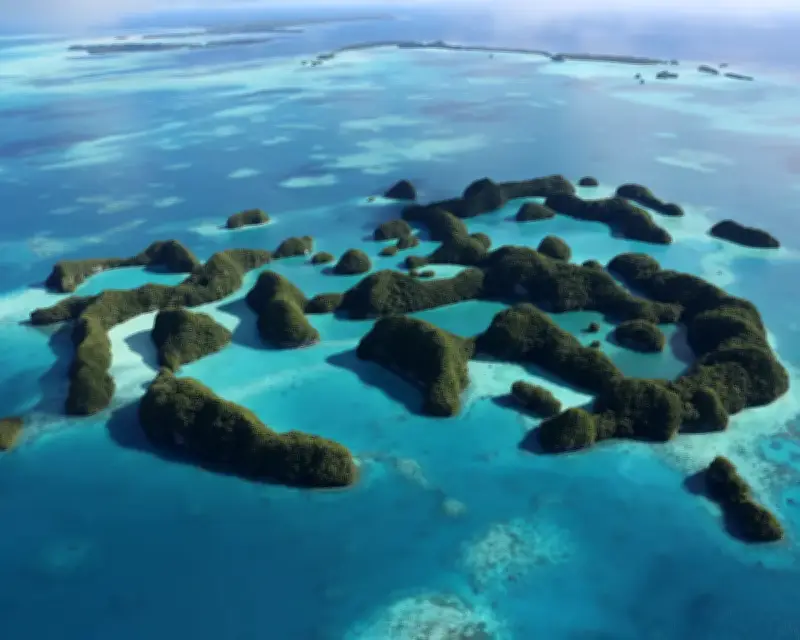
The Pacific Islands Forum opened in Palau this week with regional security, climate change, and an escalating fuel crisis topping the agenda. Australian Prime Minister Anthony Albanese is attending, facing expectations from Pacific nations to address climate change, which they call the region's greatest security threat.
China's recent nuclear-capable missile test in the Pacific has raised tensions, prompting calls for a new regional security agreement. Meanwhile, the US-Iran war has exposed Pacific economies' heavy reliance on imported fossil fuels, with fuel costs consuming a significant share of GDP.
China's missile test and regional security
In July, China launched a test missile that flew over several Pacific nations and landed near Tuvalu's exclusive economic zone. This act was condemned by Solomon Islands' Prime Minister Matthew Wale as "not the act of a friend." Ironically, Solomon Islands had signed a security deal with China in 2022, shifting the region's security dynamics.
Australia has responded by forging bilateral security pacts, including agreements with Tuvalu (2023), Naoero (2024), Papua New Guinea (2025), and Vanuatu (2026). The most recent is the Ocean of Peace Alliance with Fiji, signed in July, which is a mutual defence pact open to other Pacific nations. Discussions are ongoing with Tonga and Solomon Islands. Canberra had already been pursuing a treaty for coordinated disaster response, and China's missile test may have accelerated broader security cooperation.
Fuel crisis and renewable energy solutions
The Middle East conflict has exacerbated the Pacific's energy challenges. About 80% of the region's energy relies on imported oil, much of it transiting the Strait of Hormuz. Pacific island countries spend between 10% and 25% of GDP on fossil fuels, compared to 8% on education and 6% on health. A new report indicates Fiji's annual refined fuel import costs could rise by US$375 million (A$520 million) if high oil prices persist, exceeding its entire healthcare budget.
Renewable energy offers a clear alternative. Replacing diesel generators with grid-scale solar and battery storage could save Pacific countries about US$700 million (A$520 million) each year in avoided fuel costs. Palau's President Surangel Whipps Jr, the incoming chair of the forum, aims to make the region the world's first 100% renewable-powered. He has called for US$120 million (A$166 million) in investment to add 60MW of solar and battery storage in Palau, which would meet 90% of its power needs.
Climate change: the greatest threat
Pacific Islands Forum leaders have consistently reaffirmed that climate change is "the single greatest threat" to Pacific security. In 2025, Earth was 1.44C warmer than the long-term average, and the world's oceans are currently the warmest on record, driven by climate change and a rapidly intensifying El Niño. Pacific nations are already experiencing stronger cyclones, dying reefs, and ocean acidification.
It is now almost certain the world will temporarily exceed the 1.5C threshold, but with deep emissions cuts and "net-negative" emissions, limiting warming to 1.5C by century's end remains possible. For low-lying Pacific nations, the slogan "1.5 to stay alive" underscores the urgency. Pacific negotiators helped secure this goal in the 2015 Paris agreement.
Pacific nations expect Australia to reaffirm its commitment to 1.5C. Australia is assisting Fiji and Tuvalu in hosting a pre-Cop summit in October to highlight the survival stakes for island nations. Additionally, Pacific countries will seek new finance for a Pacific-owned climate fund to support community-scale adaptation projects. While some view collaboration with the Pacific as costly, investing in renewables and adaptation is seen as an investment in shared security amid growing US-China geopolitical competition.



