
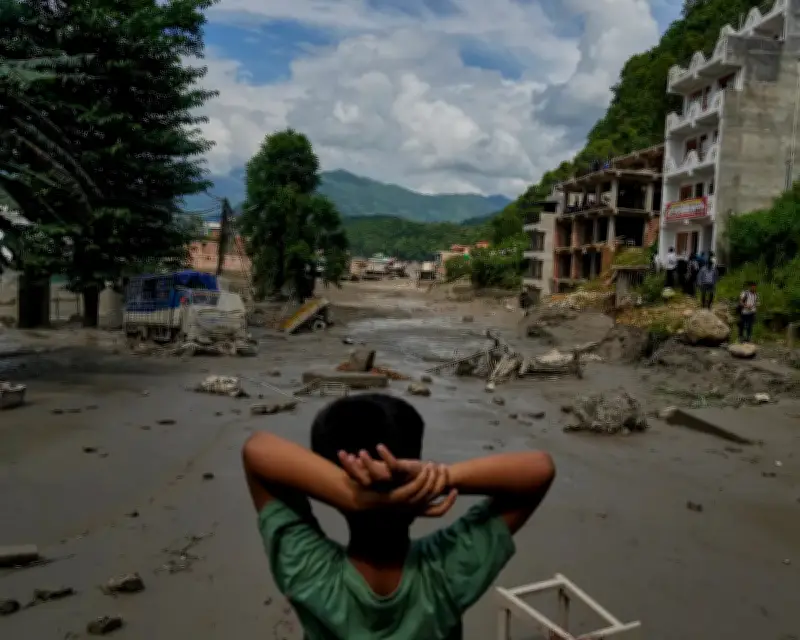
Rescue workers in Nepal and Tibet are racing to find survivors after catastrophic flash floods killed 903 people and left more than 4,000 missing, according to the latest official figures. The disaster, triggered by a glacier collapse in the Himalayas, has devastated entire villages, destroyed infrastructure, and left thousands of families uncertain about the fate of their loved ones.
The floods began on Wednesday morning when an enormous chunk of ice from a Himalayan glacier broke off and crashed onto a mountain near the Nepal-Tibet border. The resulting avalanche of ice and rock surged downstream into the Bhotekoshi and Trishuli rivers, submerging villages and sweeping away roads. In a matter of minutes, a torrent of mud and debris engulfed entire communities, snapping bridges and destroying homes.
Rescue operations under way amid widespread destruction
Hannah Ellis-Petersen, south Asia correspondent for The Guardian, is on the ground in Kathmandu and has been reporting on the rescue operation since Thursday. She described the scene in Bidur, a small city two hours from Kathmandu, where most buildings have been destroyed. "There was a bank, an ATM machine, and a truck that was lying on its side," she said. "Everything else was either submerged in mud, or mangled."
The Nepali army has been organising rescue efforts from a military base in Bidur, with helicopters landing every two to three minutes to deposit survivors. The mud is so thick in some places that helicopters have struggled to land. Rasuwa, an area where entire villages were destroyed, remained inaccessible to journalists as of Sunday afternoon. "The ground zero of the floods has still not been reached by journalists, and is only just being reached by the army," Ellis-Petersen said.
Hundreds of people have been rescued, and hundreds more are waiting outside the army base in Bidur, scanning lists of survivors posted on the walls. At hospitals in Kathmandu, health workers have put up photos of bodies that are so disfigured that families have struggled to identify them. Authorities have begun burying human remains because there isn't enough mortuary space to prevent decomposition.
Thousands still missing, including foreign nationals
According to Nepal's disaster agency, 4,247 people are missing, including 592 foreigners. Among them are 43 Australians and 48 from the UK, with 15 reported missing in China. The missing also include 933 workers from Nepal and neighbouring countries who were working on hydroelectric power projects along the river. These projects rely on vast tunnel systems built deep into the ground, and rescue teams have had to dig through mud and bore through tunnel walls to extricate trapped workers.
On Saturday, the Nepali army had a small breakthrough when it successfully inserted a pipe into a tunnel at a hydroelectric site in Trishuli, allowing air to be pumped in. In the early hours of Monday, rescue efforts were "intensified" at the site, with a team of 90 people deployed. "People are stuck in areas that have no drinking water, or access to food. They're completely cut off," Ellis-Petersen said.
The picture of devastation has emerged more quickly in Nepal than in Tibet, where the Chinese government maintains tight control over information. On Friday, as the official death toll in Nepal rose to 538, China estimated that just five people had died in Tibet. The Chinese authorities have since revised their numbers, estimating at least 16 dead and 546 missing.
Long road to recovery and climate warning
It will take months to clear away the mud, and some people will never find their relatives' bodies. Some bodies have been washed so far down the river that they have ended up in India. "People have lost everything," said Ellis-Petersen. "I saw one woman clutching a bottle of cooking oil, because it's the only thing she had left."
Nepal estimates the cost of rebuilding could be between $4bn and $5bn, almost a tenth of its economy. The EU has committed €2m to help with the floods, and Britain has committed £5m. However, Sunil Acharya, a climate policy specialist based in Kathmandu, wrote in an opinion column that systems to monitor these events were designed for yesterday's risks, not today's extremes. Nepal's warning systems were destroyed before they could alert people near the source of the flood.
The disaster highlights a wider threat: as the planet heats up and glaciers melt, events like this will keep happening. Nations like Nepal, which has contributed a minuscule amount to historic greenhouse gas emissions, will suffer the worst effects of the climate crisis. It needs far more assistance to cope with the consequences of richer nations' actions, and it needs those nations to rapidly cut their emissions before the crisis gets worse.



