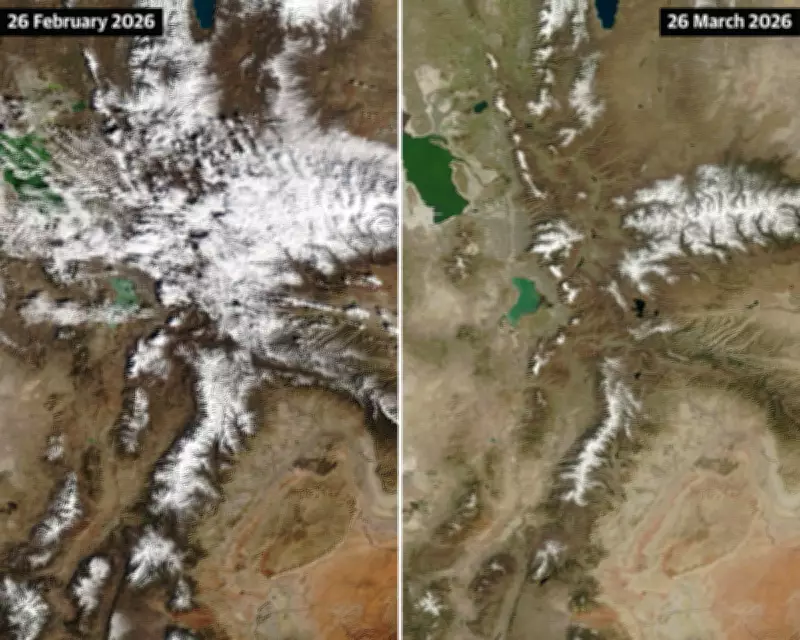
NASA Satellite Images Capture Stunning Snowpack Decline in Utah and Western US
NASA satellite images have revealed a dramatic reduction in snowpack across Utah between late February and late March, highlighting a broader crisis in the American West. Experts describe the rapid melt-off as "on a whole other level," with record-low snow water equivalent levels leaving key basins in uncharted territory for the upcoming dry seasons.
Unprecedented Heat Fuels Rapid Melt-Off
Snow surveys conducted across the American West this week paint a grim picture after a historically warm winter and searing March temperatures decimated critical snowpack. Dr Russ Schumacher, a climatologist at Colorado State University, emphasized the severity: "Seeing this year so far below any of the other years we have data for is very concerning." More than 1,500 monthly high temperature records were broken in March, an event climate scientist Daniel Swain called "likely among the most statistically anomalous extreme heat events ever observed in the American south-west."
Snowpacks act as a vital water savings account, essential for supply. Measurements taken during the week of April 1 serve as key indicators of peak water amounts that will melt into reservoirs, rivers, and streams. However, this year's snow water equivalent (SWE) levels are exceptionally low. In California's Sierra Nevada, SWE was just 4.9 inches, or 18% of average, while the Colorado River headwaters had just over 4 inches, or 24% of average—less than half of previous record lows.

Dire Measurements and Water Supply Threats
During a critical survey at Phillips Station in the Sierra Nevada, officials found zero measurable snow, marking the second worst on record since 2015. Andy Reising, manager of California's snow surveys unit, noted, "Normally we'd be standing right here," gesturing at chin height, but the tool poked into bare earth. The issue extends widely: data from the USDA shows the Great Basin at 16% of average, the lower Colorado region at 10%, and the Rio Grande at 8%.
The rapid melt has profound implications. California's reservoirs are currently filled beyond historic averages due to robust rains, but fast-melting snow may be harder to capture. In the Colorado River Basin, Lake Mead and Lake Powell are only 25% and 33% full, respectively, with officials relocating a floating marina in anticipation of receding levels. The risk of "deadpool," where water cannot pass through dams, looms catastrophically.
Early Water Restrictions and Fire Season Concerns
Municipalities are already responding to the crisis. Salt Lake City has called for conservation efforts to cut up to 10 million gallons, while Colorado and Wyoming have implemented or warned of lawn watering limits. Farmers and ranchers face hard decisions with smaller water allocations.
The diminished snowpack also sets the stage for an extended and severe fire season. Dr Joel Lisonbee of the University of Colorado Boulder warned, "Unless there's a major change in weather patterns, we're looking at an extended fire season." Landscapes that typically remain under snow longer will dry out faster, potentially leading to fires starting weeks or months earlier. Over 1.5 million acres have already burned this year, more than double the 10-year average.
Climate Change and Future Outlook
Experts link the extreme conditions to climate change, with seasons shrinking and fire risks expanding. Dr Abby Frazier of Clark University stated, "Climate change is going to result in a lot of these extreme events worsening," emphasizing the need for transformative action. The compound events of heat and drought this year serve as a stark warning, with Frazier adding, "The changes we have teed up for ourselves are going to be catastrophic."
As negotiations over Colorado River management remain stalled, the dire snowpack numbers underscore the urgent need for adaptation and mitigation strategies across the Western US.