
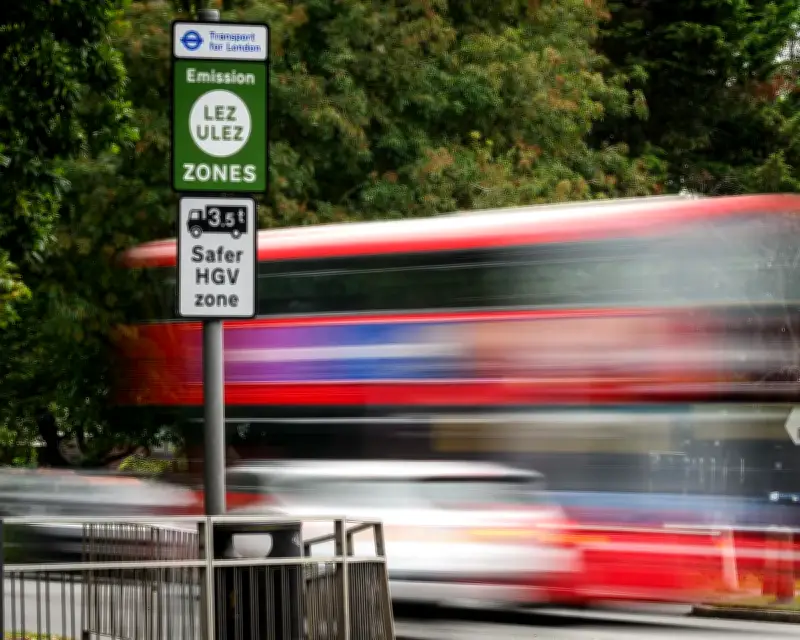
London's ultra-low emission zone (Ulez) has significantly improved children's lung health, according to a new study, yet cities worldwide remain cautious about implementing similar clean air measures, facing misinformation, political pressure, and vested interests.
Study shows Ulez improves children's lung health
A study from Queen Mary University London (QMUL) revealed that children's lungs have grown bigger and stronger since restrictions on the most polluting vehicles were introduced. The Ulez, launched by London's mayor Sadiq Khan in 2019 and expanded in 2021 and 2023, charges £12.50 a day for vehicles that do not meet stringent emissions standards, drastically cutting nitrogen dioxide levels.
Alastair Harper, a former environmental adviser to Khan, recalled a personal moment a decade ago when his child was rushed to University College London Hospital (UCLH) due to breathing difficulties caused by toxic air. "To know now that same air is so much safer for the kids that breathe it because of the political choice of one man makes me feel proud of this city," he said.
Between 6,000 and 8,000 people were dying prematurely each year in London in the late 2010s. In 2020, an inquest found that the death of Ella Adoo-Kissi-Debrah in 2013 was directly caused by air pollution, a first in the UK.
Global initiatives face barriers
Nick Hopkinson, a professor of respiratory medicine at Imperial College London, said the QMUL study was unsurprising, noting that air pollution kills 7 million people globally each year, according to the World Health Organization. Poor air quality contributes to respiratory issues, heart disease, stroke, and is linked to some cancers and cognitive difficulties.
Despite this, opposition to clean air measures persists. Cities like Paris and Barcelona have embraced cycling, while Bogotá is launching its second Zuma clean air zone, which includes expanding cycle lanes, paving roads, and planting trees. The city's environment secretary, Adriana Soto, said, "Residents helped shape the design, particularly how the works would maintain access to their homes and respond to local mobility needs."
Nairobi passed an air quality act in 2022, aiming to halve harmful emissions by 2035, and has installed 50 low-cost monitoring stations. Victor Indasi, lead for the C40 Breathe Cities project in Nairobi, said, "More remains to be done, but Nairobi is firmly on the right trajectory."
Political pressure and misinformation
Khan faced fierce opposition when launching the Ulez, including court challenges, business complaints, and personal threats. A survey found 60% of Londoners who replied to a consultation were against it. The 2023 Uxbridge byelection loss was partly blamed on the Ulez, leading some Labour figures to demand rollbacks.
Mete Coban, Khan's deputy, recalled the misinformation: "The personal abuse Sadiq got on the back of it was incredible. I think it's this, the misinformation, that is the number one thing that puts off other countries from doing this."
Hopkinson added, "Disinformation, which is lying to people, is confusing them. They are trying to persuade people that air pollution is not bad for them, and climate change is not real."
Future challenges and cautious progress
In London, the Ulez's success is threatened by wood-burning stoves, now a bigger source of particle pollution than traffic. More than 110,000 children were admitted to hospital with breathing difficulties in London in 2024. Sofia has reduced PM10 concentrations by 22% and halved days exceeding air quality guidance, while Melbourne is beginning to monitor neighbourhood-level air quality.
Chris Griffiths, a professor of primary care at Oxford University, noted, "Those who are suffering are those who have done least to cause the pollution." Hopkinson concluded, "The question for pro-pollution campaigners is 'why do you hate children?'"



