
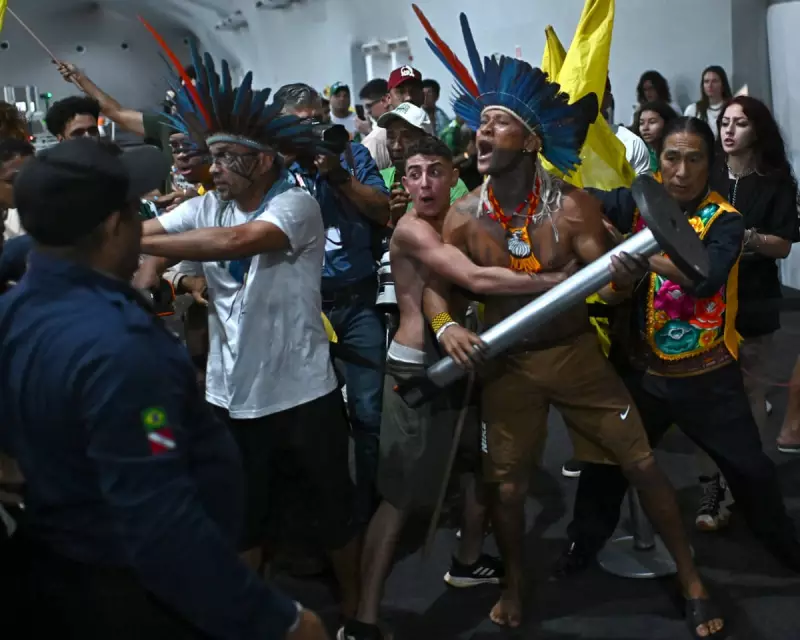
The third day of the Cop30 UN climate summit commenced amidst heightened tension following dramatic protests that marked the conclusion of the second day's proceedings. Dozens of Indigenous activists successfully forced their way into the conference centre, signalling a powerful resurgence of major demonstrations at these critical international talks.
Dramatic Protests Mark Summit's Return to Activism
The protest movement made its presence felt with undeniable force as demonstrators, some wearing traditional headdresses and carrying musical instruments, breached security protocols. They pulled doors from their hinges, pushed through security scanners, and engaged in physical altercations with guards before ultimately gaining access to the venue. One protester's sign delivered a clear message: "Our forests are not for sale."
This bold action represents the return of significant protests to UN climate negotiations after several years of suppression. Organisers have confirmed that additional demonstrations are scheduled throughout the remainder of the week, both within the conference grounds and at external locations.
Notable Absence: World's Largest Historical Polluter Missing from Talks
Approximately 50,000 participants have gathered for Cop30, representing diverse groups from civil society organisations holding rallies to researchers analysing complex documents and politicians negotiating behind closed doors. However, one delegation remains conspicuously absent: the United States, the world's largest historical greenhouse gas emitter.
Research organisation Carbon Brief confirmed on Tuesday that this marks the first complete US absence from climate negotiations. President Donald Trump, who has repeatedly described the climate crisis as a "hoax," formally withdrew the country from the Paris Agreement in January as part of a comprehensive assault on environmental policies.
California Governor Gavin Newsom, who arrived at the summit on Tuesday, delivered a blistering condemnation of Trump's anti-environmental agenda. "He's an invasive species, he's a wrecking ball president," Newsom stated during a press conference. "He's trying to roll back progress of the last century, he's trying to recreate the 19th century, he's doubling down on stupid."
Subnational Leadership Fills the Void
As the highest-ranking US official present at Cop30, Newsom attracted substantial attention throughout Tuesday, with crowds of spectators following his movements across the venue. In multiple meetings and press conferences, he reassured international audiences that California remains committed to climate action despite federal withdrawal.
"The United States of America is as dumb as we want to be on this topic, but the state of California is not," Newsom declared during an earlier meeting. "And so we are going to assert ourselves, we're going to lean in, and we are going to compete in this space."
International reaction to the US absence has revealed divided perspectives. On Monday, Tuvalu's Home Affairs and Environment Minister Maina Vakafua Talia characterised Trump's withdrawal as demonstrating "a shameful disregard for the rest of the world."
Conversely, Christiana Figueres, former executive secretary of the United Nations framework convention on climate change, offered a different interpretation on Tuesday, suggesting that the US absence "actually is a good thing." Her response to the American departure from the Paris Agreement was succinct: "Ciao, bambino."
Newsom responded to Figueres's comments during a press gathering, noting: "That's a hell of a statement coming from the mother of the Paris Agreement." He argued that Trump's absence "creates opportunity" for local leaders to assume greater responsibility for climate policy. "What stands in the way becomes the way. This is an opportunity for us bottom up at the local level to assert ourselves," Newsom explained. "He pulled away. That's why I pulled up."
Cop30 CEO Ana Toni emphasised the significance of local climate leadership during an evening press conference, describing Tuesday as "a big day" for showcasing such efforts. She reported that more than 185 city representatives convened to discuss adaptation to extreme heat, with discussions addressing concrete action and financing exceeding $20.
Research indicates that subnational actors can substantially influence climate policy, including within the United States. However, concerns persist that the Trump administration could still undermine this progress. These apprehensions have intensified following reports of US officials menacing foreign leaders and threatening tariffs during an international maritime meeting last month against those supporting a carbon fee on shipping.
Activist groups plan to direct attention specifically toward Trump during a protest scheduled for tomorrow morning. Participants will display a banner reading "resist climate saboteurs," featuring an outline of the US president.
"Trump's lack of presence so far is a blessing in disguise, but you never know when he's going to try and botch the talks," cautioned Denise Robbins, an organiser of the action. She urged global leaders to withstand any pressure they might encounter from the United States, emphasising: "No matter what happens in the US, the rest of the world needs to come together and act on climate. It's the only way we'll keep to the goals of the Paris climate agreement."



