
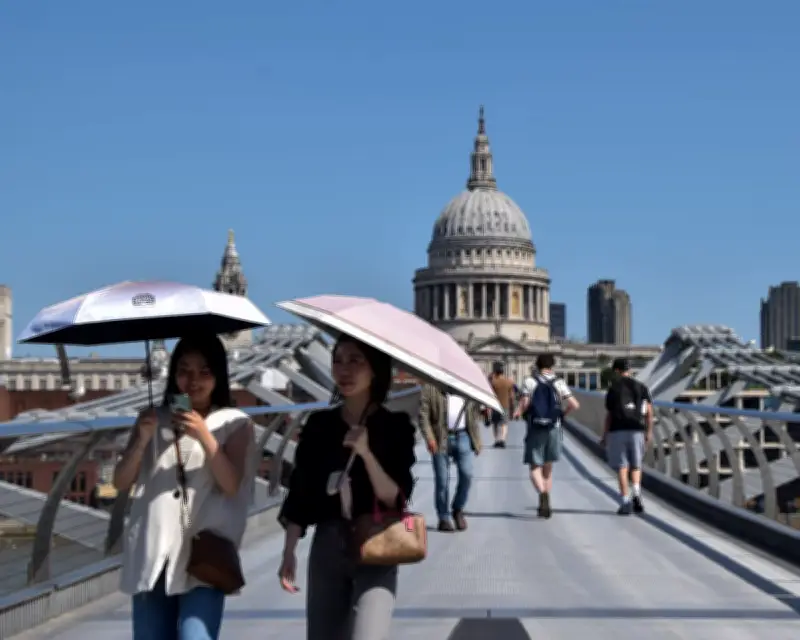
A record-breaking heatwave across western Europe is exacerbating socioeconomic divisions, with low-income families and women bearing the brunt of the extreme weather. The combination of heat and humidity, fueled by the climate crisis, has made many cities feel unliveable, according to experts.
Unequal impact of extreme heat
Asad Rehman, chief executive of Friends of the Earth, said the heatwave "throws a grenade into every vulnerability you already have," noting that vulnerable or marginalized groups often suffer the most from climate-related hardships. In urban areas, the disparity is acute: studies show that trees can halve the urban heat island effect, but green spaces are not distributed equally, leaving poorer communities in densely packed flats and houses to suffer more. Rehman cited a study finding that tree shade reduced maximum surface temperatures by 19C, while grass reduced them by 24C.
Families struggle in small spaces
Emily Dickinson, 36, her partner Danny Swain, 34, and their son Oliver, 10, live in a one-bedroom apartment in Tufnell Park, London. The small living space aggravated the heatwave's impact, making it impossible for Oliver to study after his school closed on Tuesday, along with more than 1,000 schools across the country. The family has no nearby access to green spaces and must walk in scorching heat to reach cooler areas. "It's been unbearable," Dickinson said. "At school, he was probably more comfortable than in our living situation." Families like hers face not only entertaining a child in a hot home but also losing work. "We feel like we're the peasants that just have to deal with it," she added. Expenses like air conditioning and fans add an impossible burden to already stretched finances.
Childcare challenges during school closures
Arcan Büyük Kahramanı, 43, and his wife Ayten, 41, had to keep their son Poyraz, seven, at their cafe in Islington after his school closed. "We can't just close the shop," Arcan said, expressing concern that Poyraz struggled with homework in the cafe and would miss out on education. Without a family support network, they have few childcare alternatives. "We can't leave him with anyone else … [or] afford to hire a babysitter," he added.
Kimberley Lloyd, 76, from Southend, looks after her grandson Wyatt, nine, for two nights a week at her single-parent daughter's house. Travel cancellations and delays due to the heatwave made it difficult for her to provide childcare. "If I can't get up here, she can't work," Kimberley said.
Women bear disproportionate burden
Charlotte Buxton, 41, from South Derbyshire, has five children, three of whom are autistic. The heatwave made it harder to support their needs. She chose to keep her son with the most severe learning difficulties at home with his younger brother, whose school closed on Wednesday, feeling she could safeguard him better in the heat. But this decision came at the expense of her own health. "I have to choose all the time," she said. Since the heatwave began, Buxton has balanced full-time care of her children with household duties and managing her own disabilities, fibromyalgia and postural tachycardia syndrome. She said likely hotter and more frequent heatwaves point to an unsustainable future for families "struggling anyway."
Buxton noted that women often pick up the pieces. "It's always the mums," she said. A 2022 study found that almost half of all working-age women do an average of 45 hours of unpaid care per week. Gemma Derrick, research policy and culture professor at the University of Bristol, found that women's productivity was more significantly affected than men's when either became a parent. In emergencies, mothers are often relied upon as the first port of call. "It unconsciously sidelines women," Derrick said, referring to school closures during the heatwave, because mothers are assumed to be the primary caregiver.
Need for adaptation and prevention
Rehman agreed that oppression of marginalized groups, especially women, could become more pronounced due to extreme heat. The only solutions are preventive measures to slow global heating combined with adaptation measures. "Have we created conditions that put marginalised people at risk?" he said. "It's not them that are causing [it], but they are the ones suffering."



