
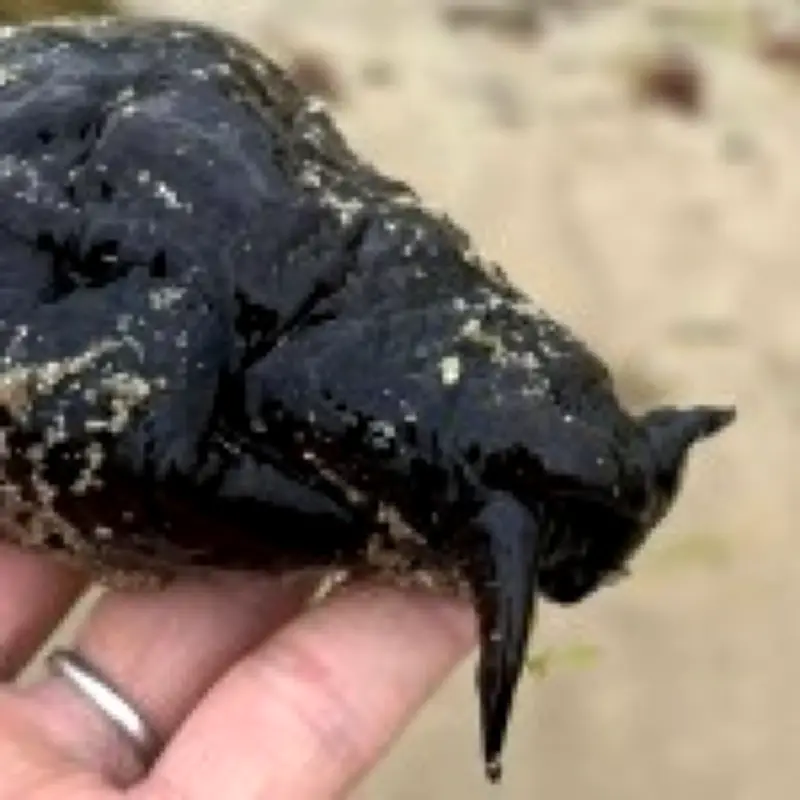
A dogwalker in Anglesey discovered a giant marine slug on the beach, prompting confusion among experts. The creature, later identified as a sea hare—a type of marine snail commonly called a sea slug—was found about 20 metres from the water's edge at low tide.
Unusual find in Trearddur
Emma Leese, the dogwalker, encountered the sea hare near Trearddur Bay. Concerned that local dogs might harm it, she returned the animal to the sea. 'When back in water, it sort of unfolded,' she said. 'It began wriggling – slug-like – and its stalks began going back up.'
Smaller sea hares are native to the UK, but this specimen is thought to be a much rarer depilatory sea hare, typically found in the Mediterranean. According to the Global Biodiversity Information Facility, the Isle of Man has three confirmed sightings of this species, and northern Scotland has one. Wales has no official records, though anecdotal reports exist in Pembrokeshire.
Expert identification
Frankie Hobro, owner and director of Anglesey Sea Zoo, said the creature is likely a depilatory sea hare. 'This is still a rare UK species, found occasionally in southwest Britain,' he explained. 'However, it's a species we're likely to see more of in the future as the seas warm and they keep moving north.'
Sea hares are molluscs related to garden snails. Instead of an external shell, they have a thin, transparent internal shell. Their fleshy mantles have evolved into large, wing-like flaps that allow them to swim gracefully through water, described as surprisingly agile.
Physical characteristics and behaviour
Commonly found in the UK is the native spotted sea hare, which typically measures around 7 cm but can grow to 20 cm. In contrast, depilatory sea hares can reach 40 cm, dwarfing their British cousins and being much bulkier. When disturbed in water, they release a dramatic cloud of purple ink derived from red algae they eat, similar to an octopus's ink, thought to confuse predators.
Sea slugs cannot absorb atmospheric oxygen, so they typically die quickly after stranding. Hobro advised anyone finding a sea hare not to touch them without gloves, as their skin stores noxious chemicals from their algal food. 'They are quite revolting to touch. As they have quite strong suction, they should never be prised off a rock, as this may damage them,' he added. 'I always say it's best to leave marine creatures alone, as it might not always be what you think they are.'



