
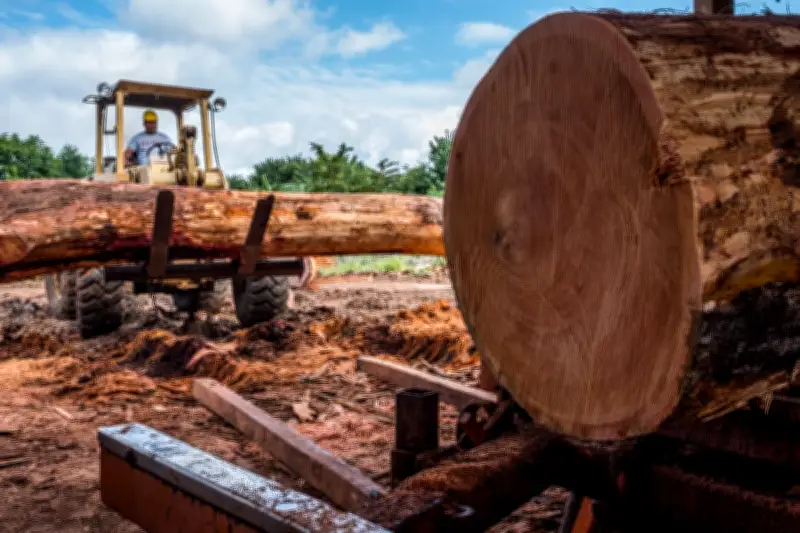
In Guatemala's Maya Biosphere Reserve (MBR), a huge harvester crashes into the open, dragging a 15-metre mahogany trunk. The tractor deposits the log onto a pile of lumber at the edge of the clearing, then lurches back into the forest. This is sustainable forestry at its most brutal. In a few weeks, silence will return, and chainsaws won't be back for at least four years, as part of a strict management plan that is bucking the trend of rampant deforestation.
The Maya Biosphere Reserve: A Model of Zoned Conservation
The 2.1-million-hectare MBR, in northern Petén province, was established by the Guatemalan government in 1990 and recognized by UNESCO. It now anchors the largest natural forest in Central America, according to José Román Carrera, a forestry director at the Rainforest Alliance, who was part of the initial discussions to establish the reserve.
The MBR is divided into three zones: a buffer zone (23%) protects the forest along its southern edge; a core zone (39%) houses national parks and conservation areas; and a multiple-use zone (38%) allows sustainable livelihoods. The multiple-use zone includes 12 community forestry concessions (CFCs), each with 25-year contracts, covering 400,000 hectares. The first concession was established in 1997 after the end of Guatemala's civil war.
Community Concessions: Green Islands of Near-Zero Deforestation
While the reserve as a whole has lost nearly 13% of its natural cover in 24 years, the community concessions have maintained near-zero deforestation, serving as 'green islands,' according to the National Council of Protected Areas (Conap).
At the Carmelita cooperative's concession, which spans 43,000 hectares, 30 men work from a temporary camp. Every year, they take just two trees from each of the 1,000 hectares earmarked for harvesting on a rotational basis. Each tree is mapped, logged, and numbered, with strict criteria on which can be felled, based on size and abundance, explains forestry engineer Hedy Godinez Pulido. 'The young trees define how many old trees you can cut,' he says.
Before the sustainable plan, says forestry technician Bayron Chub, it was 'chaos.' Private companies selected trees at random by hitting them with a hammer. 'If it sounded damaged, they left it. They cut the easy way … and left huge wasted stumps. There was no planning.'
FSC Certification and Strict Enforcement
Concessions must work to strict Forestry Stewardship Council (FSC) standards, allowing timber export. FSC staff inspect every stump, assessing the cut and fall angle; any miscalculations result in fines. 'Our fathers taught us to live with the forest without causing damage,' says Chub.
The community of La Pasadita learned the consequences of non-compliance. In 2009, Conap suspended their contract after discovering illegal logging within the 18,000-hectare concession. Walbi Cardona, outgoing president of the village association, says: 'Nobody believed in them because they did bad things.' Winning back the licence proved a struggle.
In the past five years, La Pasadita worked with the Rainforest Alliance's Prosperous and Resilient Landscape programme to create a restorative production plan. They built the largest community nursery within the MBR, nurturing over 120,000 seedlings from 23 tree species. The trees restore degraded pastureland, bringing back tree cover and reducing wildfire threats.
Restoration Success and Economic Benefits
'We're very grateful for the restoration that has taken place in our community,' says Cardona. 'There has been a lot of participation from women and youth, generating social benefits and bringing income back to their homes.'
Mahogany trees in La Pasadita's nursery grow faster than those in the forest. 'The secret of the success is the nursery,' Cardona explains—good seeds, proper planting, and space to grow, with direct sunlight and no competition. Other species planted include old spice, ramón (a nut tree), and cantemo (a type of acacia), which is a favourite nesting site for the scarlet macaw, encouraging the rare birds back.
Drones monitor the landscape. According to Conap data, there has been a net increase of 105 hectares of forest coverage. 'Restored forest is coming back at the expense of pasture,' says Carrera proudly. Conap is now using this success to guide a national policy of productive restoration.
Uaxactún: Diversifying Income with Non-Timber Products
Uaxactún, another concession in northern Petén, has seen forest cover grow by 113 hectares, according to Conap. Covering over 83,000 hectares, it uses lucrative non-timber forest products like xate palm to boost income. Harvested to strict guidelines, most fronds are sold to the US for religious ceremonies. Vice-president Francisco Aldana explains that since the community took over sales, annual revenue grew from a few hundred dollars to $60,000.
The village's timber workshop employs locals building cabins for tourism. Rafael Fajardo and Duglas Barillas work on fittings for 10 cabins, part of a tourism push that includes Maya ruins and trekking to El Mirador. Scholarships in carpentry were funded by sustainable forest management, helping stem youth migration.
Value-Added Processing and Local Employment
At Carmelita, president Jesús Barrera prepares the marshalling yard for incoming timber. Previously, they sold rough lumber due to lack of equipment. Now, with four sawmills and local carpenters, they produce value-added products like furniture, guitar necks, and house kits. 'Workers used to come from outside, now 95% are local people because we have invested in training. That's a big change,' says Barrera.
The work has brought jobs and money for health and education not provided by the government. Household incomes in concessions are up to three times higher than the national poverty level.
Sustainable Management: From Unpopular to Profitable
Initially, sustainable management was unpopular, says Carrera. But now the cooperative projects around $3 million this year by sustainably targeting a controlled number of trees. Initially, 80% of the concession was conservation and 20% production; now those figures are reversed, yet the forest continues to grow.
'The forest is best protected by those whose livelihoods depend on it,' Carrera concludes.



