
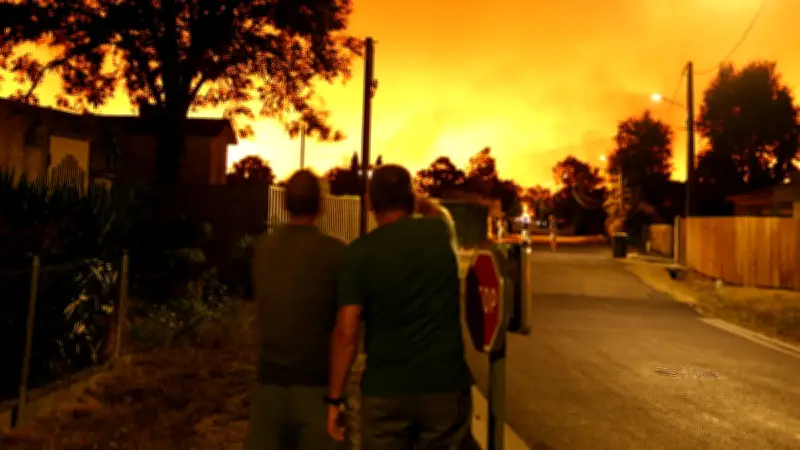
Firefighters, soldiers, and volunteers in Le Porge, near Bordeaux, are locked in a "war of attrition" against the remnants of a "megafire" that has scorched 42,000 hectares (104,000 acres) of forest, forcing 200,000 people from their homes. Although the main blaze is contained, daily flare-ups from smoldering peat—dubbed a "zombie fire" by local media—continue to strain emergency services.
Exhaustion and Adrenaline on the Frontline
At a makeshift canteen outside Le Porge's sports centre, 200 firefighters and volunteers broke for lunch under temperatures of 35C, the air thick with ash and the smell of burnt wood. A senior firefighter, speaking anonymously, said, "We've turned a corner but we are very, very tired. We have gone beyond what we thought possible. We stared into an abyss." Overhead, three planes dropped water and retardant on new fires, while a drone with thermal cameras monitored the creeping underground blaze.
The village was evacuated 14 hours after the fire broke out 6km away. Now, roads wind through a charred landscape of upright trees, some intact, others reduced to ash. Remy Bossion, 46, whose home was damaged, spends his days cutting 200-metre-wide firebreaks. "Now we are all running on adrenaline, but the crisis is going to pass and that's when it will be really hard. That's when we will weep," he said.
Wider European Crisis
The fires in France are part of a broader European emergency. In the Var region, George and Amal Clooney were evacuated. Fires also threaten Fontainebleau, Corsica, and near Dijon. In the UK, 120 firefighters battled a Suffolk blaze for three days. Spain has set a record for cumulative fires in 2026, and in Greece, three firefighters died in Crete as thousands of tourists were evacuated.
EU data shows fire weather has broken records for this time of year, with scientists noting that climate models predicted such extremes, though some disasters are arriving earlier and with more intensity than expected.
Political and Public Reaction
French leaders are trying to reassure communities. Sophie Brocas, prefect of Nouvelle-Aquitaine, said Thursday, "We are gradually getting back to normal." President Emmanuel Macron insisted it was not the time for lessons while France is in "full battle."
However, the fire's origins and resource availability are contested. Nicolas Di Domenico, a public works contractor, said a faulty machine cleaning a high-tension cable sparked the blaze. "It was a short circuit... and immediately everything went up because it's all so dry," he said. "The authorities should have stopped all work in the forest. Someone got their priorities wrong."
Many accuse the administration of being "asleep at the wheel" and failing to commit resources. Sebastien Delavoux, head of the CGT firefighters' union, said, "We feared this for a long time, and were warning about the planes specifically since 2017. This summer has shown we have reached the extreme limit of what is possible for France's firefighters."
Local Impact and Resilience
Le Porge lost 20% of its homes, escaping further devastation "by a miracle," according to Mayor Martial Zaninetti. "The conditions this year are totally exceptional. We've never seen anything like this," he said. "You can always say it's not enough... but the scale is completely beyond anything we've seen before."
In Lacanau, volunteers like Armand Fargeas, 51, run a makeshift pumping station. "We've got 600 people in our WhatsApp group... What's really great is that you have every generation getting involved. We might not agree on politics, but the spirit of solidarity is amazing," he said. Anne-Marie Nardou, 74, brought fruit and drinks, hoping tourists return: "It's a catastrophe."
Evacuees and Climate Concerns
Some of the 200,000 evacuees are returning, but many remain in shelters or with relatives. Frédéric Farrugia, 55, watched on security cameras as firefighters saved his home in Lège, though homes 50 metres away were destroyed. "We were on the dual carriageway with these flames like a wall along one side. It was a bit like the apocalypse," he said. "I think that now the French will realise that the climate is heating up and that we have to react."
Anthony Legrand, a carpenter, noted decades of change: "You'd think that would be a warning but no one paid attention. It'll be the same this time. They've got memories like goldfish."
Mayor Zaninetti stressed the long-term challenge: "Right now, we need new shelter, clothes, insurance, legal support, doctors and psychologists. But this is a problem for the long term. Unless we find another way to live with the forest, this will just happen again."



