
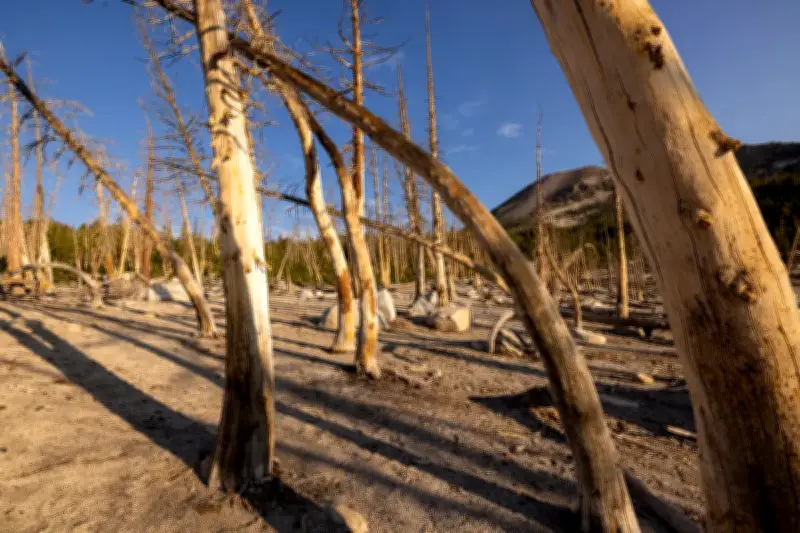
Fossilized leaves from a period of intense global warming 56 million years ago show that high carbon dioxide levels caused forests to collapse, not flourish, according to a new study published in Science. The research directly counters claims by members of the Trump administration that fossil fuel pollution benefits plant life.
Ancient Climate Event Reveals Forest Response
The study analyzed fossilized leaf cells from the Paleocene-Eocene Thermal Maximum (PETM), a period when massive amounts of carbon were released over 130,000 years, heating the planet by up to 8°C (14°F). The authors found that forests initially became denser as CO2 rose, but then collapsed dramatically, with around 60% of the standing vegetation biomass lost.
Regan Dunn, a researcher at La Brea Tar Pits and the Natural History Museum of Los Angeles County, who led the study, said: "What we see is that as the carbon dioxide ramped up, the forests became very dense but then subsequently collapsed, opening up dramatically." She added: "Around 60% of the biomass of the standing vegetation was gone, it was a huge loss. This should be a concern because the rate of carbon release has never been higher than now."
Countering Claims of CO2 Benefits
The findings challenge assertions from figures like Doug Burgum, the interior secretary, who told Fox Business: "CO2 was never a pollutant. When we breathe, we emit CO2. Plants need CO2 to survive and grow. They thrive with more CO2." Chris Wright, Trump's energy secretary, similarly claimed on Fox News last year that "a warmer planet with more CO2 is better for growing plants."
The study shows that trees require much more than CO2 to thrive. Extra carbon dioxide traps more heat, causing trees to struggle amid extreme temperatures and lack of key nutrients. Hotter conditions can also trigger pest outbreaks and dry out vegetation, leading to massive wildfires like those that have engulfed parts of Canada and western Europe this summer.
Forests Already Dying Back
The paper states that the switch from greening to browning forests occurred around 2000, when drought and heat stress overtook the benefits of extra CO2. Since then, evidence of escalating global tree mortality has piled up, including trees in the tropics dying of dehydration.
Dunn noted: "Once the climate becomes too warm plants aren't able to handle it, it affects their physiology and their relationship with water. Once they can't survive because the CO2 and temperatures are too high, that's when you see forests die back." She said there is "quite a lot of tree mortality" now occurring in Europe, North America, and the Amazon, requiring swift cuts to carbon emissions.
"There is still time to prevent the worst outcomes and best thing we can do is keep fossil fuels in the ground," Dunn said. "It's important for people to understand that once we pass thresholds it takes a long time to recover from them. The 130,000 years of the PETM change on human timescales is basically forever."
Methodology and Implications
Dunn and her colleagues ascertained the extent of ancient forests by analyzing fossilized leaf cuticle fragments, enabling them to calculate the density of the forest canopy during the PETM and track the advance and retreat of forests over time. During that era, forests covered a much larger extent of the world, with no ice at the poles and higher seas.
Trevor Keenan, a scientist at the University of California, Berkeley, who was not involved in the research, called the paper a "genuine advance" that provides a record over tens of thousands of years. "The headline is that warming won," Keenan said. "Carbon dioxide rose sharply, and any benefit that gave the forests was not enough to stop canopies from opening up and staying open for tens of thousands of years."
Keenan highlighted worrying differences today: "The ancient carbon release happened over thousands of years, ours is happening over decades. Faster forcing gives ecosystems less room to adjust. Second, those forests faced climate change alone. Today's forests are dealing with the same warming while also being fragmented, logged, converted to agriculture and exposed to altered fire regimes. If forests thinned under the slower and cleaner version of this experiment, that is not a reassuring precedent."



