
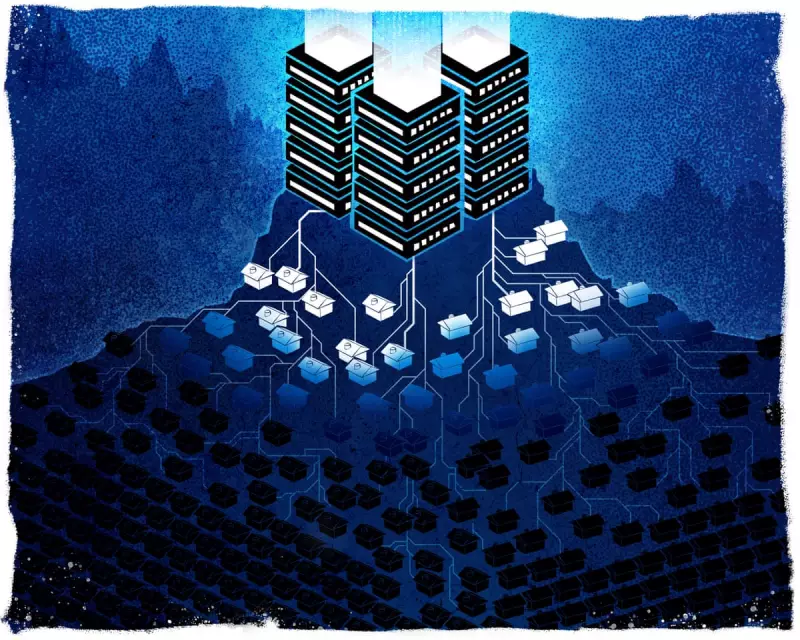
Alarm bells are ringing across Australia as experts warn that the explosive, unchecked growth of the data industry poses a severe threat to the nation's energy transition and its ability to meet crucial climate targets.
The Soaring Energy Appetite of Data Centres
Data centres, which house the banks of servers powering our digital world, are voracious consumers of electricity. These facilities, operating around the clock, generate immense heat, requiring significant power both to run and to cool the equipment. According to the Australian Energy Market Operator (Aemo), data centres currently draw about 2% of electricity from the National Grid, equating to roughly 4 terawatt hours (TWh) annually.
This demand is set to skyrocket. Aemo forecasts that data centre power consumption in Australia could triple within just five years, growing at a staggering 25% year-on-year. By 2030, it is expected to reach 12TWh, or 6% of total grid demand, surpassing the projected energy use of all electric vehicles. By 2050, this share could double to 12%.
This rapid expansion will drive "substantial increases in electricity consumption, for Sydney and Melbourne, in particular," Aemo states. In New South Wales and Victoria, where most centres are located, data facilities could comprise 11% and 8% of each state's electricity demand respectively by 2030.
AI and the 'Hyperscale' Challenge
The surge is being propelled by technology giants like OpenAI and SunCable, who are pushing for Australia to become a major hub for data processing and storage. This ambition is being supported by state governments; Victoria recently announced a $5.5 million investment to become "Australia's data centre capital."
With 260 centres already operating and dozens more planned, the scale is shifting. Hyperscale facilities, often focused on power-hungry artificial intelligence (AI) systems, are becoming commonplace. The International Energy Agency (IEA) notes that global data centre demand is growing four times faster than all other sectors.
"A hyperscale, AI-focused data centre can have a capacity of 100MW or more, consuming as much electricity annually as 100,000 households," the IEA reports. Professor Michael Brear from the University of Melbourne explains that the colossal electricity and water use is largely for cooling, as servers convert energy into heat. "When you have a very large number of computers in a confined space, you need to air condition the space to maintain these devices," he says.
Ketan Joshi, a climate analyst with the Australia Institute, points out that tech companies are reporting accelerating power consumption not just to serve more users, but per user and per unit of revenue. "The question that everybody should be asking is why are you consuming more energy?" he states, suggesting the widespread adoption of generative AI is a key driver.
Derailing the Energy Transition and Climate Goals
Experts warn this unfettered growth has two critical impacts: it increases reliance on existing coal and gas generation, and it diverts vital renewable energy resources away from displacing fossil fuels.
While companies often claim to run on clean energy through investments in solar or wind, Joshi highlights a fundamental mismatch. Data centres demand power constantly, while renewables generate intermittently. "So, even though on paper it all kind of works out, there are some times when that data centre is actually helping fossil fuels to be dispatched," he argues. The result is that new renewable capacity serves the growing data centre load instead of replacing coal. "It's like running harder just to stay in the same spot because the treadmill is getting quicker."
The demand is so intense that overseas, companies have paid to restart decommissioned nuclear plants. In Australia, some developers have proposed installing new gas generators. By 2035, Aemo forecasts data centres could consume 21.4TWh, nearly as much as the nation's four aluminium smelters use annually.
Dr Dylan McConnell from UNSW warns that if demand grows faster than anticipated and renewables don't keep pace, "then actually what we end up doing is just powering that new demand and not displacing coal." Unlike electric vehicles, data centres do not reduce fossil fuel use elsewhere in the economy. "If this demand eventuates, it will make our emissions objective... very difficult, if not impossible," he concludes.
The federal government's new national AI plan acknowledges the need for expanded energy and cooling technologies. Industry Minister Tim Ayres pledged that data centre principles due in 2026 will require "additional investment in renewable energy generation and water sustainability." However, with the Climate Change Authority warning of "additional pressure on the renewables buildout," the race is on to ensure the data boom does not come at the cost of the climate.



