
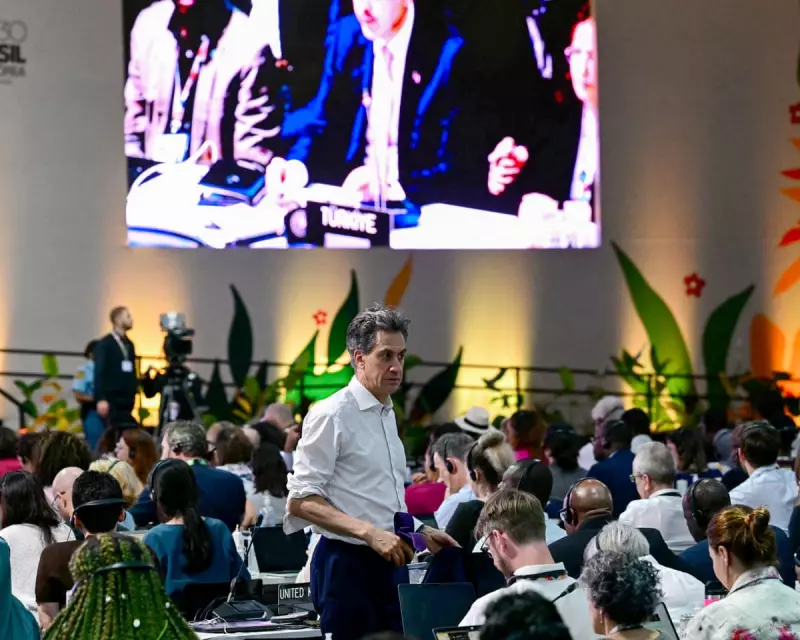
The UN Cop30 climate summit in Belém, Brazil, concluded this weekend with a deeply mixed outcome, where a hard-won victory on financial aid for developing nations was eclipsed by a profound failure to secure a decisive transition away from fossil fuels.
A Stark Warning from the Frontlines
As delegates argued late into Friday night over legal terminology, Steven Victor, the Environment Minister of Palau, delivered a powerful reminder of the human cost at stake. "Right now, our people are losing their lives and livelihoods from storms of unprecedented strength," he stated, highlighting how warming seas are powering these disasters. He warned that coral reefs and forest ecosystems are at a tipping point, with the window to protect lives and economies rapidly closing.
Minister Victor directly confronted the larger nations, stating, "We are dangerously close to a 1.5C global warming overshoot, driven by the actions of bigger countries. Unless we choose the path of course correction right here and now, leaders are dooming our world to disaster."
Minimal Headway on Finance and Fossil Fuels
The final agreement, spanning over 150 pages, yielded minimal progress on the two most critical issues: establishing a firm timetable for replacing oil and gas and securing binding commitments to slash carbon emissions.
On climate finance, the summit produced a call to "at least triple adaptation finance" by 2035. While this would amount to around $120 billion (£92bn) a year, it falls drastically short of the $360 billion that developing countries are projected to need. David Wu of Action Aid criticised the delay, saying, "Ten years from now is an unimaginably long time for communities facing life-threatening impacts now... this decision does little but lock in climate injustice."
The summit's approach to the inadequacy of national climate plans, known as Nationally Determined Contributions (NDCs), was equally weak. More than 70 countries, including India and Saudi Arabia, failed to submit new NDCs. Those that were submitted would lead to catastrophic global heating of around 2.5C. The Cop30 response was merely to agree to further talks, after China, India, and others blocked any binding decision to strengthen these plans.
A Watered-Down Fossil Fuel Transition
Perhaps the most significant disappointment was the handling of fossil fuels. A proposal from over 80 nations to begin discussions on a roadmap to "transition away from fossil fuels" was severely weakened after bitter standoffs with Saudi Arabia, Russia, and other fossil-fuel-dependent nations.
The initial proposal was already regarded as weak, as it lacked a firm timetable. Ultimately, it was diluted into a purely voluntary initiative, with the Brazilian presidency tasked to report back next year. Johan Rockström, director of the Potsdam Institute for Climate Impact Research, expressed grave concern: "The truth is that our only chance of keeping 1.5C within reach is to bend the global curve of emissions downward in 2026... We got neither [concrete roadmaps to phase out fossil fuels nor protection of nature]."
Civil society groups also highlighted a critical omission: the exclusion of text addressing the human rights abuses in mining for critical minerals needed for renewable energy, a move insisted upon by China and Russia.
A Daunting Legacy for Cop31
With key issues like NDCs, emissions cuts, and the fossil fuel transition kicked down the road into voluntary initiatives and further talks, the outcome places a heavy burden on the next hosts. The presidency of Australia, which will host Cop31 in Turkey next year, faces the monumental task of delivering real action.
Asad Rehman, chief executive of Friends of the Earth, issued a stark final warning: "The reality and scale of the crisis means that small steps forward aren’t going to be enough. The world needs to start taking giant leaps to cut emissions, fast. I won’t sugar-coat it – the consequences will be terrifying if words aren’t turned into action soon." The final wording of the Cop30 agreement, urging countries to strive to "do better" on their climate plans, leaves the world waiting for that decisive action.



