
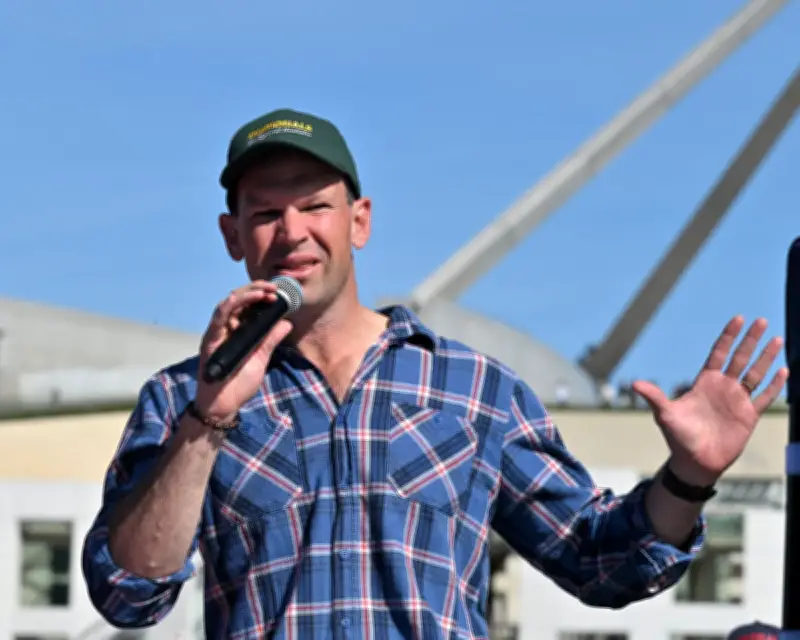
The Coalition's recent 'great net zero debate' was anything but, with Nationals leader Matt Canavan's claim that renewable energy would require 12 million hectares of land—equivalent to 'two Tasmanias'—being dismissed by experts as 'plain wrong and plain silly'. The debate, hosted by former morning TV star Karl Stefanovic at cattle saleyards near Rockhampton, featured Coalition leaders Angus Taylor and Matt Canavan in a one-sided discussion that repeated tropes about net zero and electricity costs.
Canavan's land claim contradicted by Net Zero Australia data
Canavan attributed his 12 million hectare figure to the 'very smart people' at Net Zero Australia (NZAu), a research partnership of the University of Melbourne, the University of Queensland, and Princeton University. However, NZAu's most recent reporting states that only 2 million hectares would be needed for renewable energy and transmission infrastructure to help Australia reach net zero emissions. This 2 million figure represents the total area of projects, not the actual land used for access roads, easements, and the infrastructure itself. The 'direct footprint' would be about 500,000 hectares—24 times less than Canavan's claim.
The 12 million hectare number appears to come from an earlier NZAu report, which estimated the 'total project area' for Australia to completely decarbonise its energy system and replace all current exports of coal and gas with clean alternatives. That report did not provide a 'direct footprint' figure but noted that wind turbines and access roads typically occupy only 1% of the total windfarm area. Canavan also omitted that the same report estimated a 'new forest area of 5.1 million hectares' would be planted to sequester CO2.
Experts rebut 'plain silly' claims
Prof Michael Brear, director of NZAu, said the project had not yet 'looked in detail as to how Australia might locate energy infrastructure such that it compromises all forms of land use less, including farming'. He added that their latest report 'has studied related trade-offs between locating energy infrastructure and biodiversity and suggests there may be significant opportunity for managing such risks'. Prof Andrew Blakers of the Australian National University, who calculated that a zero-emissions electricity grid would require only 120,000 hectares (1,200 sq km), said Canavan's claim was 'plain wrong and plain silly'. 'It's surprising a senator would throw around wild numbers without doing a simple reality check,' he said.
These concerns are not to discount genuine issues around badly placed projects or community concerns, but the debate failed to differentiate real issues from political fear-mongering.
Renewables not to blame for electricity price rises
The Coalition repeatedly asserted that renewable energy is driving up electricity prices and reducing reliability. However, experts have repeatedly stated this is not true. Australia's electricity prices have risen largely due to higher gas and coal prices, linked to Russia's war in Ukraine. Last week, the Australian Energy Market Operator (Aemo) reported that wholesale electricity prices—about a third of retail bills—fell by 47% from a year ago, attributing this to 'increased renewable generation' and 'higher grid-scale battery discharge during peak periods'. CSIRO analysis suggests that even if net zero policies were abandoned, future electricity prices are likely to be higher than today.
Reliability and the grid
On reliability, Aemo's recent report stated that 'reliability risks in the next five years are primarily triggered by the retirement of large power stations'. Alison Reeve, director of the energy and climate program at the Grattan Institute, said there is 'no evidence' renewables are making the grid less reliable. The reliability standard in the National Electricity Market has been breached only twice, both in 2008. 'Power outages overwhelmingly are due to network outages when poles and wires are out—a rat gets in a substation or someone drives into a pole. Between 2009 and 2019 only 0.3% of outages were due to a lack of electricity to meet demand,' she said.
Climate change ignored in 'debate'
Joining Taylor and Canavan was Liberal National MP Colin Boyce, who has previously signed a declaration dismissing carbon dioxide as 'plant food' and claiming more of it is 'favourable for nature'. Climate change did not rate a mention in the hour-long show, missing an opportunity to challenge Boyce's views.



