
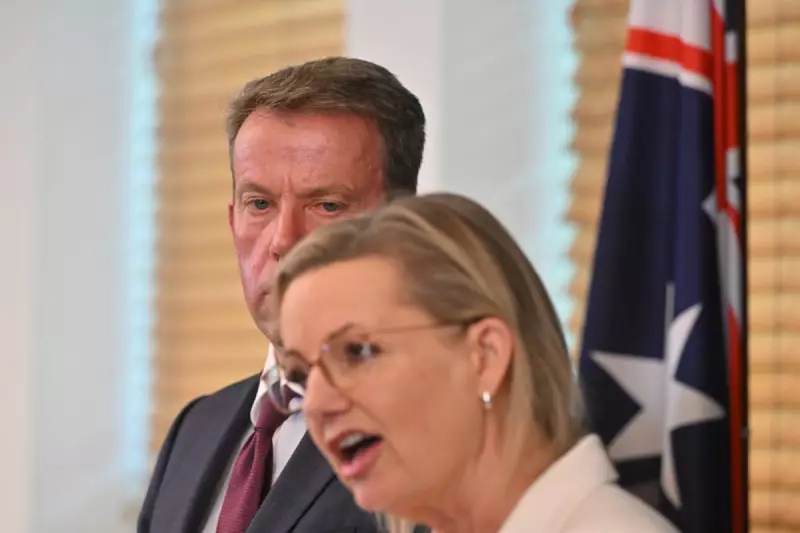
As Australia's political debate over climate policy intensifies, the Coalition has abandoned its support for the 2050 net zero emissions target, making several significant claims about the costs and consequences of climate action. But how do these assertions stand up to scrutiny?
The $9 Trillion Misrepresentation
Nationals leader David Littleproud and other Coalition MPs have repeatedly claimed that achieving net zero would cost Australian taxpayers $9 trillion. This figure has been cited at least fifteen times in recent interviews, creating a powerful narrative about the financial burden of climate action.
However, the alleged source of this information – Net Zero Australia, a partnership between universities of Melbourne, Queensland and Princeton University – has explicitly stated that their cost estimates have been misrepresented. The academics clarified that the additional cost of building an energy system to reach net zero by 2050 would actually be approximately $300 billion, not the astronomical figure claimed by politicians.
More importantly, the $9 trillion figure refers to potential capital investment between now and 2060 for energy developments within Australia and for export projects. Net Zero Australia emphasised that the "large majority" of this investment should be underwritten by overseas customers, not Australian taxpayers, and would create substantial industries and employment opportunities.
Power Bills and Renewable Energy Reality
Liberal leader Sussan Ley recently asserted that power bills have increased by approximately 40% since Labor's election, suggesting this was due to investment in renewable energy to meet emissions reduction targets. Shadow minister for energy Dan Tehan supported this position, though when pressed for evidence, could only state that "people are seeing it every single day in their electricity bills."
Energy industry analysts strongly dispute this connection. Tony Wood, senior fellow at the Grattan Institute and former Origin Energy executive, states that the price increase had "almost nothing to do with renewable energy."
The real drivers behind the 2022-23 price spike include:
- Russia's invasion of Ukraine pushing up global gas prices
- Increased coal prices due to flooding at east coast mines
- Outages at ageing coal power plants reducing competition
- Post-pandemic demand recovery and general inflation
Research from Griffith University's Centre for Applied Energy Economics and Policy Research actually found that electricity generation costs could be up to 50% higher had Australia relied solely on coal and gas without renewable energy investment.
Paris Agreement Compliance Questions
While the Coalition claims it would remain committed to the Paris agreement while abandoning emissions targets, this position appears contradictory to the agreement's fundamental principles. Article 4.3 explicitly requires that countries make successive commitments that "represent a progression" and "reflect its highest possible ambition" – meaning no backsliding on climate commitments.
The Intergovernmental Panel on Climate Change has determined that meeting the Paris agreement's 1.5°C goal requires a 45% global emissions cut between 2010 and 2030, with net zero reached "around 2050." The Coalition's current stance clearly conflicts with these scientific recommendations.
Carbon Capture Limitations
Dan Tehan has suggested that carbon capture and storage (CCS) could "provide immediate relief when it comes to emissions reduction," but the evidence tells a different story. Despite decades of government support and billions in funding, CCS remains a marginal contributor to emissions reduction.
According to the Global CCS Institute, the 77 operational projects worldwide capture up to 64 million tonnes of CO2 annually – representing just 0.17% of global emissions. Furthermore, nearly half of these projects are used for "enhanced oil recovery," where captured greenhouse gases are pumped underground to extract more fossil fuels.
As Australia continues to debate its climate policy future, the gap between political rhetoric and expert analysis appears wider than ever, with significant implications for both energy affordability and meaningful climate action.



