
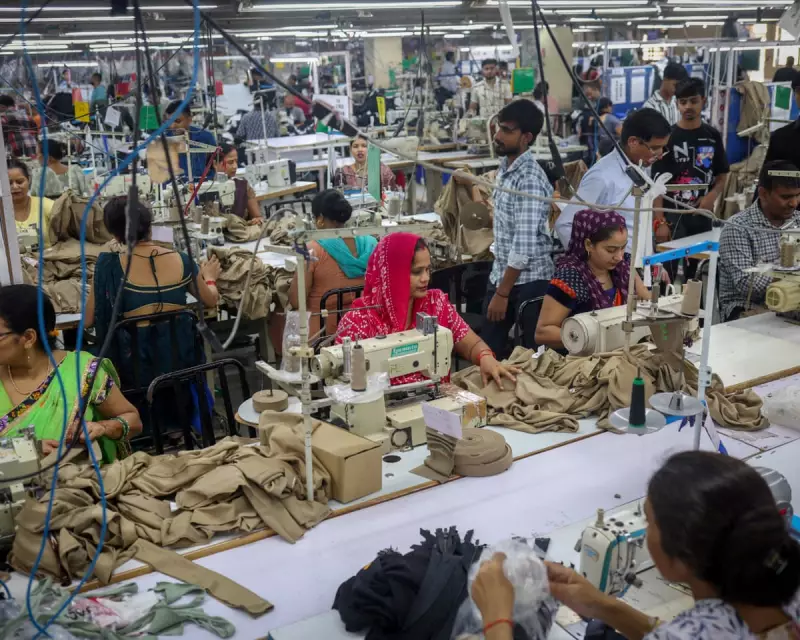
Climate Crisis Grips India's Fashion and Textile Heartlands
The clothing industry in India, a global manufacturing hub for fashion retailers, faces an existential threat from climate change that could disrupt supply chains worldwide. Researchers warn that rising temperatures, erratic rainfall patterns and severe water shortages are already causing significant damage across the entire textile production chain.
Environmental Pressures Mount on Production Hubs
In Uttar Pradesh and other key manufacturing regions, extreme heat and water scarcity are disrupting operations at multiple levels. The problems begin at the source, where cotton cultivation becomes increasingly challenging under changing climate conditions. This raw material shortage then cascades through small weaving clusters and ultimately affects major garment production facilities.
Nirbhay Rana, a sustainability researcher focusing on labour-intensive sectors like fashion, observes these impacts daily. "In India, rising heat, unpredictable rainfall and water scarcity already disrupt cotton cultivation, small weaving clusters and garment production hubs," he notes from his base in Gurugram.
The Climate Finance Inequality
The situation highlights a deeper injustice in global climate policy. Countries like India that contributed minimally to historical emissions now face expectations to adapt and decarbonise their industries while receiving negligible meaningful support. The gap between what developing nations require and what developed countries offer represents more than just financial shortfall - it reveals a structural inequality built into global development patterns.
Treating climate finance as loan-based obligations rather than shared responsibilities fundamentally undermines the concept of a just transition, experts argue. Debt cannot realistically serve as the pathway to climate resilience for the global south when these nations bear little responsibility for creating the crisis.
Data Gaps Compound the Problem
John Green from London highlights another critical dimension to this challenge, pointing to what George Monbiot describes as a "catastrophic black hole in our climate data." Vital information from outside the US and English-speaking nations often gets marginalised or ignored entirely, creating skewed understanding of global climate impacts.
This data bias means that local knowledge, experience and wisdom from regions most affected by climate change frequently gets lost. As artificial intelligence usage expands, this distortion could become even more pronounced unless corrective measures are implemented urgently.
A credible transition pathway requires fundamental changes to current approaches. Grant-based finance, accessible technology transfer and long-term partnerships that build local capacity must replace the current loan-driven model. Countries like India are already expanding renewable energy faster than historic emitters did during their industrial development, demonstrating commitment despite the challenges.
As Rana emphasises, this isn't about seeking charity but demanding fairness consistent with scientific evidence, historical responsibility and the Paris Agreement's principles. True climate ambition must finally rest upon the foundation of climate justice for all nations, regardless of their economic status or historical emissions.



