
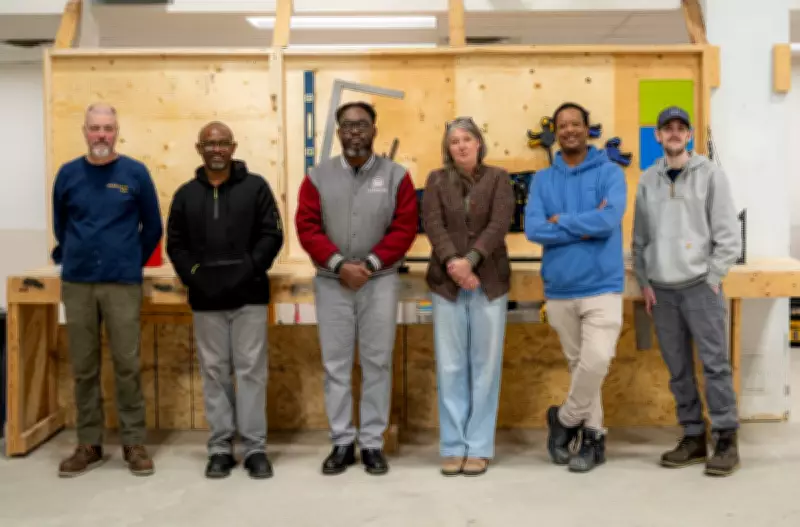
A Canadian social enterprise hopes to help solve the urgent need for retrofits and the shortage of skilled workers. The initiative, named Build, is launching in September by the Ottawa non-profit EnviroCentre. It aims to tackle two intersecting issues: the urgent need for retrofits in Canadian homes to combat the climate crisis and the shortage of skilled workers to do the job.
Background and Inspiration
John Mava was looking for work when a construction project started behind his house. Visiting the site, he saw how different construction was in Canada compared with his native Nigeria. In Canada, construction uses timber rather than bricks and focuses on the environment. This experience led him to apply to the YMCA’s Power of Trades programme, through which he became one of the first hires at Build.
The Need for Retrofits
Buildings are among the top five greenhouse gas emitters, according to the federal government’s most recent overview of Canada’s GHG emissions. The Canadian Climate Institute concluded that “Canada’s climate progress has been modest and is at risk of going in the wrong direction”. Melanie Johnston, a director at EnviroCentre responsible for Build’s launch, said: “We are seeing drastic reductions in GHG emissions by providing building envelope upgrades.”
Training and Inclusivity
Build’s goal is to provide training in insulation installation, air sealing, and other retrofitting skills for people who normally face barriers entering the industry, including women, Indigenous people, and newcomers to Canada, such as Mava. Retrofitting means upgrading a building to improve its energy performance, ranging from minor modifications like caulking to major ones like overhauling heating and cooling systems. Retrofits can also provide non-environmental benefits, such as household cost savings or improved indoor air quality. Johnston says they can also lead to “less visits to emergency rooms for asthma attacks or lost days at school or work”.
Industry Challenges
The Pembina Institute found that for Canada to achieve its goal of net zero emissions by 2050, about 600,000 homes will need to be retrofitted each year. Updated building codes mean new buildings produce lower emissions, but older ones require retrofitting, especially since 80% of the buildings that will exist in 2050 have already been constructed. Since 2017, vacancies in skilled trades in the residential construction sector have increased by an average of 11% annually. The impact of Covid-19, bias against blue-collar work, and Canada’s ageing population have aggravated the issue. According to Statistics Canada, more than 245,100 construction workers are projected to retire by 2032, leading to a shortage of more than 61,400 workers.
Build’s Approach
For the past few weeks, Build has been preparing for its September launch by training its first two mentees, Mava and Allan Kanobana. They have been learning the fundamentals of health and safety, PPE use, and other theories, while also getting their warehouse ready for opening. The warehouse is where mentees will learn practical skills, such as insulation and drywall installation and conducting pre- and post-retrofit home assessments. Most of their training will be in-house, but they also work with groups such as Toronto’s Building Up to share resources.
Kanobana moved to Canada from Rwanda in 2024, hoping to give his children a better education. He has a background in occupational health and safety and came to Build through the YMCA. Johnston said Build has been recruiting newcomers through programmes from the YMCA and the Ottawa Community Immigrant Services Organization. A common employment barrier faced by newcomers is a lack of Canadian work experience, and projects such as the YMCA’s Power of Trades help to bridge that gap.
Katie Sexton, a vice-president with the YMCA who oversees the Power of Trades programme, said: “We’re really about educating and making sure that the space is inclusive and ready as we’re bridging individuals into it.” The programme has an 84% employment rate after completion.
Creating a Welcoming Environment
The federal government says immigration is one solution to the worker shortage, but immigrants face barriers beyond a lack of training. “The construction industry is historically mostly male, white people,” said Johnston. “We have heard anecdotally through some of the trainees that the environment is not always welcoming.” That is why another goal for Build is to create a positive and welcoming space for mentees. “We’d like to be able to roll out a tool kit for employers to help them remove some of the older toxic behaviours that you might see in the construction environment,” said Johnston.
Future Plans
Build aims to take on two more mentees by the end of the year and to retrofit the homes of hundreds of clients in the Ottawa area, most of them people who are already familiar with EnviroCentre through their work in the affordable housing sector. Mava said the environmental impact of the work was central, citing a trip to Huntsville, Ontario, to see the retrofitting of a house where the owner told him he was doing it for his grandchildren. “He doesn’t want a situation where his kids will ask him: ‘What did you do about it?’” said Mava, referring to the climate crisis. “I don’t want my kids to ask me: ‘John, what did you do about this?’ With this, we’ll be able to reduce the emissions and then the kids will be happy in the future. I’ll be able to say: ‘Yes, this is my own contribution to it.’”



