
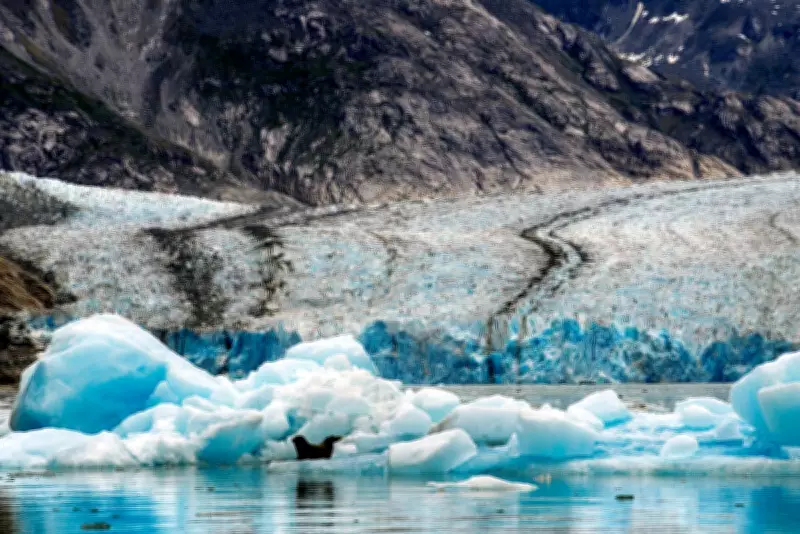
Alaska's 2025 mega tsunami in a fjord frequented by cruise ships serves as a stark warning of the growing risks from coastal rockslides and glacier retreat driven by the climate crisis, according to a new study.
World's Second-Tallest Tsunami Recorded
Scientists documented the world's second-tallest tsunami after it struck the Tracy Arm fjord in south-east Alaska last August. The wave reached 481 metres (1,578ft) in height, surpassing the Eiffel Tower's 330 metres (1,082ft). The event was triggered by a massive rockslide around the toe of a glacier.
Published in Science on Wednesday, the research led by Dan Shugar, a geomorphologist at the University of Calgary, details how the sequence began at 5:26am local time on 10 August 2025. A large landslide collapsed 1km vertically onto the South Sawyer glacier and into the narrow, 48km fjord, generating the enormous tsunami.
Narrow Miss for Cruise Ships
No fatalities occurred due to the early hour, but the area is visited by approximately three cruise ships daily, along with other vessels traveling within a few kilometres of the landslide site. Just hours after the landslide, a sightseeing vessel from Juneau and a National Geographic tour boat—each capable of carrying over 100 passengers—were scheduled to enter the fjord. The day before, two cruise ships carrying thousands of passengers had visited, with another expected the following day.
Dennis Staley from the US Geological Survey called the tsunami “a historic event,” adding: “I feel like we dodged a bullet.”
“With fjord regions increasingly visited by cruise ships, and climate change making similar events more likely, this unanticipated, near-miss event highlights the growing risk from landslides and tsunamis in coastal environments,” researchers said in their report.
Comparison with Historical Events
The tsunami was only slightly smaller than the world's tallest, recorded in Lituya Bay, Alaska, in 1958 at 530 metres (1,728ft). The Tracy Arm event also triggered a 36-hour seiche—a standing wave oscillating within a closed body of water. The landslide generated long-period seismic waves equivalent to a 5.4 magnitude earthquake.
Eyewitness Accounts
Eyewitnesses described far-reaching effects. Kayakers camping on Harbor Island, about 55km away, reported water surging past their tent, sweeping away a kayak and other gear. Another observer aboard a motor vessel in No Name Bay, roughly 50km from the landslide, saw a 2 to 2.5-metre wave cresting along the shoreline from Tracy Arm, followed by a second wave of about 1 metre.
Researchers found that landslide-generated tsunamis can have substantially higher runups than earthquake tsunamis due to larger, localized variations in water depth and direct water-column displacement by slope failure, especially in confined water bodies like fjords.
Climate Crisis Connection
Pointing to climate-driven glacier retreat, researchers noted that “without the rapid glacier retreat, the landslide would likely not have resulted in such a wave because it would have collapsed entirely onto glacier ice or might not even have occurred at all.”
In recent years, fjords with retreating tidewater glaciers have become increasingly popular cruise destinations. Annual cruise passenger numbers in Alaska rose from about 1 million in 2016 to 1.6 million in 2025. Combined with accelerating glacier retreat and permafrost degradation driven by the climate crisis, the risk of large-scale landslide-generated tsunamis is increasing across the Arctic.
Call for Risk Mitigation
Researchers emphasized the scale and potential reach of such events, calling for stronger risk mitigation measures. These include systematic monitoring of unstable slopes, more realistic tsunami-modeling scenarios, and enhanced protection for local communities, tourists, and critical infrastructure.
Several tsunamis have occurred in Alaska over the last decade. In 2024, a large landslide generated an 18 to 55-metre wave in Kenai Fjords National Park. In 2015, another landslide near a receding glacier in Taan Fjord caused a 193-metre tsunami. The 2025 event underscores the urgent need for preparedness as climate change continues to reshape Alaska's coastal landscapes.



