
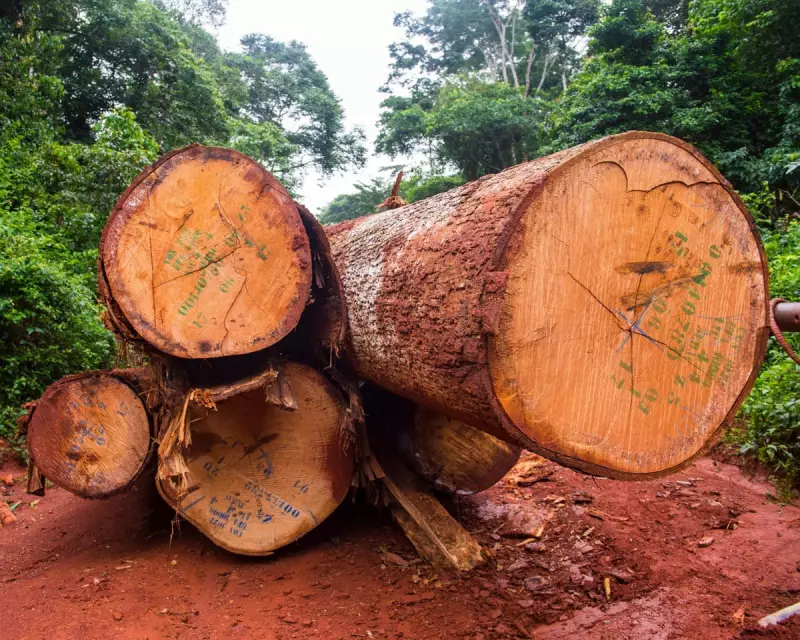
Critical Climate Shift: Africa's Forests Now Contributing to Atmospheric CO2
In a troubling development for global climate efforts, Africa's vast forests have transitioned from being carbon absorbers to carbon emitters, according to groundbreaking research. This alarming shift means all three of the world's major rainforest regions now contribute to climate breakdown rather than helping to mitigate it.
The study, published in Scientific Reports and led by researchers from the National Centre for Earth Observation at the Universities of Leicester, Sheffield and Edinburgh, reveals that this critical tipping point occurred around 2010. Since then, African forests have been releasing more carbon dioxide into the atmosphere than they absorb.
Quantifying the Damage: Staggering Biomass Loss
Scientists employed sophisticated satellite data and machine learning technology to track changes in carbon storage across African forests between 2007 and 2017. Their findings revealed that African forests lost approximately 106 billion kilograms of biomass annually during the 2010-2017 period.
To put this enormous figure into perspective, that's equivalent to the weight of about 106 million cars being removed from Earth's natural carbon storage system each year. The most severely affected areas included the tropical moist broadleaf forests in Democratic Republic of Congo, Madagascar and several west African nations.
Human Activity Drives the Destruction
The research identifies human activity as the primary driver behind this environmental crisis. Expanding agricultural land for food production represents a major cause of deforestation, while infrastructure projects and mining operations further exacerbate vegetation loss.
Compounding the problem, global heating caused by burning fossil fuels degrades ecosystem resilience, creating a vicious cycle of environmental degradation. The Congo basin, Earth's second-largest rainforest, appears particularly vulnerable to these combined pressures.
Professor Heiko Balzter, senior author and director of the Institute for Environmental Futures at the University of Leicester, emphasized the urgency of the situation. "Policymakers ought to respond by putting better safeguards in place to protect the world's tropical forests," he stated.
Global Response Falling Short
The research team points to Brazil's Tropical Forest Forever Facility (TFFF) as a potential solution. This initiative aims to mobilize more than $100 billion for forest protection by compensating countries for keeping their forests intact.
However, the current response has been inadequate. Only a handful of nations have committed approximately $6.5 billion to the TFFF so far, far short of what's required to make a meaningful impact.
Despite world leaders declaring their intention to end global deforestation by 2030 at COP26 in Glasgow four years ago, Professor Balzter notes that "progress is not being made fast enough." The TFFF offers a mechanism for governments and private investors to counteract deforestation drivers like mining and agricultural expansion, but requires significantly broader participation to be effective.
The transformation of Africa's forests from climate allies to climate contributors represents a critical warning about the fragility of Earth's natural carbon buffers. Without immediate, coordinated international action, we risk losing one of our most important defences against climate breakdown.



