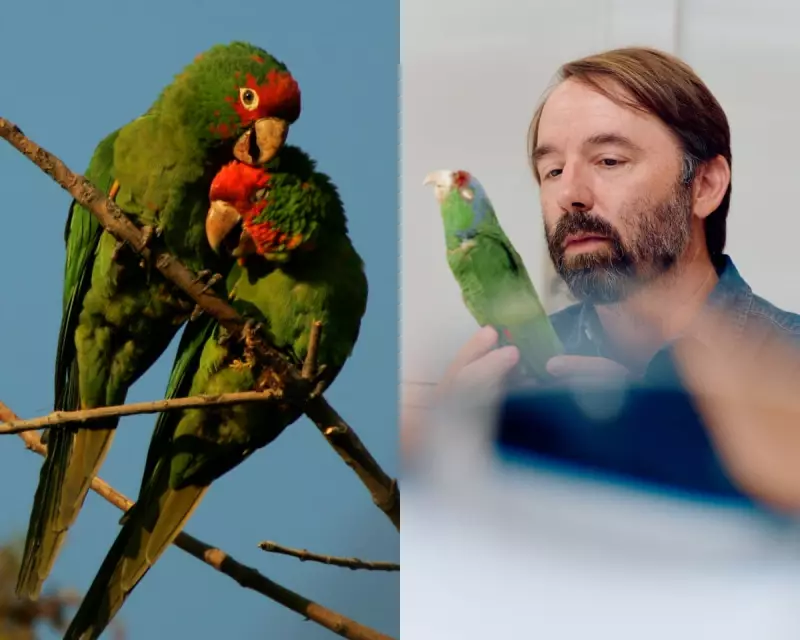
In the bustling urban landscape of Los Angeles county, an unexpected population of vibrant green parrots has established itself, creating a tropical spectacle amid the city's palm trees and traffic. These are not native birds, but descendants of pets imported during the peak of the exotic pet trade in the 1970s.
From Cage to Concrete Jungle
The story of how these parrots came to dominate parts of the LA skyline reads like urban legend. Originally imported from Mexico and South America and often sold to celebrities, their freedom came through various means - including tales of a pet store fire where firefighters released caged birds to save them from flames. In the decades since, these escapees have not just survived but thrived, adapting remarkably to city life.
Today, the feral parrot population numbers in the thousands, with red-crowned parrots being the most common species among several that now call Los Angeles home. The birds have become a familiar sight in neighbourhoods from Pasadena to Malibu, their loud squawks echoing through streets that are far from their native tropical habitats.

Scientific Mystery Unfolds
What began as an accidental introduction has become a subject of serious scientific study. John McCormack, director of the Moore zoology lab at Occidental College, initially dismissed the parrots as unworthy of scientific attention. That changed when a parrot collided with a library window at Occidental College in 2006, presenting researchers with an unexpected mystery.
The deceased bird showed characteristics of both red-crowned and lilac-crowned parrots - two species that would never encounter each other in their native Mexican habitats, separated by millions of years of evolution. This discovery prompted McCormack and his team, including research assistant Diego Blanco, to launch the Free-Flying Los Angeles Parrot Project (Flapp).
Using the Moore lab's extensive collection of Mexican bird specimens dating back a century, researchers can compare the genetics of current LA parrots with their ancestors. Genetic analyses of 40-50 birds have revealed significant hybridization between species that nature kept apart.
Conservation Implications
The success of Los Angeles's parrot population takes on added significance given their endangered status in their native Mexico. Habitat loss and illegal trapping have dramatically reduced their numbers in the wild, to the point where the population in Mexico is believed to be smaller than the one thriving in Los Angeles.
This surprising turn of events has led scientists to consider the urban parrot colonies as potential conservation assets. McCormack notes the fanciful idea that, should they ever go extinct in the wild, you might be able to repopulate them from the urban populations.
The parrots' adaptation to city life has been remarkable. They face few predators beyond occasional hawks and don't compete with native birds for food, subsisting mainly on imported ornamental plants. Their loud calls, evolved to carry across jungle canopies, prove equally effective in the urban environment.
Researchers like Janel Ortiz from Cal Poly Pomona are studying how the parrots select roosting sites, with theories suggesting they might use busy roads as protection against predators. Meanwhile, the Nanday parakeet population has adapted to feed on sycamore trees, similar to their native food sources in South America.
Despite challenges including habitat changes as LA's palm trees age and die, and occasional human threats like a 2023 incident where several birds were netted and killed, the parrot populations remain strong. Their addition to the California Bird Records Committee in 2021 represents formal recognition of their established presence.
For Angelenos, the parrots inspire both admiration and occasional frustration at their noisy presence. But as Diego Blanco observes while tracking them through Pasadena, they represent a little piece of the tropics that's being brought here, bringing with them the imagination of distant ecosystems now thriving unexpectedly in an urban setting.