
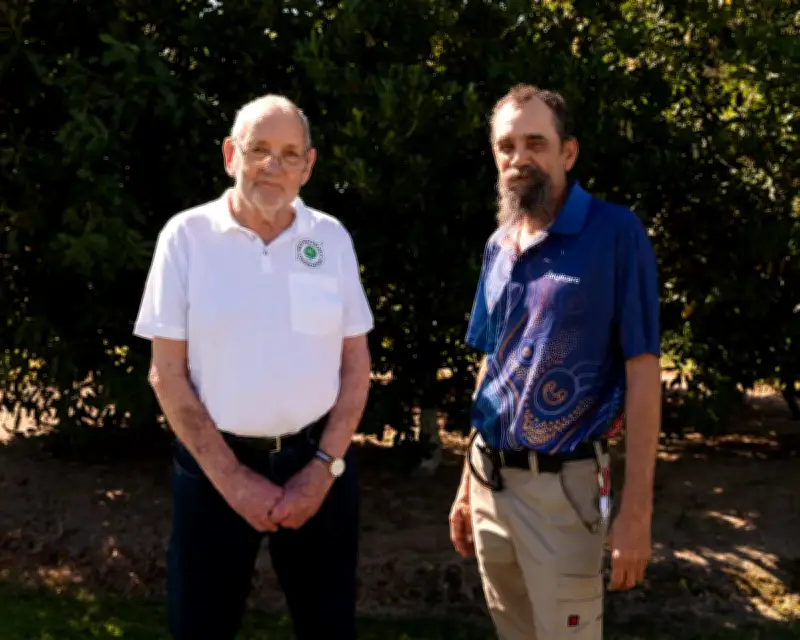
Deep in the rainforest at Mary’s Creek in Queensland, a group of wild nut hunters is searching for macadamia trees. These trees, the ancestors of the commercial macadamia grown worldwide, may hold the key to saving what Ian McConachie calls “the world’s finest nut.” The global macadamia industry is worth $2bn annually, but the crop is vulnerable due to limited genetic diversity.
The Search for Wild Macadamias
Ian McConachie, now 90, has devoted his life to macadamias. As a boy in Brisbane in the 1940s, he used to climb fences to steal nuts from backyards. He later spent 35 years in macadamia-related businesses, developed 20 orchards in Gympie and Bundaberg, and created a tree that has raised $2m in royalties for the Macadamia Conservation Trust.
McConachie and fellow conservationist Russell Bennet, a Kabi Kabi elder, regularly walk the remnant rainforests to find and document wild macadamias. Bennet, known for his spotting ability, says finding a new undocumented tree is “almost like finding gold.” The trees are cryptic, blending into the rainforest except when they flower in September.
Genetic Importance and Threats
Genetic testing shows that one tree, Macadamia integrifolia, is the genesis of 70% of commercial macadamia trees worldwide. There are four species total: M. tetraphylla is also grown commercially, while M. ternifolia and M. jansenii are wild and nearly inedible. Commercial cultivation began in Hawaii in the 1920s, but Australia did not start until the 1960s.
More than 80% of the habitat these trees evolved in over 120 million years is now remnant. M. jansenii is seriously endangered, with locations kept secret to protect it. The other three species are listed as threatened or vulnerable. An invasive creeper called cat’s claw is smothering trees, and storms have damaged others.
Conservation Efforts and Challenges
Denise Bond, executive director of Wild Macadamia Conservation, says cultivated trees have significantly less genetic diversity than wild ones, making the remaining wild trees “a genetic bank.” If a disease like root rot fungus hits commercial populations, wild trees could provide resistance. McConachie notes that “one of the very few things Australia has got going for it is the wild trees and their genetic potential.”
McConachie’s tree, named MCTI, has sold about 1.5 million trees and raised $2m in royalties, all gifted to Wild Macadamia Conservation. He says, “We can conserve DNA, but we can’t regenerate it. So one of the goals in the future will be to find out if we can store the genetics of the wild macadamias, so that they’re available for breeding for conservation.”
First Nations Australians have received little financial benefit from the nut’s global popularity. Bennet says the trees’ modest appearance “is their problem – they get dozed over.” The group remains passionate about conservation, with McConachie adding, “We’re probably all a bit eccentric, but we’re passionate about the need to conserve the wild genetics.”



