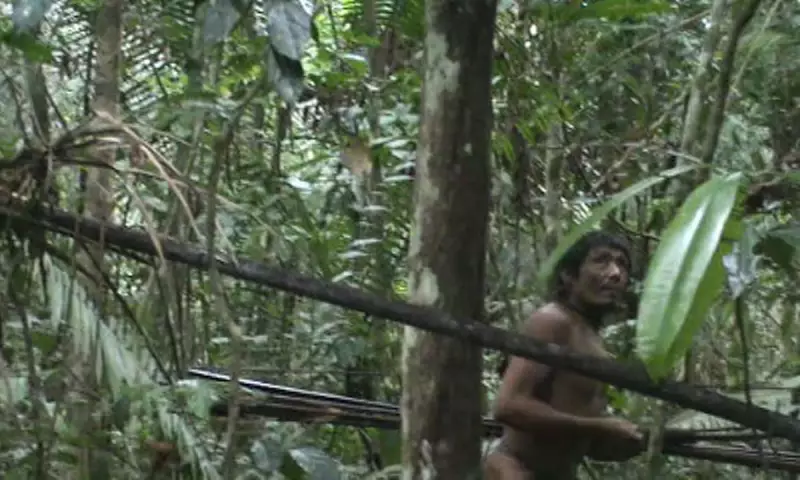
Deep in the southern reaches of the Brazilian Amazon, a race against time is unfolding. The Pardo River Kawahiva, an Indigenous community with no contact with the modern world, continue to wait for the legal protection of their ancestral lands, despite a ruling from Brazil's supreme court. Bureaucratic inertia, funding shortfalls, and violent land conflicts have left this vulnerable group exposed to the advancing threats of loggers and cattle ranchers.
Expedition Reveals Fragile Existence
In 2024, a dedicated team from Brazil's National Foundation for Indigenous Peoples (Funai) trekked over 60 miles through dense rainforest. Their mission was to monitor the elusive Kawahiva. The evidence they found was poignant and recent: a freshly woven leaf basket, a child's footprints by a creek, and trees hacked open for honey mere hours before. These traces, alongside decaying huts and old campfires, confirmed the community's fragile presence in a forest under siege.
This was no discovery for veteran Funai agent Jair Candor, who first confirmed the Kawahiva's location in 1999. A quarter of a century later, their proposed 400,000-hectare reserve—the largest unprotected forest area housing uncontacted people in Brazil—remains in legal limbo. "We are doing everything in our power to make sure that Kawahiva is demarcated in 2025," vowed Janete Carvalho, Funai's director of territorial protection, in an interview following the expedition.

Bureaucratic Delays and Mounting Threats
The contrast at the territory's edge is stark. Just beyond its undefined boundaries, forest has been razed for pasture, fences erected, and roads carved deeper into the wilderness. The physical demarcation—placing concrete markers along a 200-mile perimeter—is a critical step to deter invaders, yet it remains stalled.
Funding intended from compensation for a highway's environmental impact in Mato Grosso state never materialised. Funai has now turned to the Federal University of Minas Gerais (UFMG), stating fieldwork is scheduled for early 2026. However, anthropologist Elias Bigio of the Observatory of Isolated Indigenous Peoples (Opi) warns the delay may be political, not just technical. "We fear that this may not happen even next year," he said, noting that a change in government in 2026 could halt all demarcations, as seen under former President Jair Bolsonaro.
The region is dangerously volatile. In 2018, an armed group attacked a Funai base, resulting in a fatal shootout. Recently, a man calling himself "Chief Francisco," allegedly linked to loggers and facing charges including the attempted murder of Candor, was recorded threatening the agent and urging ranchers to reclaim the land.
A Constitutional and Humanitarian Crisis
The supreme court's directive was unequivocal, ordering the government to present a firm schedule for demarcation, recognising the "risk of genocide, food insecurity and acculturation." The petition was filed by APIB, Brazil's national Indigenous organisation. Their lawyer, Ricardo Terena, describes the process as "stalled," with the court awaiting compliance.
Advocates condemn the inaction as a life-threatening constitutional violation. "The delay in demarcation is not only illegal," says Priscilla Oliveira of Survival International, "it is also extremely dangerous and puts the lives of the isolated Kawahiva Indigenous people at risk." With every passing day, the loggers and ranchers close in, pushing one of the planet's most vulnerable cultures closer to the brink of eradication.