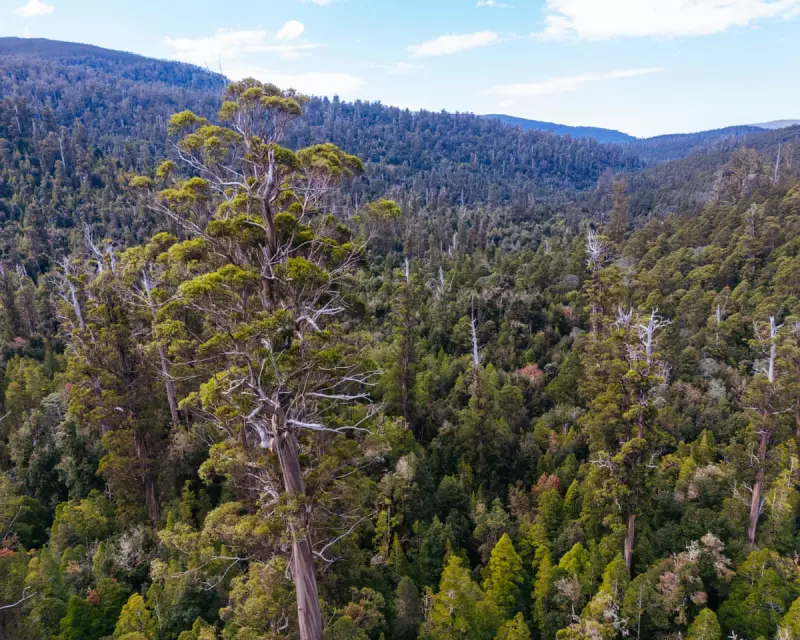
Australia's Forest Figures Concealing Environmental Damage, Study Reveals
Australia's official statistics showing increasing forest cover are masking the devastating reality of ongoing deforestation and its environmental consequences, according to groundbreaking new research.
A comprehensive analysis led by Griffith University's Climate Action Beacon has uncovered fundamental flaws in how Australia calculates forest coverage, suggesting the method obscures the true ecological impact of tree clearing.
The Accounting 'Sleight of Hand'
Australia employs a net forest cover calculation system where losses are offset against gains. However, the study reveals this approach fails to account for critical ecological differences between established forests and new growth areas.

Professor Brendan Mackey of Griffith University, one of the study's co-authors, described the current measurement system as an accounting trick. "We need to measure gross losses and gains, and collect much better information about what's been lost and the regeneration that's happened to assess whether we are meeting our global obligations to climate and ecosystems," he stated.
The research, commissioned and funded by the Australian Conservation Foundation (ACF), found that most forest destruction occurs in species-rich forests while regrowth predominantly happens in drier regions with sparse vegetation. These areas are not comparable in terms of carbon storage capacity or wildlife benefits.
Stark Environmental Consequences
The analysis estimates that clearing in intensive regions releases up to 120 times more greenhouse gas emissions per hectare than could be removed from the atmosphere through vegetation thickening in areas where most forest gains have been recorded.
According to the federal government's 2023 State of the Forests Report, Australia's total forest area increased by 0.75 million hectares between 2016 and 2021, continuing an upward trend observed since 2008.
However, the new research casts serious doubt on these figures, suggesting "there is considerable uncertainty about whether the reported net increase in forest area in Australia is real." The official dataset tends to overreact, frequently misclassifying areas as experiencing change when none has occurred.
Nathaniel Pelle of the ACF emphasised the gravity of the situation, particularly given Australia's potential role in hosting future climate talks. "No other rich countries in the world destroy forests like Australia does," he said from the Cop30 climate summit in Brazil.
Pelle noted the embarrassment of Australia's position as a prospective Cop president while taking minimal action on deforestation. "It's very important that, should we take the baton from Brazil and host the next Cop, that we do justice to the good work that Brazil has done," he added.
The findings highlight the urgent need for Australia to reassess its forest accounting methods, particularly as a signatory to the 2021 Glasgow leaders' declaration on forests and land use, which pledges to reverse forest loss and land degradation.