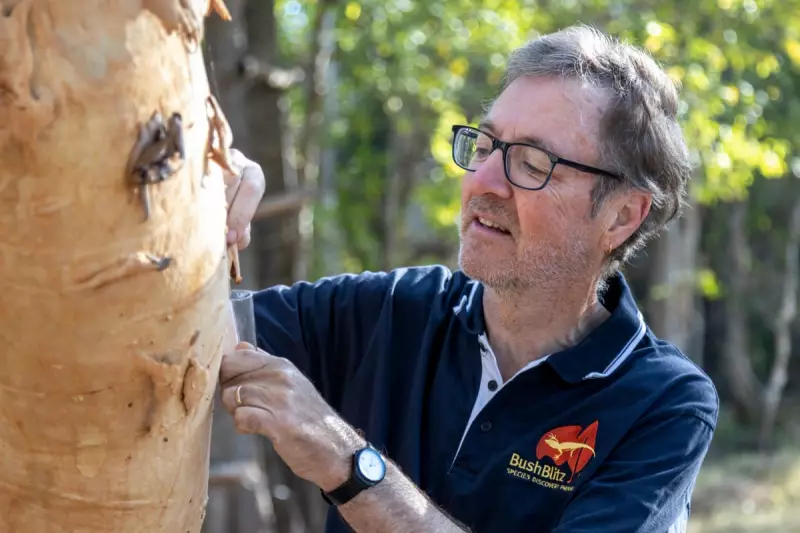
While the world mourned the death of Elvis Presley on 16 August 1977, an 18-year-old Australian named Mark Harvey was having a pivotal moment of his own. Under a rock in western Victoria, he found a tiny, ancient relative of the spider—a pseudoscorpion—and preserved it in a jar of ethanol. That specimen, still undescribed, marked the beginning of an extraordinary scientific journey.
A Taxonomic Milestone: 1,000 Species and Counting
This year, Dr Mark Harvey joined an elite global group of scientists by achieving a remarkable feat: he has formally described more than 1,000 new species. The official count recently stood at 1,015, but by the end of last week, it had already grown by two more. These latest additions, pseudoscorpions named Enigmachernes dissidens and Enigmachernes parnabyi, were discovered clinging to the fur of bats and published in the Australian Journal of Zoology.
Harvey, who spent most of his career as the curator of arachnids and myriapods at the Western Australian Museum in Perth, reached his thousandth species milestone in October. He co-authored a paper describing 24 new species of wishbone spiders. His prolific output spans arachnids like spiders, scorpions, and his beloved pseudoscorpions, as well as other invertebrates including millipedes and velvet worms.

His very first described species was the pseudoscorpion Geogarypus rhantus in 1981. "I was very excited about describing a whole new species. I thought I was king of the world," he recalls with a laugh. Harvey's memory for specimen details is legendary, though he humbly admits it took him until the 1990s to realise he had a particular gift for the meticulous science of taxonomy.
The 'Unquantifiable' Legacy of a Master Taxonomist
Taxonomy—the science of discovering, defining, and naming species—is a painstaking but critical discipline. "If you don't know what it is or where it occurs, you can't conserve it," Harvey emphasises, highlighting its fundamental role in biodiversity protection.
Colleagues are effusive in their praise. Dr Mike Rix, curator of arachnology at the Queensland Museum, has collaborated with Harvey for thirty years. "Describing more than 1,000 species is an enormous achievement," Rix states. "Mark is one of very few taxonomists in Australian history to have reached that milestone. He is undoubtedly one of the greatest taxonomists of his generation."
Rix adds that beyond the sheer volume of new species, Harvey's legacy as a mentor and leader in the field is "almost unquantifiable." This influence is reflected in the 45 species that other scientists have named in his honour.
A Lifelong Fascination with Nature's Details
Harvey's passion began in childhood, exploring a local creek in Melbourne and bringing creatures home, much to his mother's dismay. He attributes his skill to a good eye for detail and a talent for drawing, which is essential for illustrating anatomical features. "I can remember all the shapes," he says modestly.
His fascination with pseudoscorpions, of which he is the world's leading expert, stems from their complexity, ancient lineage—with fossils hundreds of millions of years old—and a peculiar trait: they can run faster backwards than forwards. "Me being an avid basketballer, I think that's a useful skill," he quips.
While he typically uses straightforward Latin names, Harvey occasionally indulges in more creative taxonomy. He named the short-tailed whip scorpion Draculoides bramstokeri because its pincers reminded him of Dracula's fangs and it was found in a cave.
A Race Against Time for Biodiversity
Now officially retired, Harvey views the future with concern. He is saddened by the decline of the invertebrates he loves, blaming habitat loss, climate change, and bushfires. "They are suffering and populations are dropping off here, there and everywhere," he says. "I am troubled by the legacy we are leaving for our children and grandchildren."
Yet, his work is far from over. With a backlog of perhaps thousands of collected but undescribed specimens and about ten manuscripts in progress—including one 400-page tome—he estimates he has another decade of productive work ahead. "Maybe I can describe a few hundred more?" he muses.

And that very first pseudoscorpion from 1977? It remains in its jar at the WA Museum, still awaiting its formal scientific description. Harvey believes it, too, is almost certainly a new species—a fitting symbol of the vast, hidden world of biodiversity that dedicated taxonomists like him continue to reveal.