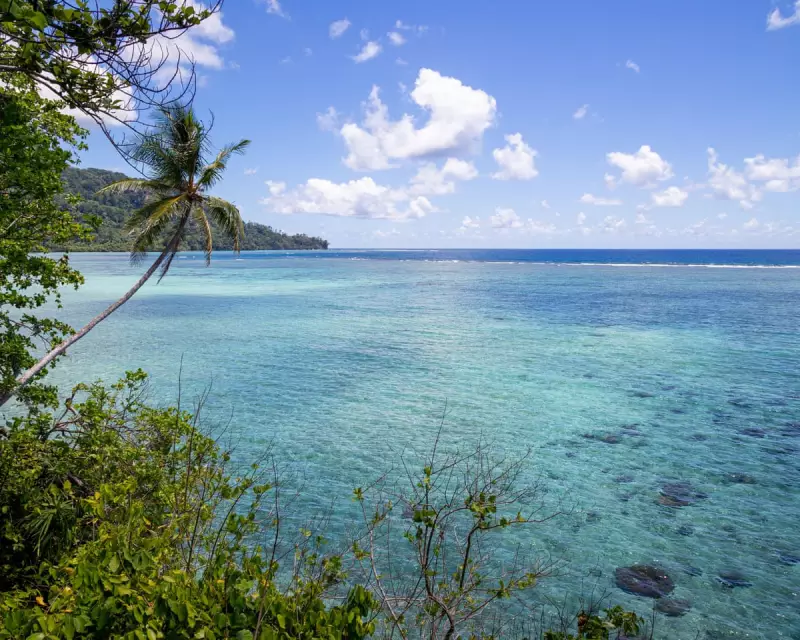
Respected ocean scientist Dr Katy Soapi has dedicated her life to protecting one of the Pacific's most precious natural treasures - Tetepare Island in Solomon Islands. Her journey from childhood ocean lover to internationally recognised conservation leader represents a powerful story of community resilience and environmental stewardship.
From Childhood Waters to Conservation Battle
Dr Soapi's deep connection to the marine environment began in her earliest years growing up on Rendova Island in western Solomon Islands. "I remember when the big waves came, we would dive under them and come up laughing on the other side," she recalls, describing how natural elements brought her profound joy during childhood.
Her academic journey took her from studying chemistry to researching medicinal plants across Fiji, Australia and the UK. She achieved the historic distinction of becoming the first woman from Solomon Islands to earn a PhD in natural sciences, yet her heart remained drawn back to the ocean that had shaped her childhood.

The Fight to Save Tetepare
The conservation battle began in the mid-1990s when commercial logging threatened to destroy Solomon Islands' forests. Soapi had witnessed firsthand the environmental devastation when Rendova fell to loggers' axes, watching crystal clear rivers turn brown with silt and forest sounds fade into silence.
When similar threats emerged for Tetepare, the situation felt profoundly different. The island held sacred status - known as 'tabu' - containing ancestral gardens, burial sites and deep cultural heritage. "To lose Tetepare would have been like losing part of ourselves," Soapi explains. "It wasn't just about trees any more, it was about identity and heritage."
As a university student, Soapi became a founding member of the Friends of Tetepare, which later evolved into the Tetepare Descendants' Association (TDA). The grassroots movement worked tirelessly, writing letters to decision-makers and connecting descendant groups across villages.
Soapi served as a crucial bridge between traditional knowledge and conservation science, recognising that both ancestral wisdom and scientific evidence were essential to demonstrate Tetepare's global significance.
Community-Led Conservation Success
The campaign gained international attention when an Australian documentary film crew arrived to document the struggle. Since the Company Came brought Tetepare's story to global audiences, reinforcing the importance of their conservation mission.
Their persistent efforts proved successful when no logging company received permission to operate on Tetepare. Today, the island remains one of Solomon Islands' last untouched wilderness areas, managed by the TDA with thousands of member descendants.
The conservation model integrates traditional knowledge with modern approaches:
- Community rangers patrol the island using both ancestral wisdom and scientific methods
- The Tetepare Eco Lodge provides sustainable tourism income supporting conservation work
- Annual gatherings enable collective decision-making among descendants
Despite these successes, challenges persist. TDA patron John Read notes that recent development proposals threaten forest areas bordering marine-protected zones. At the October annual general meeting, members expressed strong opposition to any logging, settlements or commercial extraction plans.
A Pacific Conservation Legacy
Dr Soapi's work has earned international recognition, with the TDA receiving the prestigious United Nations Equator Prize in 2012 for their community-led conservation model. "Tetepare taught us that conservation isn't just about protecting land," Soapi reflects. "It's about protecting who we are."
Elisabeth Holland, former professor of ocean and climate change at the University of the South Pacific, describes Soapi as a "talented Pacific scholar and a science rock star" whose leadership has created clear career paths for emerging scientists.

Now serving as partnerships coordinator at the Pacific Community Centre for Ocean Science, Soapi continues advocating for indigenous knowledge and community-led approaches. She remains humble about her role, stating: "I feel like I'm just one of many. The real work belongs to the Tetepare descendants. They are the true guardians of the island."
The Tetepare conservation story stands as a powerful example of Pacific-led environmental protection, demonstrating how cultural heritage and scientific conservation can work together to preserve irreplaceable natural treasures for future generations.