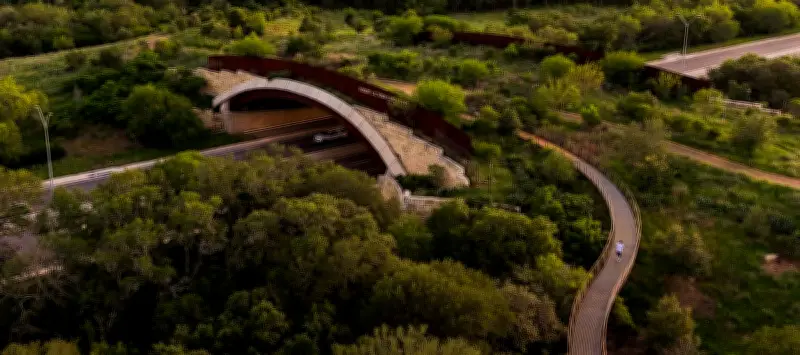
The Robert LB Tobin land bridge in San Antonio, Texas, spans a six-lane highway in Phil Hardberger Park, offering a safe crossing for wildlife including deer, coyotes, bobcats, and pedestrians. The 150ft-wide structure is part of a larger effort to restore endangered Texas prairie land, with only 1% of the original prairie remaining.
Park origins and vision
Phil Hardberger Park is named after the former mayor of San Antonio, who served from 2005 to 2009 and campaigned on improving public parks. 'My advisers had also told me that all of this talk about parks, beauty is soft stuff that will not get you any votes,' Hardberger said. 'But I felt deep down in my heart, as well as my political mind, that people were responding to that.' The park, built on a former dairy farm, features mature oak trees, including one 400 years old.
Design and conservation
The landscape architecture firms Stimson Studio and Rialto Studio preserved or restored 75% of the park's area to prairie land, with the remaining 25% for picnic areas, an urban ecology center, and parking. 'The balance is in favor of wildlife and nature,' said Lauren Stimson, a principal at Stimson Studio. Eight miles of trails wind through native plants like magenta Texas thistle and yellow creeping oxeye.

Addressing the highway barrier
A freeway built in the 2000s cut through the park, threatening biodiversity. Inspired by European wildlife crossings, Stimson Studio designed a land bridge that reads as a natural extension of the park. To ensure accessibility, entry points extend deeper into the park, with winding elevated walkways maintaining an ADA-compliant 5% grade. At its midsection, the bridge is 150ft wide, with pedestrian areas pushed to one side and buffered by a steep berm and plantings to avoid disturbing wildlife.
Wildlife and human use
Eight-foot-tall steel walls on the bridge block views of the highway and shield animals from headlights and noise. The land bridge is slightly warmer than the rest of the park due to building materials like stone and metal, which collect and radiate heat, and because young plants produce less evapotranspiration than the established oak savanna. Circular cutouts provide airflow. The bridge opened in 2020; within six months, wildlife biologists had spotted coyotes, deer, bobcats, and small mammals crossing it.
Ecological connectivity
Viewing sheds near the bridge offer quiet, shaded resting areas, adorned by local artists like Ashley Mireles. Migratory birds, including the Nashville warbler, pass through the park, with more than 180 species counted. 'Connectivity is an extremely important part of ecology,' says Gregory Tuzzolo, an associate principal at Stimson Studio. 'You can make a conservation area over here and a park over there, but if wildlife can't pass from one area to another, we still have a degraded landscape. And so being able to really have this signature piece and this park means so much to this landscape.'