New Aggressive Lizard Morph Puts Ancient Italian Color Variations at Risk of Extinction
In the sun-drenched landscapes of Italy, a dramatic evolutionary shift is unfolding that threatens to erase millions of years of biodiversity. Researchers have discovered that the arrival of a new, more aggressive color morph of the common wall lizard (Podarcis muralis) could drive three ancient color variations—white, yellow, and orange—toward extinction. This development underscores the critical importance of understanding biodiversity within species, not just between them, as it reveals how delicate natural balances can be disrupted over short timescales.
The Delicate Balance of Color Morphs in Italy
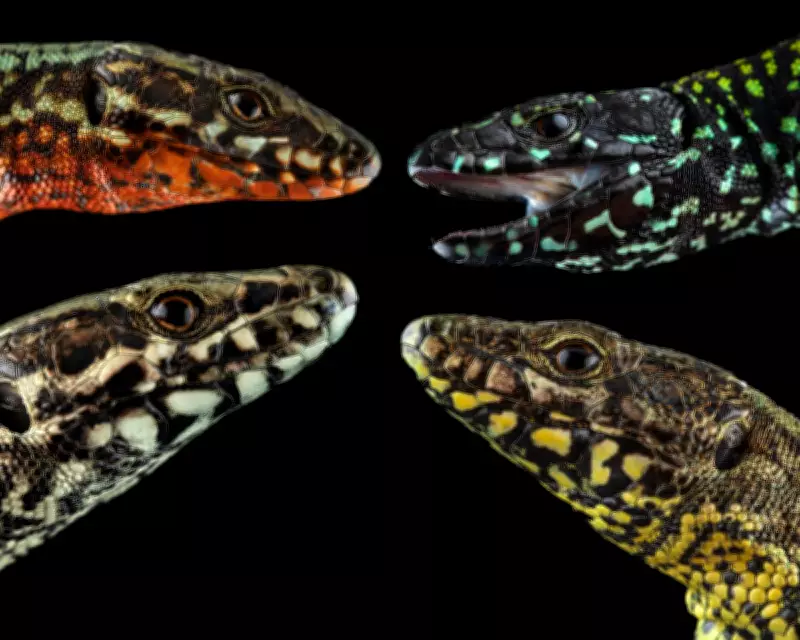
For millennia, three distinct color morphs of the common wall lizard have coexisted in Italy in a complex equilibrium maintained through social and sexual interactions. Some males display brown bodies with pale, almost white, throats and bellies, while others exhibit yellow undersides, and a third group showcases bright orange or reddish hues. These variations are not merely aesthetic; they represent a crucial dimension of biodiversity, offering insights into how species adapt and evolve. However, a recent study published in Science warns that this ancient balance is now under threat.
The study, led by Prof Tobias Uller of Lund University in Sweden, involved an international team that measured the coloration of 2,506 lizards across 148 locations in Italy. Their findings reveal the emergence of a fourth morph, known as nigriventris, characterized by a bulkier form, bright green dorsal color over a pitch-black reticulation, and heightened aggression. This new morph likely originated on ancient islands in the Rome basin during the Pliocene and Pleistocene epochs and is now spreading, skewing competition among males and leaving the original three morphs struggling to persist.
Implications for Biodiversity and Evolution
Biodiversity within species extends far beyond appearance, encompassing genetic, behavioral, and morphological variations that shape what a species is and what it might become. Dr Nathalie Feiner of the Max Planck Institute, a co-author of the study, emphasizes that without such variation, evolution would stall, and the capacity for adaptation would be lost. Understanding and preventing the erosion of this diversity is at the very core of conservation biology, as it provides a reservoir of traits that help populations face present and future challenges to survival and reproduction.
The case of the common wall lizard illustrates how the emergence of new traits can rapidly alter natural processes that have maintained diversity for millions of years. As Uller notes, "We are seeing how the coexistence of different color morphs—something that has been stable for millions of years—is being lost over a very short evolutionary timescale." This shift not only threatens the lizards themselves but also offers a broader lesson on the fragility of intraspecific biodiversity in the face of environmental changes.
Human Pressures and Conservation Efforts
Human activities are exacerbating these threats, as seen in the plight of the Aeolian wall lizard (Podarcis raffonei), one of Europe's most endangered vertebrates. Inhabiting small islets in the Aeolian archipelago north of Sicily, these lizards display distinctive colors ranging from pale brown to emerald green. However, habitat degradation, invasive black rats, and the introduction of the Italian wall lizard (Podarcis siculus) have pushed them toward extinction. Research shows that Aeolian wall lizards perform poorly in encounters with invasive species, leading to reduced reproductive opportunities and territorial monopolization by invaders.
In response, the Life Eolizard conservation project was launched in 2023, combining habitat restoration, rat control, and the removal of invasive lizards. Scientists have also initiated captive breeding programs at Rome's Bioparco zoological centre, using genomic data to maximize genetic diversity. Dr Daniele Salvi of the University of L'Aquila reports that in 2025, the first 64 captive-born juveniles were produced, aiming to reintroduce them into restored island ecosystems. Dr Leonardo Vignoli of Roma Tre University, coordinator of Eolizard, highlights that creating sanctuaries on islets like Lisca Bianca and Bottaro is a turning point for the species, reshaping its distribution and improving long-term survival chances.
The Broader Significance of Intraspecific Diversity
Diversity within species contributes significantly to ecosystem functioning and represents an often-overlooked layer of biodiversity. Uller reflects that understanding why wall lizards have such an extraordinary capacity to generate diversity brings us closer to comprehending why nature operates as it does. This research not only sheds light on the specific challenges facing Italian lizards but also underscores the urgent need to protect intraspecific variation globally. As human pressures mount, conserving this hidden dimension of biodiversity becomes ever more critical for maintaining resilient ecosystems and ensuring species' adaptability in a changing world.