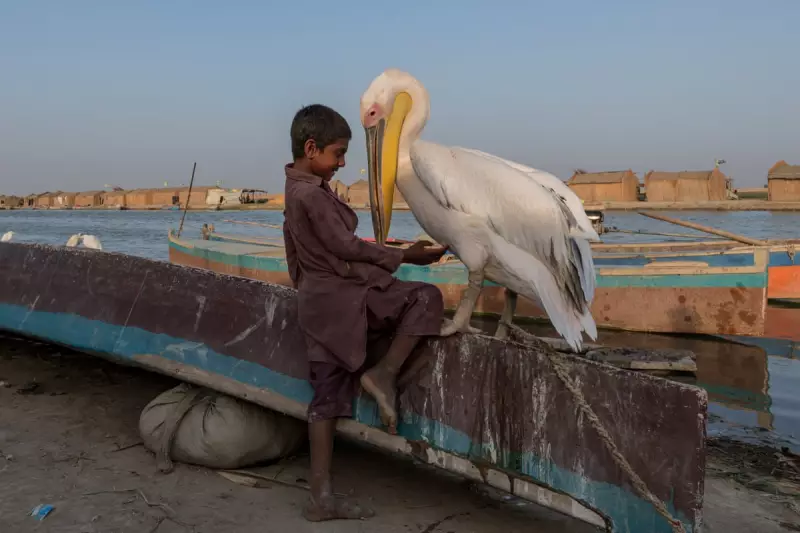
At the edge of Lake Manchar in Pakistan's Sindh province, the gentle sound of water lapping against boats masks an environmental catastrophe unfolding beneath the surface. The Mohana people, who have lived on these waters for generations, watch helplessly as their world slowly disappears.
The Lords of the Lake
Bashir Ahmed navigates his slender boat with practiced ease, the bamboo pole scraping against the muddy canal bottom. This fragile craft represents more than transportation—it embodies the heritage of the Mohana, a community whose existence has always been dictated by the rhythm of water.
Mohamed, Bashir's father and leader of their 50-strong community, remembers better times. "We were the lords of the lake," he recalls, sitting in the shade. "This water was full of fish. Our boats were our homes. We thought they would never sink. But look now—the lake has turned to poison."

The Poison Flows In
The source of this poisoning can be traced to a specific channel: the Right Bank Outfall Drain (RBOD). Constructed in the 1990s, this canal was intended to make western Sindh's salty soils suitable for farming. Instead, it became a conduit for agricultural runoff laden with fertilisers and pesticides, combined with industrial waste and sewage from multiple cities, all flowing directly into Lake Manchar.
The environmental impact has been devastating. Within decades, the lake's salinity skyrocketed while oxygen levels plummeted. Algae blooms proliferated, and the delicate ecosystem collapsed. Climate change has accelerated this disaster, with reduced rainfall and two upstream dams on the River Indus significantly diminishing freshwater flow.
The statistics tell a grim story. Where more than 200 fish species thrived in the 1930s, only 32 remained by 1998. Today, about a dozen more have vanished completely. The Sindh Fisheries Department documents a catastrophic decline in catches—from over 3,000 tonnes in 1950 to just 300 tonnes in 1994, and now less than 100 tonnes annually.
A Way of Life Washed Away
Bashir represents a generation caught between traditions. Born on a houseboat as part of a floating village that no longer exists, he was forced to settle on dry land twenty years ago when fishing could no longer sustain their aquatic lifestyle.
"For us, leaving the lake was like asking the birds to stop flying," says Ali Kasghar, one of the last Mohana who continues to hunt birds using ancient techniques. "The birds taught us so much. Like them, we lived on the water. Like them, we drank from the lake. And like them, we fed ourselves on the fish it gave."
The demographic shift has been dramatic. Once, more than 20,000 Mohana lived in floating homes across Lake Manchar. Today, only about 40 such homes remain, housing fewer than 500 people. Their numbers continue to dwindle as the water grows increasingly toxic.
Ancient Hunting Traditions
Kasghar preserves one of the Mohana's most distinctive traditions—bird hunting using methods passed down through generations. He moves slowly across the lake's surface, guided by a live bird tethered to a slender branch. This feathered decoy allows him to approach other birds undetected until the final moment when he captures them with lightning speed.
Some hunters employ an even more remarkable technique: submerged up to their necks, they fix stuffed birds to their heads as camouflage. Deceived by the decoy, unsuspecting birds approach closely enough to be caught.
The captured birds serve multiple purposes—sold at nearby markets, used for family meals, or kept as pets and future hunting decoys. This symbiotic relationship with birds has defined Mohana culture for centuries, but now faces extinction.
The Disappearing Flyway
Lake Manchar was once a crucial stopover on the Indus flyway, hosting tens of thousands of migratory birds from Siberia and central Asia. Recent counts by the Sindh Wildlife Department reveal a disturbing trend: migratory bird numbers across the province have more than halved in just two years.
The statistics are alarming: from 1.2 million birds in 2023 to 603,900 in 2024, and just 545,000 this year. Drought, shrinking wetlands, and relentless pollution are systematically destroying the habitats these migratory species depend on.

Kasghar voices the community's deepest fear: "It is partly thanks to the birds that we still survive here, around Manchar. When they disappear for good, I fear we may disappear with them."
As the Mohana watch both their livelihood and their cultural traditions vanish alongside the lake's biodiversity, their story serves as a stark warning about the interconnectedness of human communities and their natural environments. The collapse of Lake Manchar represents not just an ecological disaster, but the erasure of an entire way of life.