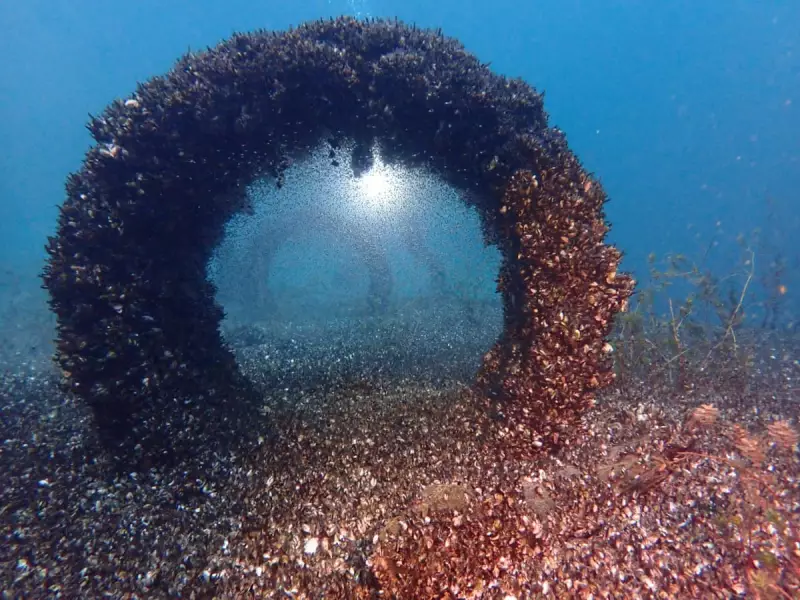
Like a silent, spreading plaque, an invasive mollusc is wreaking havoc in the heart of Europe, with scientists warning the UK is now on the front line. The quagga mussel, a tiny but devastating creature, has transformed Switzerland's iconic Lake Geneva in under a decade and was detected for the first time in Northern Ireland this week.
An 'Open Invasion' Clogging Critical Infrastructure
The Swiss Federal Institute of Technology in Lausanne (EPFL) became an unwitting battleground. In just a couple of years, quagga mussels infiltrated the 5km network of pipes that draws cold water from 75 metres deep in Lake Geneva to cool the university's buildings. By 2022, the blockage was so severe that the power of some heat exchangers had dropped by a third, causing air conditioning to fail and indoor temperatures to soar above 26°C.
"It's an open invasion," stated Mathurin Dupanier, utilities operations manager at EPFL. The crisis extended beyond comfort, threatening the university's data centres, long-running scientific experiments, and even the Tokamak nuclear fusion reactor, which risks melting without constant cooling. "Research is one of the things we do; if it stops, then the school closes," Dupanier emphasised.

A Lake Transformed Beyond Recognition
From the surface, Lake Geneva appears unchanged, but beneath the waves lies an ecological revolution. Professor Bastiaan Ibelings of the University of Geneva describes a lake floor now resembling "a meadow of quaggas." Chains hauled from the depths emerge completely encrusted, with native snails and shrimp vanished. The mussels have colonised record depths of 250 metres, surviving in near-zero oxygen conditions where almost nothing else can live.
"It is too late for this lake," Ibelings declared. Research confirms the staggering scale: a 2024 survey found quagga mussels constituted 100% of samples, with densities reaching over 35,000 per square metre in places. The biomass now rivals that of North America's Great Lakes, which the species invaded in 1989.
Global Threat Reaches UK Shores
Originating in the Ponto-Caspian region, quaggas have spread globally via shipping. Their discovery in Northern Ireland prompted Environment Minister Andrew Muir to call for "increased vigilance and surveillance." The potential impact is severe, mirroring the US where they dominate ecosystems and have triggered fish population collapses.
Each mussel filters up to two litres of water daily, stripping out the phytoplankton that forms the base of the aquatic food chain. This clarity allows light and warmth to penetrate deeper, potentially increasing toxic algal blooms. The livelihoods of 120 professional fishers on Lake Geneva are now at risk.
For EPFL, the only solution is a new, closed-loop cooling system, with construction not starting until 2027—a race against time. For the lakes themselves, there is no cure. "Going back is a fairytale," says Ibelings, citing the combined forces of quagga mussels and climate change. "We need to accept... this is a different lake, now." The urgent lesson for the UK is clear: prevention through biosecurity is the only viable defence.