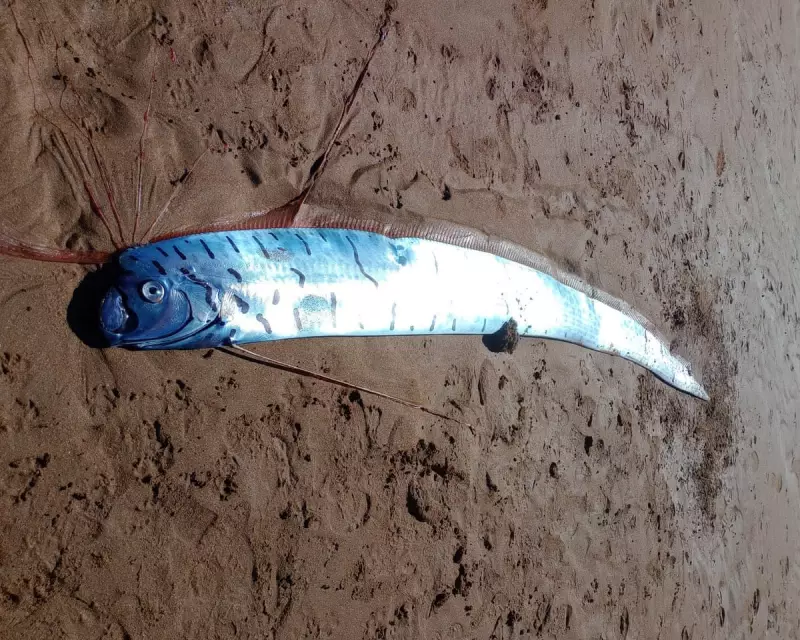
A spectacular and rare deep-sea creature, traditionally seen as a portent of catastrophe, has been discovered on a beach in north-west Tasmania, sparking both wonder and the debunking of a long-held myth.
A Serpentine Surprise on a Sunny Day
The discovery was made on a beautiful, warm Friday morning at Preservation Bay in the seaside town of Penguin. Local resident Tony Cheesman was walking his two dogs, Ronan and Custard, when he spotted a silvery, massive fish surrounded by gulls.
"When I got to it, I saw this massive fish, then I noticed the beautiful colours, and it had these long fans coming out of its chin and the top of its head," Cheesman recounted. "I'd never seen anything like it."

The Science Behind the 'Sea Serpent'
Professor Culum Brown, a fish expert from Macquarie University, identified the three-metre specimen as a giant oarfish. He described them as "very unusual looking fish" that are "super long and skinny, kind of like a ribbon, and they have a continuous dorsal fin."
These enigmatic creatures can grow to a staggering eight or nine metres in length. However, they inhabit the deep ocean, living at depths of 200 to 1,500 metres, and are only seen at the surface when they are sick or dying, making any sighting an extraordinary event.
Folklore, Fear, and Fact
In Japanese folklore, the oarfish is known as ryūgū-no-tsukai, or "the sea god's palace messenger." Its appearance was historically believed to be a harbinger of imminent disaster, such as an earthquake or a tsunami.
However, science has cast doubt on this ominous reputation. One study found no link between oarfish sightings and subsequent disasters. As Professor Brown succinctly put it, "Oarfish just rock up at random. We don't know very much about them. So any specimen that washes up is really valuable."
Associate Professor David Waldron, a historian at Federation University, explained that these rare appearances also fuelled myths about sea serpents in the 18th and 19th centuries. One Australian newspaper in 1878 even reported a "supposed sea serpent" at Penguin, Tasmania, with an engraving that closely resembled an oarfish.
Waldron added that the oarfish's legendary appeal is similar to other mysterious deep-sea denizens like the giant squid, describing it as a "very spectacular looking fish."
As for whether this particular oarfish was a sign of impending doom, the discoverer, Tony Cheesman, remained sceptical. "It was too nice a day for that," he said.