Bonobos Demonstrate Imaginative Abilities in Scientific Breakthrough
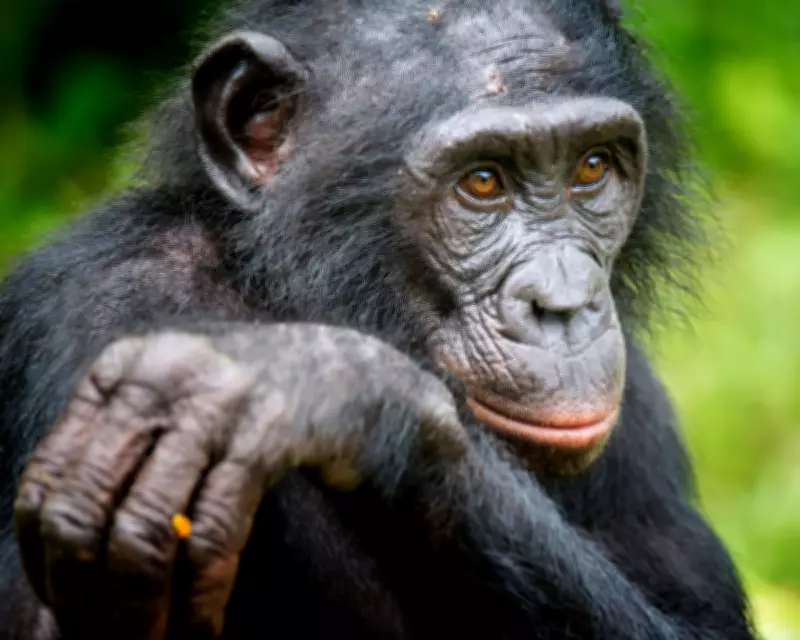
New research has provided the first rigorous experimental evidence that apes possess a form of imaginative thinking, challenging long-held assumptions about the uniqueness of human cognition. The study, conducted with a bonobo named Kanzi, reveals these primates can engage in make-believe scenarios much like human children.
Experimental Evidence of Pretend Play
While anecdotal reports of apes using imaginary objects have existed for years, scientists have now conducted controlled experiments that demonstrate this ability beyond reasonable doubt. The research team from the University of St Andrews and Johns Hopkins University worked with Kanzi, a bonobo who has since passed away at age 44, to test his capacity for imaginative thinking.
The experimental design was carefully structured to eliminate alternative explanations. Researchers first trained Kanzi to point to containers filled with juice, then presented him with pretend scenarios involving imaginary liquids. In one key experiment, they showed Kanzi two empty transparent cups and pretended to fill them using an empty jug.

Kanzi's Remarkable Performance
The results were striking. When researchers pretended to pour imaginary juice into both cups, then tipped the contents of one back into the jug, Kanzi correctly identified which cup remained "full" in 34 out of 50 trials. This performance significantly exceeded what would be expected from random chance.
"This shows that animals are capable of understanding pretence in a controlled experimental setting, which hadn't been done before," explained Dr Amalia Bastos, the study's first author from the University of St Andrews.
Importantly, Kanzi received no rewards for correct answers during these tests, eliminating the possibility that he was simply learning to mimic human movements for treats. This suggests genuine comprehension of the pretend scenarios.
Distinguishing Real from Imaginary
Further experiments demonstrated Kanzi's sophisticated understanding. When presented with one cup containing real juice and another empty cup, researchers pretended to fill the empty cup. Kanzi consistently chose the cup with actual liquid in 14 out of 18 trials, showing he could distinguish between tangible and imaginary substances.
In a third test, Kanzi successfully identified the location of an imaginary grape placed in one of two transparent containers, further confirming his ability to track pretend objects through imagined scenarios.
Evolutionary Implications
The findings have significant implications for our understanding of cognitive evolution. The researchers suggest this ability likely dates back to our common ancestor with bonobos, placing its origins somewhere between six and nine million years ago.
"Because we share this ability with bonobos, we could reasonably expect that this sort of dates back to our common ancestor," said Dr Bastos, highlighting the deep evolutionary roots of imaginative thinking.
Scientific Community Response
Professor Zanna Clay of Durham University, who was not involved in the research, praised the study while noting areas for further investigation. "The study provides a first rigorous experimental test that apes have a form of imaginative thinking," she said.
Clay added that given bonobos' advanced cognitive abilities and complex social environments, "what's then striking is why people should be amazed that our closest living relatives can do something we can do too." She suggested it would be more surprising to find this ability in more distantly related species with different social and cognitive structures.
Limitations and Future Research
The researchers acknowledge that Kanzi had unique rearing and learning experiences, having been trained to communicate with humans. They note it remains unclear whether their findings would apply to apes without similar training backgrounds.
Nevertheless, the study represents a significant breakthrough in animal cognition research. The team concludes that "our findings suggest that the capacity for representing pretend objects is not uniquely human," opening new avenues for understanding the evolution of imagination across species.

This research challenges traditional boundaries between human and animal cognition while providing concrete experimental evidence for imaginative thinking in our closest primate relatives.