
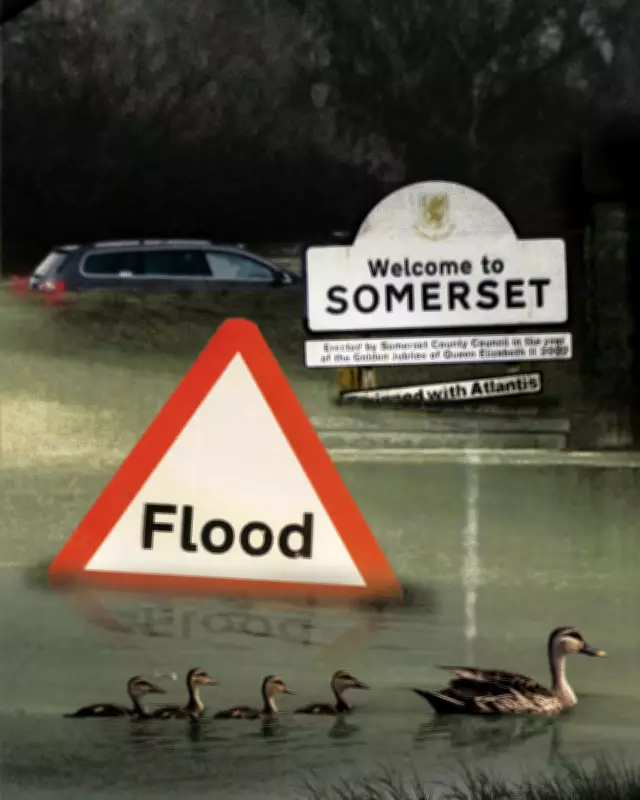
Climate Crisis Accelerates UK Flood Risk: Winter Rains Arrive 20 Years Early
The relentless barrage of Atlantic storms that has battered southwest England throughout January has exposed the accelerating reality of climate change impacts across Britain. Storm Chandra, which pummelled the region this week, followed closely behind Storms Goretti and Ingrid, creating a perfect storm of saturated soils and supercharged rivers that has left communities reeling.
Rapid Escalation of Flooding Events
Rebecca Horsington, chair of the Flooding on the Levels Action Group and lifelong Somerset resident, witnessed a dramatic acceleration in flooding patterns. "When flooding hit the low-lying Somerset Levels in 2014, it took two months for the waters to rise," she explained. "This week it took just two days. The stress and anxiety is palpable in our community. Since 2014, weather events are becoming more frequent and the rain just dumps now."
Scientists confirm this represents the face of climate crisis in Britain today, with devastating impacts accelerating faster than protective measures can be implemented. Professor Hayley Fowler, a climate change impacts expert at Newcastle University, revealed alarming findings: "We're already experiencing changes in UK winter rainfall that climate models predicted for the 2040s – we're 20 years ahead of schedule."
Scientific Evidence of Accelerated Change
The physics behind this acceleration is straightforward yet alarming. Warmer air holds more water vapour, resulting in heavier downpours that are becoming increasingly intense. Professor Fowler quantified the scale: "The extra water falling in the UK each year now equals approximately three million Olympic-sized swimming pools. This means ground saturation is more widespread and flooding becomes more likely."
Met Office data supports these observations, indicating storms are now 20% more intense than previous decades. Professor Fowler attributes this directly to human activity: "It's directly attributable to fossil fuel burning and greenhouse gas concentrations. This will continue worsening until we stop emissions."
Community Impacts and Infrastructure Strain
Across southwest England, the human cost is mounting daily. Somerset Council declared a major incident on Tuesday as homes and businesses flooded, communities became isolated, schools closed, trains cancelled, and emergency services rescued dozens from stranded vehicles.
Bryony Sadler, a hairdresser from Moorland village on the Somerset Levels, was preparing to evacuate her family and animals as waters rose. "These events are getting more frequent and more serious," she reported. "The rain is heavier and more intense, the winds stronger. We don't get anywhere near the help we need."
Funding Gaps and Protection Shortfalls
Despite serving on the Climate Change Committee's adaptation subcommittee, Professor Fowler expressed concern about "the widening gap between action we're taking and impacts we're feeling." She noted that while flooding represents one of Britain's better-managed climate risks, "given the actual impacts we're feeling almost every week now, that's slightly horrifying."
Dr Martina Egedušević, a flooding scientist at the University of Exeter and independent member of the Environment Agency's South West Regional Flood Committee, highlighted systemic issues: "We're still funding flood protection like climate change is a future problem, but for southwest communities it's already here. Funding is often short-term and reactive, with maintenance particularly underfunded."
Infrastructure Overwhelmed by New Realities
The changing nature of rainfall presents new challenges beyond traditional flood zones. Dr Egedušević explained: "Flash floods now overwhelm drainage systems, meaning areas historically not classed as flood-prone are experiencing flooding. Drainage systems are frequently outdated and not designed for today's rainfall extremes."
James Wade from Taunton experienced this firsthand when his home flooded for the first time in thirteen years due to blocked drains. "Even during the huge floods of 2014 we were dry," he recalled, highlighting how changing patterns are catching communities off guard.
Systemic Challenges and Future Uncertainties
Bill Revans, leader of Somerset Council, described the practical challenges: "We've only got so much money. As soon as you clean a drain out, it starts filling again. I'd love to maintain drains to high standards, but that's not the situation local councils are in."
Environment Agency data reveals the scale of the challenge: due to funding shortfalls, properties to be better protected from flooding by 2027 were cut by 40% in 2025, while 500 of 2,000 new flood defence projects were abandoned entirely.
Broader Implications and Existential Questions
The crisis extends beyond southwest England, with Environment Agency estimates suggesting 6.3 million properties in England face flood risk, rising to 8 million by 2050. Wales, Scotland and Northern Ireland face similar challenges.
Dr Egedušević placed Britain's experience in European context: "Everyone across Europe is failing to keep pace with climate changes. We're entering an era where we must learn to live with these impacts rather than fighting them completely."
In Somerset, this reality prompts difficult conversations. Mike Stanton, chair of the Somerset Rivers Authority, contemplated: "It may be that in the next 50 years, perhaps in the next 20, some homes around here will have to be abandoned."
Council leader Bill Revans reflected on the human dimension: "It's a beautiful, tight-knit community here. Everyone's really friendly and supportive. They don't deserve this. I would fight tooth and nail to keep communities viable, but ultimately it's a question of whether we're prepared to spend resources keeping them dry every winter."
As communities across Britain face increasingly frequent and severe flooding events, the gap between climate impacts and protective measures continues to widen, raising fundamental questions about long-term resilience and the future viability of flood-prone settlements.



