
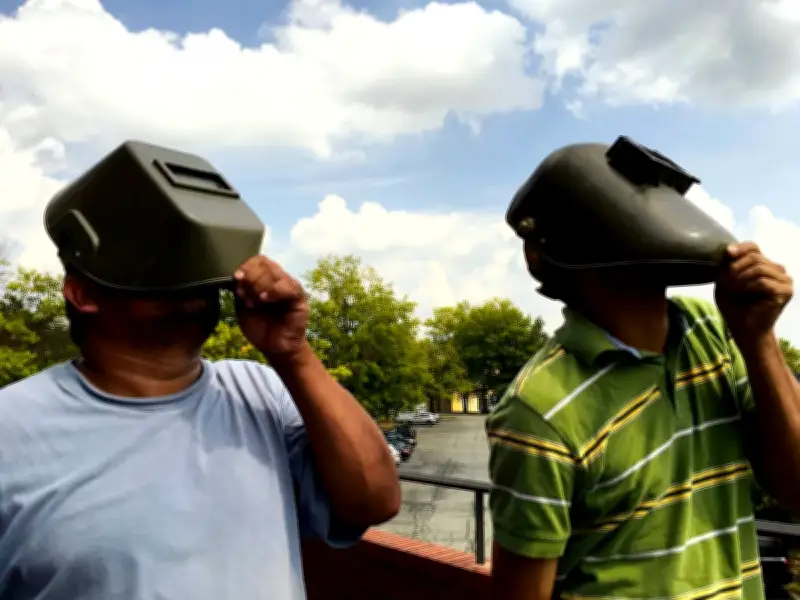
Londoners preparing for tonight's rare partial solar eclipse (Wednesday, August 12) are being urged to use only certified eye protection, as welding masks are safe only if they have a shade rating of 12 or higher. With eclipse glasses sold out across the capital and online orders no longer possible, many are considering alternatives, but experts warn that most welding helmets do not offer adequate protection.
Eclipse Coverage and Risks
The eclipse is the most significant the UK has witnessed since 1999, with around 90 per cent of the sun obscured across different regions. While the South West will see the greatest coverage, Londoners will still experience a deep and impressive partial eclipse. Viewing the eclipse safely is essential, as looking directly at the sun during an eclipse is more dangerous than it appears.
Because the sun seems dimmer than usual, the body's natural reflex to look away is suppressed, allowing intense solar radiation to reach the retina without any sensation of pain. Following the 1999 total solar eclipse, the Royal College of Ophthalmologists reported around 70 cases of vision problems after incorrect viewing, with around 40 per cent having looked at the sun for less than a minute.
Welding Mask Safety: Shade 12 or Higher
According to NASA, welding goggles or helmets can be used to view a solar eclipse safely, but only if the lens has a shade rating of 12 or higher. The US space agency states: "The only ones that are safe for direct viewing of the Sun with your eyes are those of Shade 12 or higher. These are much darker than the filters used for most kinds of welding."
Most standard welding helmets used for everyday tasks have a shade rating well below 12, meaning they would not provide adequate protection. NASA warns: "If you have an old welder's helmet around the house and are thinking of using it to view the Sun, make sure you know the filter's shade number. If it's less than 12 (and it probably is), don't even think about using it to look at the Sun."
Shade 13 lenses are uncommon and hard to find, while shade 14 can make the sun appear too dim. Shade 12 is therefore the most practical option, though NASA notes many people still find the sun too bright even at this level. If you have a welding helmet at home, check the shade number printed on the lens or in the product documentation before using it. If you cannot verify the shade rating with certainty, do not use it.
Why Sunglasses Are Unsafe and Safe Alternatives
No matter how dark your sunglasses are, they do not offer adequate protection for viewing a solar eclipse. They are designed to reduce glare, not block intense solar radiation that can damage the retina. Wearing them during an eclipse may actually make things worse, as reduced brightness makes it feel comfortable to look at the sun for longer while harmful radiation continues to pass through. Never use regular sunglasses to look at the sun during an eclipse.
If you have not been able to get eclipse glasses or a suitable welding mask, there are other safe indirect viewing methods that require no specialist equipment. The simplest is a DIY pinhole projector: make a small hole of approximately 1mm in a piece of card, hold it above a white sheet of paper or card on the ground, and allow sunlight to pass through the hole, projecting the sun's image. The greater the distance between the card and the paper, the larger the projected image. You are not looking at the sun directly, making this method completely safe.
You can also project the sun's image through a household item with holes such as a colander or grater, or look at the dappled light passing through gaps between tree leaves onto the ground. Both methods produce a natural projection of the sun's shape. For those who would rather not venture out, the Royal Observatory in Greenwich will be streaming the eclipse live online, offering a free broadcast of the spectacle from London.
Whatever method you choose, plan ahead to safely enjoy this remarkable astronomical event. The next solar eclipse of comparable significance visible from the UK is not expected until 2090, making this a genuinely once-in-a-lifetime opportunity for most Londoners.



