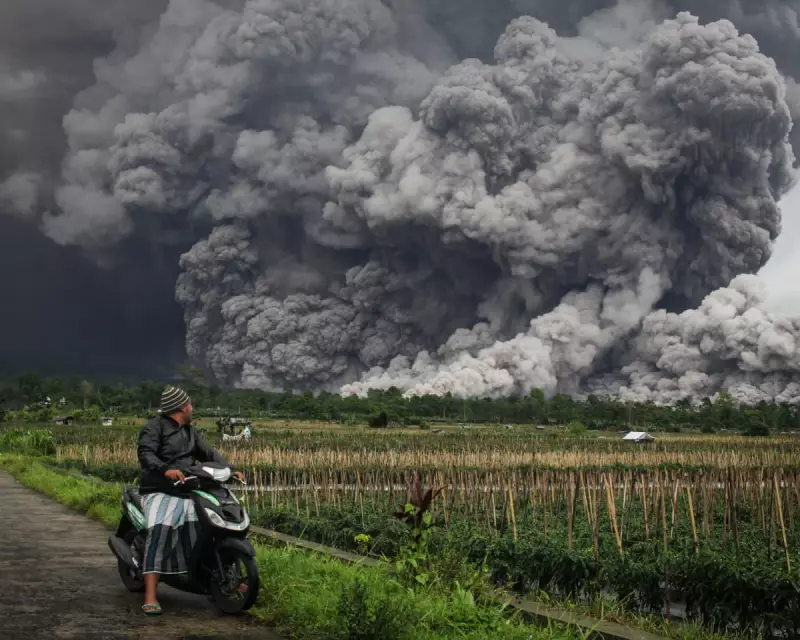
Indonesia's highest volcano, Mount Semeru on Java island, has violently erupted, catapulting the nation into a state of high alert and triggering urgent evacuations for local residents.
Eruption Details and Escalating Danger
According to the country's Geology Agency, the eruption began on Wednesday afternoon. Mount Semeru unleashed searing clouds of hot ash, rock, and gas that cascaded up to 7 kilometres down its slopes multiple times from midday until dusk. A massive column of hot clouds was seen rising an estimated 2 kilometres into the sky above East Java.
The sustained volcanic activity forced authorities to take decisive action. The volcano's alert level was raised twice in a single day, moving from the third-highest level directly to the highest possible level as the situation deteriorated.

Immediate Evacuations and Rescue Efforts
In response to the escalating threat, the National Disaster Mitigation Agency swiftly coordinated evacuations. Agency spokesperson Abdul Muhari confirmed that more than 300 residents from the three most vulnerable villages in Lumajang district have been relocated to government shelters for their safety.
The danger zone around the crater was expanded to a radius of 8 kilometres. Officials issued specific warnings for people to avoid the area along the Besuk Kobokan river, which serves as the primary path for the volcano's deadly lava flow.
A separate rescue operation is underway for a group stranded on the mountain. An official from the Bromo-Tengger-Semeru National Park (TNBTS) reported that approximately 178 people, including 137 climbers, are currently safe at the Ranu Kumbolo monitoring post. TNBTS spokesperson Endrip Wahyutama assured the public that the post is situated 4.5 kilometres from the crater on the northern slope, away from the south-southeast path of the hot cloud flow. However, bad weather has forced the group to remain there overnight.
Historical Context and Regional Volatility
This is not the first time Semeru, also known as Mahameru, has demonstrated its power. The volcano has experienced numerous eruptions over the past two centuries. The last major eruption in December 2021 proved devastating, claiming 51 lives, burning hundreds, and forcing over 10,000 people to evacuate. Following that disaster, the government relocated nearly 3,000 houses from the most hazardous areas.
Despite the ever-present danger, tens of thousands of people continue to live on the volcano's fertile slopes, a common pattern across Indonesia. The archipelago nation, home to more than 280 million people, sits on the volatile Pacific 'Ring of Fire', a horseshoe-shaped zone of intense seismic and volcanic activity, making it prone to such geological events.