
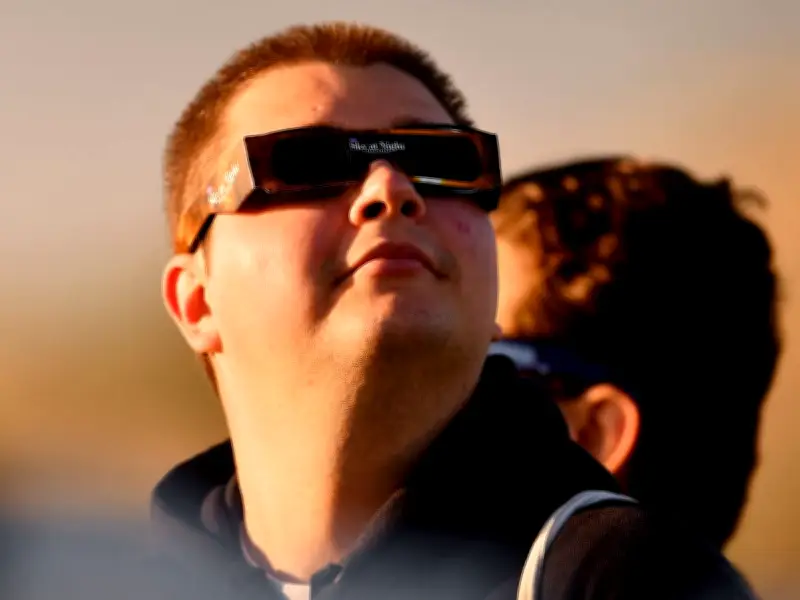
London is set to witness its most significant solar eclipse since 1999 on Wednesday, August 12, 2026, with the Moon covering up to 96% of the Sun. The Royal Greenwich Observatory confirmed that between 90 and 96 per cent of the Sun will be obscured, making it the starkest such event in over two decades. While viewers in parts of Greenland, Iceland, and northern Spain will see a total eclipse, Londoners will experience a deep partial eclipse that will noticeably darken the sky.
Exact timings for the eclipse in London
The eclipse will begin in London at 6:17pm, when the Moon first makes contact with the Sun's edge, an event astronomers call 'first contact'. Over the following hour, the Moon will gradually slide across the Sun, reaching its maximum coverage of roughly 90 per cent at 7:12pm. At this peak, daylight will dim to resemble dusk or dawn, and temperatures will drop noticeably. The eclipse will conclude at 8:06pm, nearly two hours after it started.
According to the Royal Greenwich Observatory, the alignment of the new Moon and Sun will be visible throughout the late afternoon, with the two bodies moving closer together in the sky as the evening progresses. Spectators are advised to find a location with an unobstructed view to the west-southwest, where the Sun will be positioned during the event.
Safe viewing methods: avoid eye damage
While the Sun will appear dimmer during the eclipse, health experts warn that this reduced brightness can be deceptive. The natural reflex to look away is weakened, allowing intense sunlight to reach and damage the retina without causing immediate pain. During the 1999 total solar eclipse, which was visible in Devon and Cornwall, around 70 people reported vision problems, with 40 per cent of them having looked at the Sun for less than a minute, according to the Royal College of Ophthalmologists.
Ordinary sunglasses are not safe for eclipse viewing. They reduce glare, which may make it more comfortable to stare at the Sun for longer, but they do not block the harmful radiation that can burn the retina. The only safe direct-viewing method is to use specialist eclipse glasses or handheld solar viewers that meet international safety standards (ISO 12312-2). These are available from reputable retailers, but be cautious of cheap online products that may not provide adequate protection.
For those without eclipse glasses, indirect viewing methods are recommended. A simple pinhole projector can be made at home by poking a small hole in a piece of card and projecting the Sun's image onto a sheet of paper. Alternatively, a colander can be used to project multiple images of the crescent Sun onto the ground. These methods allow you to observe the eclipse without looking directly at the Sun.
How a solar eclipse differs from a lunar eclipse
Both solar and lunar eclipses occur during 'eclipse seasons', which happen twice a year when the Earth's orbit brings it closest to the Sun. These seasons last 31 to 37 days. During this period, if a new Moon occurs, its shadow can fall on Earth, creating a solar eclipse. If a full Moon occurs, it can pass into Earth's shadow, causing a lunar eclipse.
However, not every new or full Moon results in an eclipse. The Moon orbits Earth at an angle of about five degrees, so most of the time, the new Moon passes above or below the Sun from our perspective. Only when the Moon's trajectory aligns with Earth's orbital plane do eclipses occur. When this happens, a solar eclipse is followed two weeks later by a lunar eclipse, as the Moon moves to the opposite side of Earth.
Upcoming lunar eclipse: August 28, 2026
A partial lunar eclipse will follow on Friday, August 28, 2026. It will begin at 3:33am, peak at 5:12am when 90 per cent of the Moon is in Earth's shadow, and end as the Moon sets at approximately 6:15am. Because it occurs close to dawn, the Moon will be low on the horizon, so a high vantage point with a clear view to the southwest will be essential for the best observation.
During the peak, the Moon will appear dark red, earning the nickname 'blood moon'. This happens because Earth's atmosphere scatters blue light, allowing only red light to reach the Moon's surface. Unlike a solar eclipse, a lunar eclipse is safe to view with the naked eye, no special glasses are needed.



