
The city of Toledo approved a three-year $846,000 contract with Flock Group Inc in November 2025, $282,000 annually. But roadside safety advocates say some automated license plate readers may not meet highway safety standards.
Potential Roadside Hazards
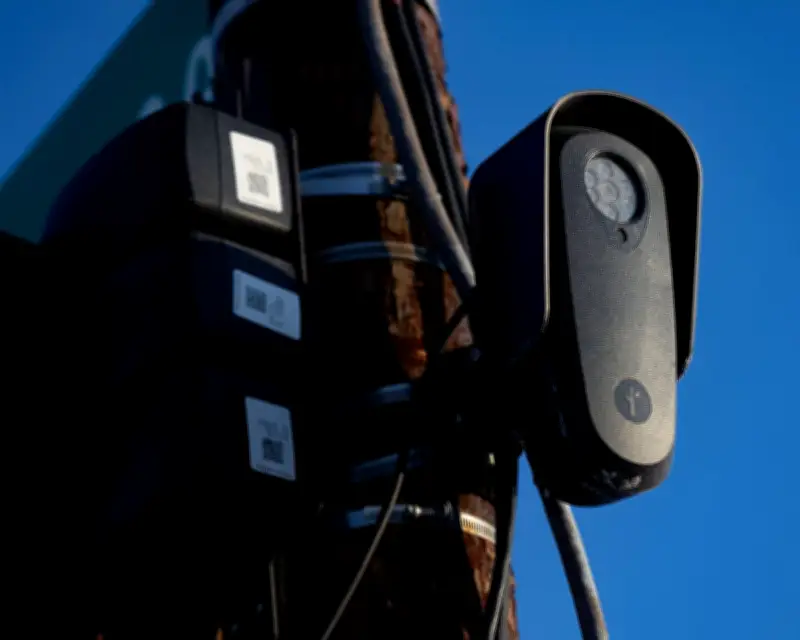
Flock Safety cameras have been criticized for AI-powered surveillance and targeting immigrants. Now, safety advocates claim their physical location poses roadside hazards. At the bottom of a tree-lined hill on a narrow, two-lane rural road in Greene county, Ohio, stands a black metal rod with a camera and solar panel. The camera, an automated license plate reader (ALPR), is owned by Flock Safety and is painted black, making it difficult to see.
The metal rod has no breakaway plate—a safety feature that allows the pole to snap upon collision, reducing impact. It also lacks stickers indicating safety inspection and is placed about two feet from the edge of the asphalt. According to the Ohio Department of Transportation (ODOT), license plate readers must be at least 8 feet from the nearest edge of a travel lane on uncurbed facilities.
Flock's Responsibility and Deployment
The Beavercreek police department, Flock's customer in this case, says Flock is responsible for all installations and that all cameras received appropriate approval. ALPRs record license plate details, vehicle make, model, color, and other features. Flock has an estimated 80,000 to 100,000 cameras deployed in over 6,000 communities across the US. Flock told the Guardian it would not share exact numbers or locations.
Advocate's Findings
Tennessee-based Steve Eimers, known as the Guardrail Guy, has documented this issue. After his 17-year-old daughter died in a crash into a roadside structure a decade ago, Eimers tours the country highlighting safety failures. His videos have garnered millions of views. He says, “There are a billion different people looking into the top part of the cameras, but nobody’s been looking at the bottom, and the crashworthy elements.”
In 2024, crashes between a motor vehicle and a fixed barrier accounted for 26% of vehicle deaths nationwide, according to the National Safety Council. The Federal Highway Administration requires all roadside sign supports in the clear zone to be breakaway, yielding, or shielded.
Regulatory Oversight
David Rose of ODOT says permits are required for work within ODOT’s right-of-way, including ALPR installation. However, ODOT is not involved in ALPR installation even on state right-of-way. All work within corporation limits must be approved by the appropriate city or village.
Eimers has only found one Flock pole, in Erie county, Ohio, with a breakaway plate, but it was positioned higher than permitted, potentially causing a low-lying vehicle to catch the pole and ignite a fire. He says, “Flock is not a sophisticated user of roadside safety hardware. They are nowhere near doing what they are supposed to be, what should be done.”
Company Response
Flock and police departments say cameras are effective crime reduction tools, recovering stolen property and missing persons. Flock spokesperson Paris Lewbel says, “We do not agree with the premise that Flock regularly installs poles in violation of federal, state, or local safety requirements.” The company plans to review camera pole installations across its network. Customers generally determine locations based on public safety priorities.
ALPR companies like Motorola Solutions and Redflex Traffic Systems also reportedly fail to meet roadside structure requirements. In urban areas, Flock cameras are often attached to traffic lights, reducing crash risk, but in suburban and rural areas with higher speeds, they are standalone structures. Eimers warns that black, non-reflective poles can be difficult to see at night, and a metal pipe can act like a spear. He says, “We know that a lot of people leave the road, so we want a forgiving roadside.”



