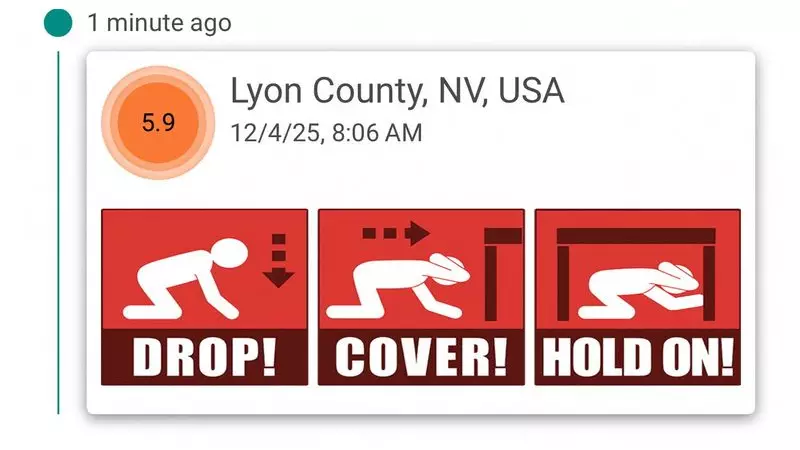
A widespread earthquake alert urging residents to "drop, cover, and hold on" was sent to mobile phones across parts of the western United States on Thursday, only for authorities to later confirm it was a complete false alarm.
What the Bogus Alert Said
The alert, distributed via systems like the MyShake app, warned of a significant 5.9-magnitude earthquake striking near Dayton, Nevada. The notification reached people as far away as the San Francisco Bay Area, approximately 180 miles from the reported epicentre.
However, the shaking never materialised. Multiple law enforcement agencies in the vicinity of the supposed epicentre quickly reported no signs of tremors or any damage. A seismic event of magnitude 5.9 typically causes pronounced shaking and can result in minor property damage, making the erroneous alert particularly alarming for those who received it.
A First for the Seismic Warning System
Seismologists indicated this appears to be an unprecedented error for the automated public alert system. Yaareb Altaweel of the National Earthquake Information Center in Colorado stated, "To my knowledge we've never had a false alert like this."
He clarified that while the system has previously issued corrections for exaggerated magnitude or depth details, a completely bogus event notification is a novel occurrence. Angie Lux from the Berkeley Seismological Laboratory echoed this, confirming she had never heard of a fully false alert being disseminated before.
Searching for the Cause: 'Noisy Triggers'
The precise cause of the malfunction remains under investigation. Experts suspect the automated system may have been triggered by anomalous signals known as "noisy triggers." These can originate from human-made sources such as large explosions, major construction work, or even the movement of very large vehicles.
Natural phenomena like powerful ocean waves or intense wind can also occasionally generate seismic noise that might confuse sensitive detection algorithms. The incident has prompted a review of the system's filters to prevent a similar false alarm in the future.
In related seismic news, the UK experienced a genuine, albeit smaller, tremor this week. The British Geological Survey (BGS) reported a 3.3-magnitude earthquake in northwest England, which was felt across parts of the South Lakes and Lancashire, mainly within a 20km radius of the epicentre, including in Kendal and Ulverston.