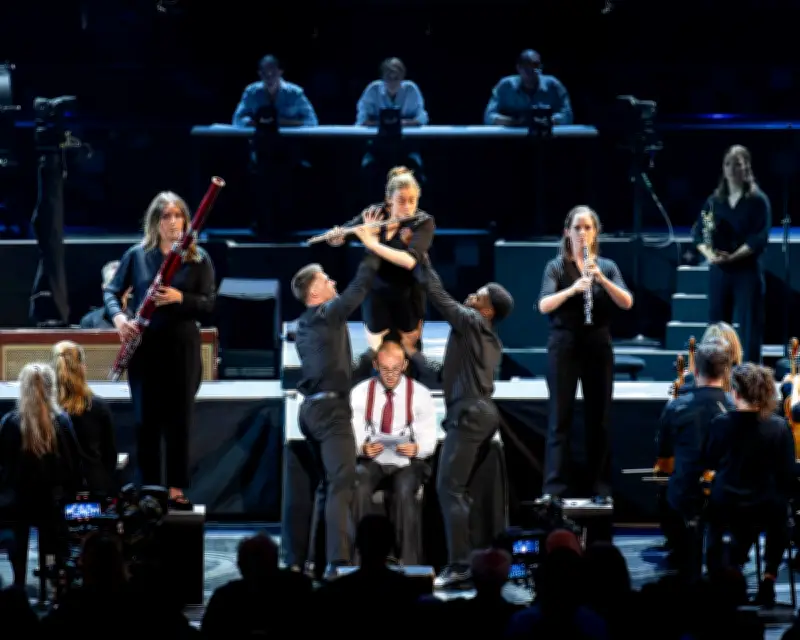
Aurora Orchestra will perform Mahler's First Symphony from memory at the BBC Proms on 1 and 2 August 2026, accompanied by a new play about Sigmund Freud and the composer's emotional journey. Artistic director and flautist Jane Mitchell describes the process as akin to skydiving without a parachute, but in a good way.
From Mozart to Mahler: a decade of memory feats
In 2014, Aurora Orchestra made history at the Proms by performing Mozart's 40th Symphony from memory. Bassoonist Amy Harman likened the experience to skydiving without a parachute. Twelve years later, the orchestra is tackling Mahler's First Symphony, a piece nearly twice as long as the Mozart and requiring over double the musicians. The first half of the concert will feature a play written by Mitchell, incorporating choreography for the entire orchestra, two actors, and complex sound design.
The evolution of orchestral theatre
After the Mozart success, the orchestra's memory performances became a regular feature. Three years ago, they took on Stravinsky's The Rite of Spring, dedicating the entire concert to a single piece. The first half introduced the work through a combination of text, musical analysis, orchestral excerpts, choreography, and video projection, featuring actors Charlotte Ritchie and Karl Queensborough. This format continued with Beethoven's Ninth Symphony and Shostakovich's Fifth, evolving into what Mitchell calls 'orchestral theatre.'

Research and rehearsal: the making of the play
Mitchell's creative process begins with reading. For Mahler, she delved into the composer's words, which reveal an artist constantly analysing his own emotions. Mahler's First Symphony draws on his lived experience: memories of soldiers in forests, cuckoo sounds, and songs about love affairs. Mitchell discovered that Mahler met Sigmund Freud in 1910, discussing why he felt compelled to write certain music and why audiences struggled to understand him. This meeting became the framework for the play, which follows Mahler from conception to premiere and his attempts to explain his work.
Flat-packing the orchestra: military precision
The orchestra has only a day and a half to rehearse the first half, which requires remembering altered versions of symphony excerpts and choreographed movements. Mitchell calls this 'flat-packing' – a military plan mapped out in advance. Players have developed individual memorisation techniques: some run with headphones, others play repeatedly, and some use highlighter pens. The conductor Nicholas Collon works closely with Mitchell to untangle the score, while co-director James Bonas serves as a 'bad audience member,' identifying what works and what is too academic.
Why bother? Giving audiences the keys to the kingdom
Mitchell explains two main reasons for the effort. First, as a flautist seated in the middle of the orchestra, she experiences a visceral, immersive aural experience and wants to share that with audiences. Second, despite her extensive music education, she believes that understanding a score's mechanics or historical context enhances listening. The plays aim to give audiences 'keys to the kingdom,' making the music more accessible whether it is their first orchestral concert or they know the work well.
Mahler's First By Heart is at the BBC Proms at 7pm on 1 August and at 11am on 2 August. All Proms are live on BBC Radio 3 and available on BBC Sounds until 12 October.