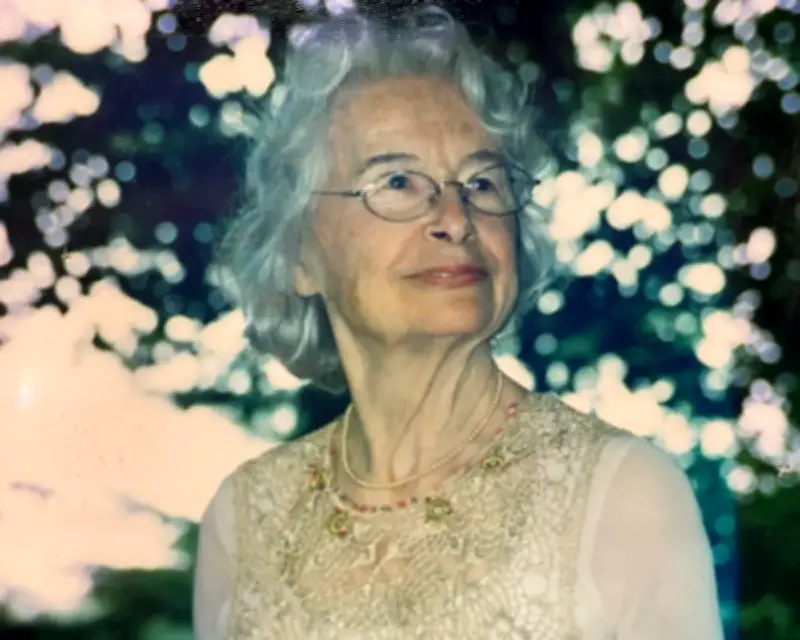
Eilidh Urbach, a soprano who performed with Benjamin Britten and regularly on BBC radio in the 1950s, has died aged 104. Her varied cultural life also included leading workshops at the Small festival for more than 20 years.
Early life and wartime singing
Born in Kirkcaldy, Fife, into a musical household, Eilidh was the daughter of Charles McNab, a grocer who sang and played the cello, and his wife, Nellie (née Fitzpatrick). She showed artistic and musical talent from an early age. After leaving Kirkcaldy High School in 1939, she studied at Edinburgh College of Art, commuting by train across the Forth Bridge, and then taught art in a school.
During the second world war, she developed her singing by touring army camps in Fife, performing to enthusiastic audiences of Polish servicemen. “It was quick success compared to paintings,” she later wrote, “and an easier way to make a living I thought.” In 1946, she won a scholarship to the Royal College of Music in London, where she studied opera, before moving to the Guildhall School of Music and Drama, specialising in German lieder.
Career with the English Opera Group and BBC
Eilidh became a member of the English Opera Group, founded by Britten in 1947, with which she sang in Aldeburgh and on tour in Britain and Holland. She performed as a soloist at concert halls in London and elsewhere. For a celebrated 1952 recording of Purcell’s Dido and Aeneas, she sang the role of the First Lady, in a cast that included Kirsten Flagstad and Elisabeth Schwarzkopf.
Throughout the 1950s, Eilidh featured in broadcasts on the BBC Third Programme (now Radio 3) and the Home Service, and regularly performed alongside the guitarist Julian Bream.
Marriage and family life
In London, she met Philip Urbach, a German Jewish refugee whose parents, brother and extended family had been murdered by the Nazis. Together they hitchhiked across postwar Europe, walking abandoned orchards by day and singing for their supper in cafes by night. They married in 1953, and Philip became a senior lecturer at the then Polytechnic of North London.
The couple settled in north London and raised three daughters, Helen, Celia and Rachel. Eilidh focused on her family while continuing to take occasional singing engagements. The Urbachs’ house became an open and bohemian space for stimulating conversation, frequent parties and music evenings.
Later years and legacy
Philip died in 2002. Eilidh became a central figure in the annual Small festival, founded by Celia in 2004, where for more than 20 years she led workshops from calligraphy to Latin dancing, organised singalongs in music hall and Scottish folk, sang classical recitals with Rachel, and produced madrigals and operas.
While travelling on the London underground in 2023, aged 101, her coat became trapped in the closing doors of a tube train, causing an injury that never healed, leading to a series of further falls and frailty. She soldiered on, continuing to relish conversations and to be deeply moved by music. But while her mind remained bright, as her mobility became exceedingly arduous she chose to end her days with the same resolve with which she had lived her life.
She is survived by her children, and by five grandchildren, Radanath, Jiva, Evan, Eilidh and Jessie. Another grandchild, Ramai, predeceased her.