Amandaland Series Two Review: A Mesmerising Comedy Icon Alongside Alan Partridge and David Brent
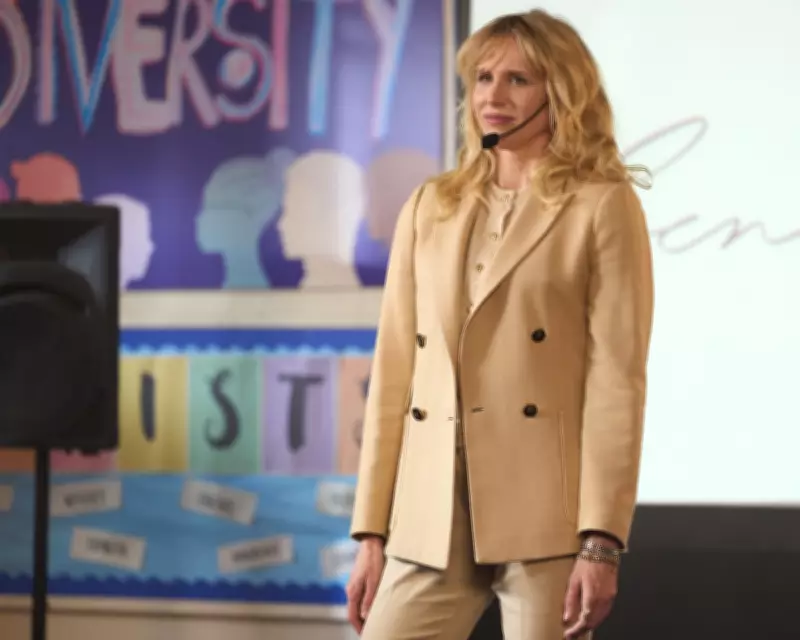
If God truly loves a trier, then he would absolutely adore Amanda Hughes from Amandaland. The former owner of the west London boutique Hygge Tygge may be in what she considers the gutter—a single mother recently relocated from a spacious house in Chiswick to a Harlesden maisonette (which she must clean herself) and currently working in sales for a high-street kitchen company—but she remains fixated on the stars. Do not be fooled by the outrageous laziness and negligence she brings to her actual job; when it comes to her true calling of becoming a successful influencer to promote her bland lifestyle brand Senuous, she is truly putting in the hours.
In this sense, Amanda fits neatly into a lineage of British comedy icons; she belongs alongside the delusional, narcissistic, and indefatigable likes of Alan Partridge and David Brent. Yet Lucy Punch’s character—who first appeared in the modern-classic sitcom Motherland before landing her own spin-off—receives an easier ride than her peers. Initially, she was Motherland’s resident antagonist: a smug, slinky blonde securely installed at the top of the school mum food chain, spending her time exploiting her primary acolyte Anne (Philippa Dunne) and patronising the permanently harried protagonist Julia (Anna Maxwell Martin). Later, we witnessed her divorce and dysfunctional relationship with her judgmental mother (Joanna Lumley). As the mask slipped, her likability ballooned. By the end, we were encouraged to think of Amanda as more of a flawed striver than a boo-hiss baddie.
In her own show, now back for series two, she is even more pitiful and sympathetic, fruitlessly pursuing a social media following through a series of desperate collaborations and stunts. This is one reason why Amandaland is never as delectably spiky as Motherland, but there are other factors too. Whereas its impeccably observed predecessor made hay from the surreal stresses of juggling work and family, here the children are older, and the logistical nightmares of child-rearing are largely over.

If Motherland’s centre of gravity was the school drop-off, Amandaland shifts the parental spats to the sidelines of their teenagers’ football training sessions. Anne remains in the picture, joined by Fi (Rochenda Sandall) and her celebrity chef partner Della (Siobhán McSweeney), who are the mothers of Amanda’s daughter’s best friend Morten (Anya McKenna-Bruce). Amanda’s downstairs neighbour Mal (Samuel Anderson) is the footy coach, while his son Ned’s stepdad JJ (Ekow Quartey)—keep up!—also makes regular appearances. In this second series, Ned’s no-nonsense mother Abs (Big Boys’ Harriet Webb) becomes a constant presence too.
The social aspect does feel a bit forced at times (do Abs, JJ, and Mal all really need to watch Ned play, or do they have a joint phobia of free time?). And while there is some spot-on skewering of the sharp-elbowed middle classes—Amanda is delighted that her neglected corner of London is finally gentrifying when a trendy coffee shop opens—the show is increasingly steeped in soothing sitcom artifice.
Amandaland—whose first series was mostly the work of Motherland writers Barunka O’Shaughnessy, Helen Serafinowicz, and Holly Walsh and is now penned exclusively by Walsh and Horrible Histories’ Laurence Rickard—has become the sort of comedy where you know exactly what everyone is going to say before they have said it. To its credit, that is partly because the main characters are so firmly established, yet the script is also full of predictable wisecracking and arbitrary plotting. Some of the secondary storylines (Fi buys a new vehicle to facilitate her dog-walking business and promptly transforms into a white-van man; Mal and JJ battle over whether to use gadgets or old-fashioned knowhow when building a shed) might as well have been picked out of an old hat lurking in a dusty cupboard in the BBC comedy department.

Yet other plotlines, such as Anne becoming an inadvertent Instagram phenomenon, are immensely satisfying in the way only a show rooted in tried-and-tested comic convention can be. And counteracting all the cliches is Punch’s mesmerisingly convincing portrayal of Amanda. Lumley is also magnetic as her mother, Felicity, a Sloanier and (slightly) more sober Patsy from Ab Fab. Dunne puts in an equally bravura performance as the beleaguered Anne, whose flustered wittering I could listen to all day. It is a cliche of popular fiction, but these are characters you genuinely want to spend time with, even if they are doing relatively dull things such as filming themselves jogging or getting an eye test.
As with the first series, in which Amanda eventually rejects her wealthy new boyfriend’s offer to move her and her children into his Wapping penthouse, this second outing presents our hero with a moral dilemma. It is part of the show’s continued insistence that beyond the entitlement and snobbery, Amanda does have a heart. Not, perhaps, the most mercilessly funny angle, but an undeniably comforting one—and Amandaland is worth stepping back into for that feeling alone.