Ava Pickett has had the career start every writer dreams of. Her debut play about Anne Boleyn — though not really about Anne Boleyn — became the hottest ticket in town at the Almeida Theatre, earning two Olivier nominations. It also caught the attention of Margot Robbie, who declared Pickett a generational talent. Now, Pickett is writing a film about Joan of Arc with Baz Luhrmann. With such rapid ascension, skepticism about the West End transfer of 1536 was understandable. But the production lives up to the hype, and then some.
Co-produced with Robbie's Lucky Chap, 1536 is an astonishing production. Director Lyndsey Turner has crafted a heady, sensory experience propelled by faultless performances from the female leads. The 110-minute one-act runtime might raise eyebrows, yet the show never loses pace and refuses to overcook its material. 1536 is a once-in-a-blue-moon theatrical experience that evokes laughter, tears, and even screams.
A Story of Three Women in 1536
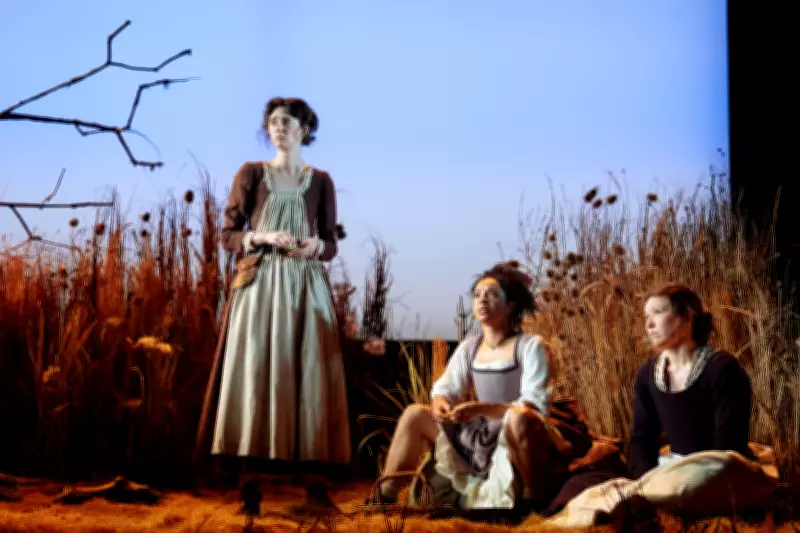
Set in 1536, three women in their early twenties sit in a field in rural Essex. With little happening in their lives, they are scandalized by gossip from London: King Henry VIII has arrested his second wife, Anne Boleyn. Practical Mariella (Tanya Reynolds) wonders if Henry will kill Anne, while Anna (Siena Kelly) dismisses the idea: 'Kings don't kill their wives. It just doesn't happen.' Initially inseparable, the trio's constantly shifting power dynamics play out through subtle facial twitches and bodily movements.

Each character embodies an archetype by which the audience — like society — recognizes and judges them. Through their cheeky back-and-forth, depths and nuance are naturally revealed. Anna (asserted with confidence by Kelly as the natural leader) is beautiful but poor, with a reputation threatening to catch up with her. Wealthy, soon-to-be-married Jane (Liv Hill) is terrified of wedded life. Mariella works as a midwife, pained by the memory of a man she could never marry due to societal standings.
Hope Amid Bleak Prospects
Despite bleak prospects, Anna, Jane, and Mariella are not women without hope. Their lively, laugh-out-loud dialogue, expressed through contemporary Essex accents, brings to mind a scene from EastEnders or TOWIE — Kelly's accent is particularly reminiscent of Amy Childs, and all the funnier for it. While exclamations of 'fackin' hell' fill the air, the script is subtle enough to avoid feeling like an easy revisionist reimagining. The language is somewhat anachronistic, but the energy is believable. Who's to say women didn't talk like this when alone?
With each scene, marked by a blackout and Tingying Dong's surging soundtrack, the group begins to fracture. Anne Boleyn's prospects worsen, bleeding into the women's lives as Mariella worries that 'the men are changing.' Anna's lover Richard (Oliver Johnstone) grows aggressive, and Mariella's former love William (George Kemp) loses his nerve. The threat of violence, both sexual and physical, is actualized in traumatic detail. When Anne is beheaded, the backdrop — transitioning from an orange glow to a blood-red wash over the play's duration — is lit by the glow of the field's smoking grass. 'The men are celebrating,' Jane says, horrified.
Feminist Message Without Hammering
In Pickett's script, which has undergone significant changes since the original Almeida run, the comedy never lets up. Attempting to maintain humor only adds to the gnawing dread Turner melds. While 1536 was a terrible time to be a woman, the misogyny spewed by all genders on stage instantly evokes the present. There is no hammering on the head with the feminist message; no wink when Anna asks Mariella in despair: 'Has it always been like this? Will it always be like this?' There is just stillness, leaving the audience to answer in their heads.

In Girl on Girl, a recent book about how pop culture in the 1990s and 2000s destroyed feminist progress, journalist Sophie Gilbert argues that society's feelings about women are reflected in and influenced by its treatment of famous women. Pickett's script follows this big-picture thinking, making it all the more raw and real. We know Anne's story ends — we sang about it in school — yet Pickett draws clear lines between how Anne Boleyn was treated and how it impacted women then, with ripple effects still felt in a time when witch hunts play out on livestreams. Under Turner's direction, the anger and horror never let up. Neither does the entertainment. Pickett's play is a tour de force, and 1536 is one of those theatrical moments that stays with you for a very long time.
Details
Address: Ambassadors Theatre, West Street, London, WC2H 9ND
Transport: Rail/Tube: Charing Cross; Tube: Leicester Square
Price: £30-£150. Runs 1hr 50min.