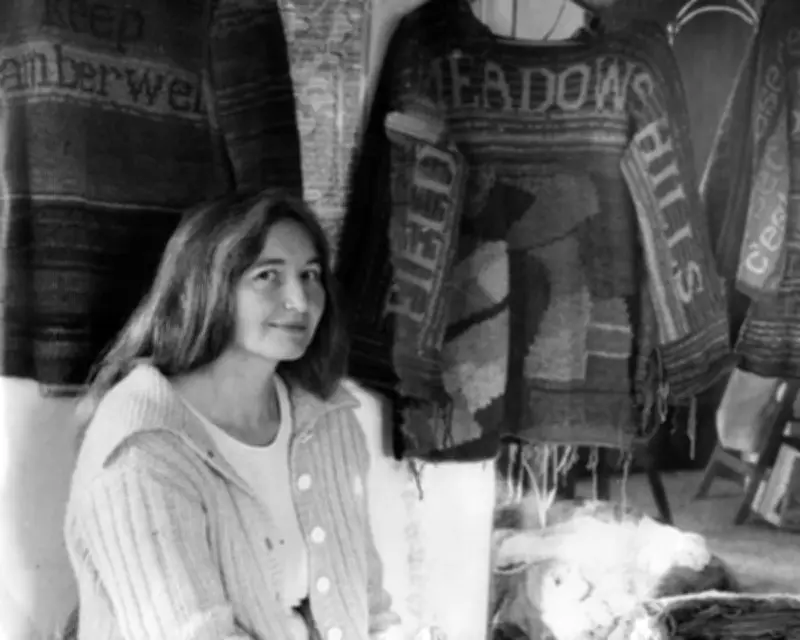
Astrid Furnival, a pioneering textile artist who blended concrete poetry with hand-knitted wool works, has died aged 85 after a long illness. She co-founded Satie’s Faction, a collaborative organisation that fused poetry, visual art, music and performance, and rejected distinctions between arts and crafts.
Early life and escape from war
Born in Stendal, near Berlin, to Leonore (née Weber), later a scientist at the Kiel Institut für Weltwirtschaft, and Erich Belling, Astrid was cared for by her grandmother. As the Red Army advanced at the end of the second world war, her grandmother pushed Astrid in her pram several hundred kilometres to safety in northern Germany while avoiding strafing by aircraft.
Her early life in Kiel, and later Bonn, was not to Astrid’s liking; her sanctuary was listening to Radio Luxembourg. In 1957, she escaped to London as an au pair, and the following year met John Furnival, then a student at the Royal College of Art. He was a friend of David Hockney, Pauline Boty, RB Kitaj and Peter Blake, and some pop art influences found their way into Astrid’s work.
Career and artistic philosophy
Astrid worked mainly with wool that she spun herself and used dyes that she developed from plants in her garden in Nailsworth, Gloucestershire, or in the surrounding fields. She was a hand-knitter who firmly rejected the use of machines, and she utilised the cerebral concerns of concrete and visual poetry – in which the shape or appearance of a poem is related to its message – to produce works that feature the spatial arrangements of words but are also practical objects, such as knitwear and quilts.
She and John married in 1960 and moved to a cottage near Nailsworth. Together with the typewriter artist Dom Sylvester Houédard (AKA dsh) and the kinetic poetry sculptor Kenelm Cox, they nurtured GLOUP (GLOUcestershire grouP), and Nailsworth became an important centre for the world of concrete and visual poetry.
Collaborations and exhibitions
In 1975, Astrid and John founded Satie’s Faction, a collaborative organisation that fused concrete poetry, visual art, music and performance to celebrate the life and work of Erik Satie. Also in the 70s, Astrid organised a touring exhibition, Afts and Crats, that brought about a fusion of the traditions of the arts and crafts.
Among the inspirations for her work were Dante, Blake, Mallarmé, Niedecker, Marvell, Lear, Joyce, Beckett, Klee, Satie, Schumann and Roland Kirk. She collaborated with many artists, including John, Tom Phillips, Ronald King, Adrian Mitchell and Richard Loncraine. Astrid is well represented in archives of concrete and visual poetry.
Personal life and legacy
John died in 2020. Astrid is survived by her children, Eve, Jack and Harry, her stepdaughter, Claudia, four grandchildren, Joe, Martha, Dora and Lucas, and a great-grandchild, Frankie.