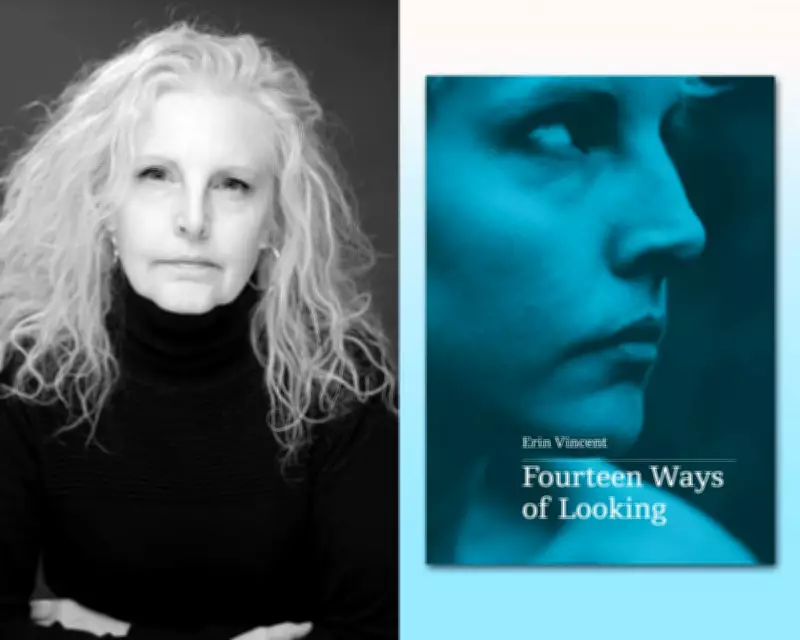
Erin Vincent's Fourteen Ways of Looking: A Poetic Reckoning with Grief
In her acclaimed 2007 memoir Grief Girl, Erin Vincent presented her tragic story with straightforward clarity. Now, with Fourteen Ways of Looking, she delivers a more poetic and audacious confrontation with grief, transforming personal trauma into literary art through fragmented composition and relentless repetition.
From Straight Narrative to Fragmented Exploration
When Erin Vincent was just fourteen years old, her life shattered irrevocably. Her parents were struck by a speeding tow truck while crossing the road—her mother died instantly, her father succumbed to injuries a month later. This devastating tragedy formed the core of her earlier memoir Grief Girl, narrated in the present tense voice of her fourteen-year-old self.
Fourteen Ways of Looking represents a complete departure from that conventional narrative approach. Where Grief Girl offered sturdy paragraphs and linear storytelling, this new work presents a succession of fragments—most only a sentence or two in length—with the word "fourteen" appearing in nearly every segment.

The Obsession with Fourteen
In adulthood, Vincent found herself increasingly preoccupied with this number that marked her traumatic turning point. "This all started innocently enough," she explains. "One day I noticed the word fourteen in a novel I was reading. The next day it happened again... Now I can't look away."
This preoccupation evolved into an organizing principle for the entire book. Vincent grapples with fundamental questions: What does it mean to have been fourteen? What does it mean to have lost both parents suddenly at that age? Can someone who experienced such trauma ever truly move beyond being fourteen?
Literary Influences and Experimental Form
Vincent draws inspiration from Georges Perec, another writer orphaned in childhood who employed formal constraints in his work. She recalls Perec's aspiration to write exhaustively about "a constituted fragment of the world" and asks herself, "I wonder if I can do the same?"
The book loops and repeats itself as Vincent seeks first to locate her subject and then to exhaust it. Refrains like "at fourteen" and "when I was fourteen" introduce slivers of memoir—some banal, some deeply shocking. These are interrupted by quotations, aphorisms, and other stranded texts that initially appear unrelated except for their shared repetition of the number.
The fragments include diverse references:
- "It is advised that sutures be removed within fourteen days"
- "In the list of permission credits for The Penguin Book of Oulipo the number 14 is missing"
- "At fourteen I decided I would be hard as a stone and burn bright as the sun"
Assembling the Pieces
Vincent describes her creative process in terms of puzzle-solving: "As I try to put this book together I am in a jumble; I can't keep my thoughts straight. It's as though someone has thrown an old, faded 5,000-piece puzzle on the floor and told me to solve it without seeing the picture on the box."
This method allows patterns and motifs to surface from the chaos of fragments, creating new images and associations. Vincent takes what she calls a "tiger's leap into the past" to salvage what she can from the scene of trauma—a phrase she gleaned from the 14th fragment of Walter Benjamin's On the Concept of History.
Literary Lineage and White Space
Vincent operates within a tradition of literary minimalism familiar to readers of Jenny Offill, Kate Zambreno, Maggie Nelson, and Patricia Lockwood—writers whose works similarly assemble found texts and language. Yet through her omnivorous practice of quotation and allusion, she acknowledges a broader lineage of modernist experimental practice.
Her influences span from Gertrude Stein and Walter Benjamin to Oulipo and Samuel Beckett, from Andy Warhol and David Wojnarowicz to W.G. Sebald. In all these writers' work, as in Vincent's, the white space surrounding textual fragments signifies what remains absent, unsayable, and forever lost.

Transforming Trauma into Art
"Sometimes I imagine what it would look like if I could cut the number fourteen from my life and create a whole new story," Vincent writes. This sentence reveals the complex psychology of trauma—the child's wish for the event never to have happened, the adult's desire to forget it.
Yet Vincent transforms these psychological impulses into a generous artistic credo. In Fourteen Ways of Looking, she has literally cut "fourteen" from her life, snipping it from texts and memory, then splicing the pieces together to create something entirely new. The result is not a narrative of smooth redemption but a wrenching and true reckoning with the lifelong work of grief.
Fourteen Ways of Looking represents a mature artist confronting trauma through innovative literary form. Where Grief Girl told the story straight, this new work circles, fragments, and poetically reconstructs the experience of loss, offering readers an exhilarating and dazzling exploration of how we live with—and through—profound grief.