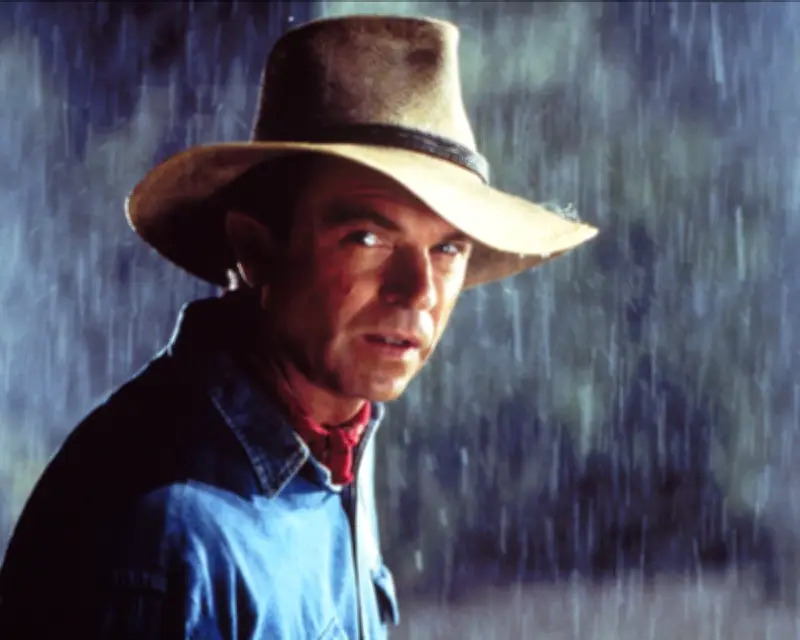
Sam Neill, the versatile character actor who gained international stardom with standout performances in Jurassic Park and The Piano, has died aged 78. Born in Northern Ireland, raised in New Zealand, and adopted by the Australian film industry, Neill conveyed a seen-it-all worldliness without ever seeming jaded. With his floppy fringe and amused, rueful eyes, he was a man of decency, humility and wit. “I’m just Mr Triviality, as shallow as my washbasin,” he once said. “No deep glacial lakes of profundity here.” The intelligence of many of his performances suggested otherwise.
Breakthrough roles in 1993
Though never defined by one role, a pair of films released in 1993 promoted him to the A-list and showcased his versatility. In Steven Spielberg’s blockbuster Jurassic Park, groundbreaking in its use of computer-generated imagery, he played a palaeontologist awestruck to find himself among dinosaurs created from prehistoric DNA. He reprised the role in two sequels: Jurassic Park III (2001) and Jurassic World: Dominion (2022).
That same year, he starred in Jane Campion’s poetic, Oscar-winning arthouse hit The Piano, playing an emotionally stifled 19th-century Kiwi landowner to whom a mute Scottish woman (Holly Hunter) is sold in marriage. When he discovers her unfaithfulness, he drags her into the rain and severs her finger with an axe. Neill made the character seem achingly sad even amid his rage. “I don’t think I can overestimate how important The Piano is for me in hindsight,” he wrote in 2023. “It sits on my funny old CV like a medal on my chest.”
Phlegmatic about fame
Both films were runaway successes, but Neill was typically phlegmatic about what that meant for his prospects. “If you’re the bloke who takes off somebody’s finger in a film, you are not going to be the pin-up for somebody who’s 25 years old and lives in Delaware,” he said in 1994. “Same thing if you’re in a big Spielberg film in which the principal attraction is dinosaurs.” More durable than a mere pin-up, he was a beloved character actor who improved everything he was in.
Versatile career
He was capable of tenderness and warmth in the Ealing-esque comedy The Dish (2000), which revealed Australia’s role in beaming images of the moon landings to television viewers worldwide, and in the gentle, eccentric Dean Spanley (2008), in which he played a clergyman who was a Welsh springer spaniel in a previous life: “My most difficult role ever,” he said. He was equally convincing as a brutal police inspector in the first two series of the BBC period gangster drama Peaky Blinders (2013-14). Audiences loved him either way, feeling him to be believable, chameleonic and true.
Early life and education
Born Nigel Neill in Omagh, County Tyrone, to Priscilla (née Ingram) and Dermot Neill, a New Zealander and British army colonel, the family moved to Christchurch, New Zealand, when he was seven, then Dunedin. At school, he encouraged people to call him Sam “because even in England Nigel’s a bit nerdy”. A delicate child with a stammer, he was educated at Medbury school, Christ’s College, the University of Canterbury, and Victoria University, Wellington.
First acting roles
Having first acted at college, Neill spent his initial year after graduation travelling with the New Zealand Players Drama Quartet “taking Shakespeare, Shaw and the like to mostly ungrateful schoolchildren”. In 1971, he was hired by the New Zealand National Film Unit to direct documentaries but still acted on the side. Stage appearances included a 1976 production of Juno and the Paycock directed by Dick Campion, father of Jane.
His turn as a priest in the drama-documentary Ashes (1975) brought him to the attention of director Roger Donaldson, who cast him in Sleeping Dogs (1977). At the end of the shoot, co-star Warren Oates said: “I’ll see you in the movies, Sam.” Neill was unconvinced. “I thought: ‘Unlikely. But thanks for saying it.’”
Move to Australia and Hollywood
After discovering his casting file at the national broadcasting company contained the note “Could be all right in homosexual roles”, Neill resolved to leave New Zealand. While in Australia promoting Sleeping Dogs, he stayed on and was cast in My Brilliant Career (1979), which became an international success. Among its fans was actor James Mason, who sent Neill a plane ticket to visit him in Switzerland and letters of recommendation. This helped Neill secure the lead in The Final Conflict, the third Omen film, as Damien Thorn, the son of Satan.
He starred with Isabelle Adjani in Andrzej Zulawski’s Possession (1981), which he considered “one of the best films I was lucky to be in”, and played a KGB agent in Enigma (1982). Television hits included Reilly, Ace of Spies (1983) and Kane and Abel (1985). Fred Schepisi directed him and Meryl Streep in Plenty (1985) and A Cry in the Dark (1988), about the real-life “dingo baby” case.
Later career and personal life
His work in Dead Calm (1989) won him the Jurassic Park role that Harrison Ford had turned down. Neill balanced Hollywood assignments like The Hunt for Red October (1990) with oddball projects including Death in Brunswick (1990) and Until the End of the World (1991). He made two films with John Carpenter and played Charles II in Restoration (1995). “A dream part, like a pavlova cake, and I consumed it with gusto,” he said. “I looked so fabulous I hardly needed to act, but I acted my pants off anyway.”
In the late 1990s, he began producing and selling his own pinot noir, Two Paddocks. “I had planned on making only a couple of hundred cases of something drinkable,” Neill said in 2001, “and no one was more surprised than I when we opened up that first bottle and thought: ‘Hey, this is pretty good.’”
He was known for environmental concerns and leftwing politics. In 2000, he had a public spat with Warren Cooper, mayor of Queenstown, New Zealand, over ecological damage from tourism; Cooper labelled him a “chardonnay socialist”. Neill later sent Cooper a case of a limited edition Two Paddocks product called Socialist Chardonnay.
During the first Covid lockdown, he cheered up fans by posting videos of his garden gnomes or ukulele renditions, and updates about his farm animals named after celebrity pals. After being diagnosed with a rare form of blood cancer in 2021, Neill wrote a memoir, Did I Ever Tell You This? His most recent work included three series of the Australian legal drama The Twelve (2022-25) and Godzilla x Kong: Supernova, to be released next year.
Neill was made OBE in 1991 and appointed a Distinguished Companion of the New Zealand Order of Merit in 2007, redesignated as a knighthood in 2022. He is survived by four children: Tim, from his relationship with actress Lisa Harrow; Elena, from his marriage to film makeup artist Noriko Watanabe (1989-2017); Maiko Spencer, Watanabe’s daughter he adopted; and Andrew, a son given up for adoption in the 1980s with whom he was later reunited.