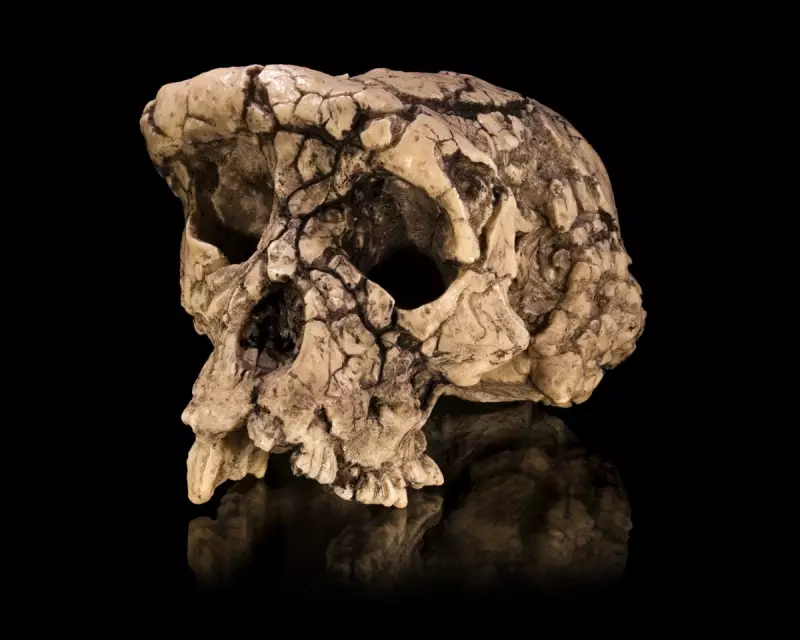
A groundbreaking new analysis of ancient bones has reignited a fierce scientific debate over the identity of humanity's earliest possible ancestor. Researchers are making a fresh case that Sahelanthropus tchadensis, an ape-like creature that roamed Africa approximately 7 million years ago, walked upright and could be the oldest known member of the human lineage.
The Bipedal Ape: Evidence from a Damaged Thigh Bone
The study, led by Dr Scott Williams of New York University, re-examined a partial thigh bone and forearm bones discovered in Chad's Djurab desert. Using modern techniques to compare their structure with known hominins and apes, the team identified features they argue are hallmarks of walking on two legs. A key piece of evidence is a small bump on the femur called the femoral tubercle.
"It's the attachment point for the largest and most powerful ligament in our bodies," explained Dr Williams. "This ligament is crucial for stabilising the torso during upright walking and, as far as we know, this feature is only found in bipedal hominins." The research, published in Science Advances, also points to a natural twist in the thigh bone and adaptations for buttock muscles as further signs of bipedalism.
A Scientific Feud That Has Raged for Decades
The debate over Sahelanthropus is not new. It began in 2001 when the initial fossils, including a skull nicknamed 'Toumaï', were unveiled by Professor Michel Brunet of the University of Poitiers. Brunet boldly declared the species "the ancestor of all humankind," citing the positioning of the head as evidence for upright posture. However, the scarcity of bones, particularly from the lower body, left many experts sceptical.
This latest analysis is the newest salvo in that long-running dispute. While Williams and his Franco-Chadian colleagues see a creature adapted to walking on the ground, others remain unconvinced. Dr Marine Cazenave of the Max Planck Institute for Evolutionary Anthropology called the evidence "weak," noting the femoral tubercle is in a "highly damaged" area and may not be definitive proof of terrestrial bipedalism.
Ancestor or Early Chimp? The Unanswered Questions
The central question is whether Sahelanthropus represents a pioneering human ancestor or an early chimpanzee. Dr Rhianna Drummond-Clarke, also at the Max Planck Institute, suggested the findings could equally point to an early chimp that later evolved into a knuckle-walker. "More work is needed to clarify whether walking on two feet was used to walk in the trees, or to move on the ground," she stated.
Dr Guillaume Daver and Dr Franck Guy from the University of Poitiers, who support the bipedalism theory, welcomed the new study but agree the case is not closed. The ultimate resolution likely hinges on one thing: finding more fossils. The Chadian-French research team hopes to do exactly that when they return to the excavation site later this year.
As Dr Williams summarised, the core of the problem is a familiar one in palaeontology: "I think it's a case of too few fossils and too many researchers." For now, the 7-million-year-old mystery of Sahelanthropus tchadensis and its place at the dawn of humanity remains tantalisingly unresolved.