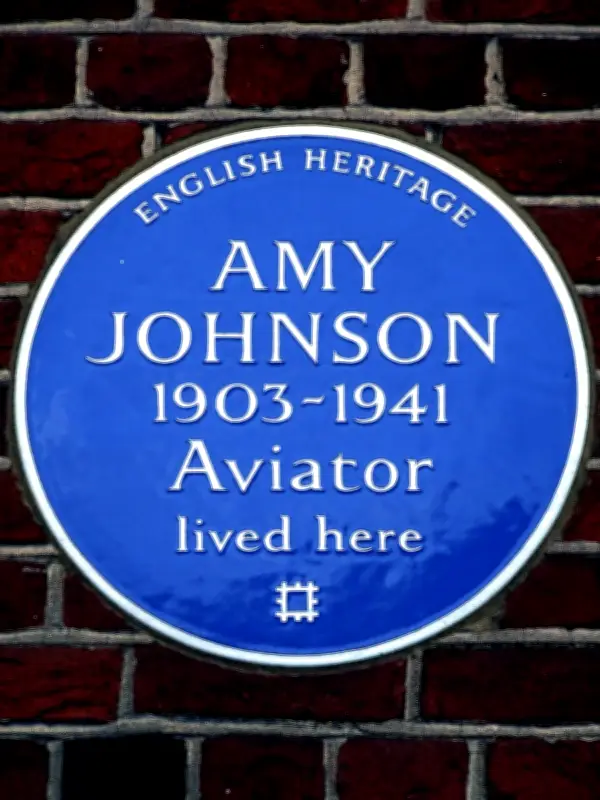
A blue plaque now marks the former London home of Amy Johnson, the pioneering aviator whose record-breaking flights made her one of the UK's most famous female pilots. The plaque, located in Hendon Way, Child's Hill, commemorates the building where Johnson lived in 1930, the same year she achieved global fame by becoming the first woman to fly solo from England to Australia.
A Trailblazer's Early Life and Rise to Fame
Born in 1903 in Kingston upon Hull, Johnson moved to London after earning a degree in economics from the University of Sheffield. She worked as a secretary to a solicitor, where she was introduced to flying as a hobby. In 1928, she joined the London Aeroplane Club at Stag Lane, Edgware, and by the end of 1929, she had qualified as a ground engineer and received her pilot's licence.
Johnson's father provided the money to buy her first aircraft, a second-hand Gypsy Moth she named Jason. On May 5, 1930, she took off from Croydon Airport, an unknown pilot with just 100 hours of flying experience. She landed in Darwin 19 days and 11,000 miles later, becoming a global celebrity. She was awarded the Harmon Trophy and a CBE in King George V's birthday honours.
Record-Breaking Flights and Marriage
In July 1931, flying a de Havilland Puss Moth named Jason II, Johnson and co-pilot Jack Humphreys became the first to fly from London to Moscow in a single day. They continued to Tokyo, setting a new record for the fastest flight from Britain to Japan.
In 1932, she married Scottish pilot Jim Mollison, who proposed just eight hours after they first met during a flight. The couple lived nomadically at the Grosvenor and Dorchester hotels. That same year, Johnson broke her husband's record for a solo flight from London to Cape Town, South Africa, flying the Puss Moth Desert Cloud. In 1933, the couple attempted a nonstop flight from south Wales to New York City in a de Havilland DH.84 Dragon I named Seafarer. Low on fuel and flying in the dark, they crash-landed short of their destination. Both survived with minor injuries and were celebrated in New York with a ticker tape parade down Wall Street.
War Service and Mysterious Death
After divorcing Mollison in 1937, Johnson explored other career opportunities, including journalism, business, and fashion, even modelling for designer Elsa Schiaparelli, who launched a travel bag in her name. During World War II, she returned to aviation, flying RAF aircraft around the UK for the Air Transport Auxiliary (ATA). She rose to the rank of first officer under the command of her friend and fellow pilot Pauline Gower.
In her final letter to friend Caroline Haslett on New Year's Day 1941, Johnson wrote: "I hope the gods will watch over you this year, and I wish you the best of luck (the only useful thing not yet taxed!)." She died on January 5, 1941, while flying an Airspeed Oxford for the ATA. She was believed to have run out of fuel in poor weather and crashed into the Thames Estuary. A convoy of ships saw her parachute into the water and heard her calls for help, but despite rescue attempts, she was lost beneath the waves. Lt Cmdr Walter Fletcher, captain of the HMS Haslemere, dived into the icy waters to save her but later died in hospital from exposure.
Johnson's watertight flying bag, logbook, and chequebook were later recovered near the crash site, although subsequent accounts have surfaced to claim she was mistakenly shot down. Her body was never recovered, but a memorial service was held at St Martin-in-the-Fields on January 14, 1941. She is commemorated under the name Amy V. Johnson on the Air Forces Memorial at Runnymede, Windsor. The blue plaque in Hendon Way now ensures her legacy remains visible in the city she once called home.