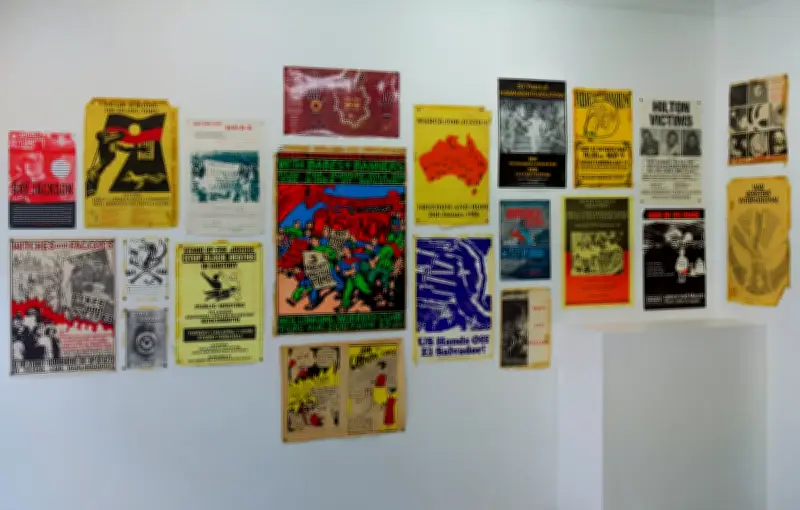
An exhibition at Sydney's Numbers gallery in Potts Point is displaying a selection of Aboriginal protest posters collected by Wiradjuri elder Ray Jackson over 50 years, until 2 August. The collection, titled Ray Jackson Doing Time with Penrith Miers Archive, includes posters from the 1970s to 2015, covering rallies, protests, union meetings, and film screenings.
Exhibition Highlights Jackson's Activism
Ray Jackson, who died in 2015 at age 74, was a prominent activist and founding secretary of the New South Wales Aboriginal Deaths in Custody Watch Committee in 1987. He was a regular at the Redfern Aboriginal Tent Embassy. His Waterloo home was filled with posters and memorabilia, now curated by his granddaughter Madika Penrith, a Wiradjuri/Yuin/Gumbaynggirr archivist, and her partner Sam Miers.
Notable Posters on Display
The exhibition features several key posters. Tall Ships Tall Stories (1987), measuring 60cm x 85cm, was created by designer Amanda Holt, photographers Juno Gemes and Elaine Pelot-Kitchener, and artist Tracey Moffatt ahead of Australia's Bicentenary celebrations. It includes a quote from Moffatt: 'The re-enactment was an insult to the memory of the thousands upon thousands of Aborigines murdered by the invading British.'
We Have Survived! White Australia Has a Black History (1988) by artist Peter Chester promoted a 26 January rally. Its central image of men raising an Aboriginal flag was inspired by Chips Mackinolty's work, itself based on the Pulitzer prize-winning photograph Raising the Flag on Iwo Jima.
We Are Surviving the Killing Times (date unknown) reflects Jackson's focus on Aboriginal deaths in custody. According to Miers, 'Aboriginal deaths in custody was one of the causes Jackson cared most about.' Jackson also established the Indigenous Social Justice Association Sydney to support families of those who died in custody.
Redback Graphix and Other Works
The Workplace Is No Place for Racism (1985) was screen-printed by Wollongong studio Redback Graphix, founded by Michael Callaghan and Gregor Cullen. Numbers co-founder Seb Henry-Jones noted that the studio produced approximately 300 of these posters in its first run using fluorescent ink that is 'incredibly vibrant in person.'
A poster for Robert Walker (circa 1987) honours the Indigenous poet and activist who died in Fremantle prison aged 25 in 1984. It features 'Secretary: Ray Jackson' in the bottom right corner, though it is unknown if Jackson designed it himself.
Broader Activism Themes
White Australia Has a Black History (1988) by Colin Russell protested the Bicentenary. We're Family Too (circa 1999) by the Australian Federation of Aids Organisations (now Health Equity Matters) aimed to reduce discrimination against Indigenous people living with HIV/Aids.
Jackson's activism extended to international causes. Displacements – Palestinian / Northern Irish / Aboriginal (1983-84) by Merilyn Fairskye and Pam Debenham promoted an event co-hosted by the Biennale of Sydney and Artspace, drawing comparisons between oppressions. Numbers co-founder Emma O'Neill said Jackson saw the Palestinian cause as part of the international working class struggle.
Rat Social and Control Conference (1984) by NSW artist collective Without Authority promoted a countercultural event at the University of Sydney, reflecting intellectual and activist movements in 1980s Australian universities. Miers said Jackson attended 'hundreds' of such events.
Commemorative Poster
A 2015 poster by artist Mickie Quick from Bad Press commemorates Jackson's life, showing him wearing his signature cap covered with badges of movements he supported. The cap is also on display in the exhibition.